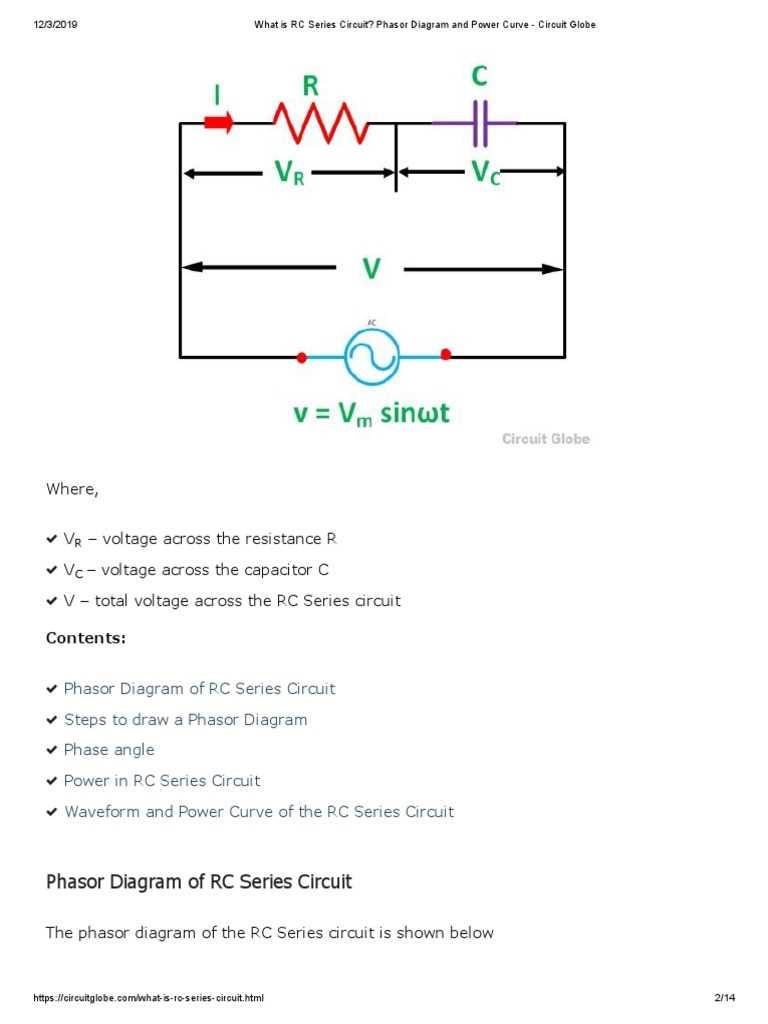
Connect a resistor and capacitor in series and measure the voltage across each element to calculate the phase difference. Use an oscilloscope to observe the lag of current behind voltage, which typically reaches up to 90 degrees across the capacitor.
Calculate the total impedance by combining resistive and capacitive reactance. For a resistor of 100 ohms and a capacitor of 10 microfarads at 50 Hz, the reactance equals 318 ohms, yielding a total series impedance of approximately 332 ohms. This value determines current amplitude and phase shift precisely.
Draw vectors representing voltage and current to scale on a polar plane. Position the resistor vector in phase with current and the capacitor vector lagging by 90 degrees. The resulting vector sum gives the source voltage and visually conveys the phase relationship between elements.
Use these measurements to verify theoretical calculations of phase angle, which for this setup equals arctangent of reactance over resistance. For the given values, the phase shift is about 72 degrees, guiding adjustments in signal processing or filtering applications.
Phasor Analysis Techniques for RC Networks
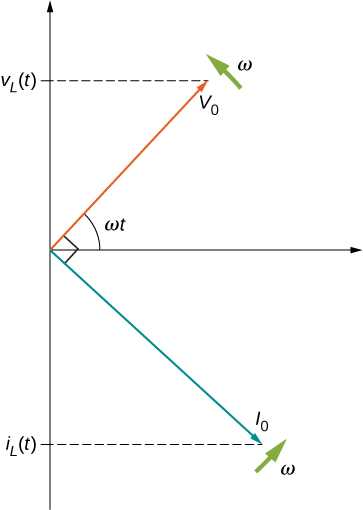
Represent each component as a rotating vector on a complex plane to determine voltage and current relationships. For a resistor of 200 ohms in series with a 20 μF capacitor at 60 Hz, calculate the capacitive reactance as XC = 1/(2πfC) ≈ 132.6 ohms. This establishes the magnitude and angle for each element.
Use vector addition to find the total applied voltage. Place the resistor vector along the real axis and the capacitor vector 90 degrees behind current. Combine them using Pythagoras or trigonometric functions to determine both amplitude and phase angle accurately. For this example, the total voltage magnitude equals √(R² + XC²) ≈ 241 ohms, and the phase angle is arctangent(XC/R) ≈ 33.4 degrees.
Apply polar representation for quick visualization of phase shifts. Draw vectors to scale using a protractor or software tool. Highlight the current vector, the resistor drop in phase with current, and the capacitor lagging, allowing precise comparison between theoretical calculations and experimental measurements.
Perform iterative adjustments to optimize signal behavior. For high-frequency inputs, note that the capacitor’s reactance decreases, increasing phase lag. Record measurements and update vector lengths accordingly, ensuring accurate analysis of transient responses or filtering characteristics in practical applications.
Determining Phase Angle Between Voltage and Current
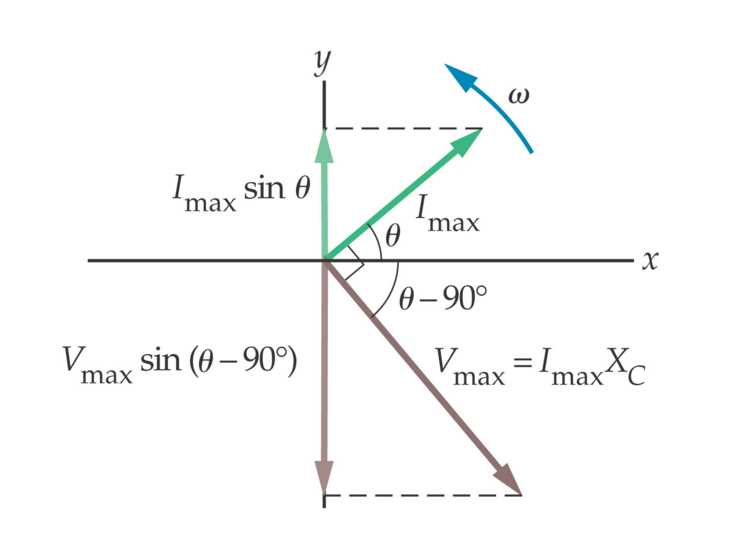
Calculate the phase angle by comparing the resistive and reactive components of the network. For a series combination of a 150 ohm resistor and a 10 μF capacitor at 50 Hz, compute the capacitive reactance XC = 1/(2πfC) ≈ 318 ohms. The phase angle θ can be found using arctangent(XC/R), resulting in θ ≈ 64.4 degrees. This directly indicates the lag between current and applied voltage.
Use vector representation to visualize the relationship. Draw the voltage drop across the resistor along the reference axis and the voltage across the capacitor perpendicular and lagging current. Measuring the angle between the total voltage vector and the current vector provides a practical check against calculated results, ensuring accurate interpretation for both steady-state and transient analyses.