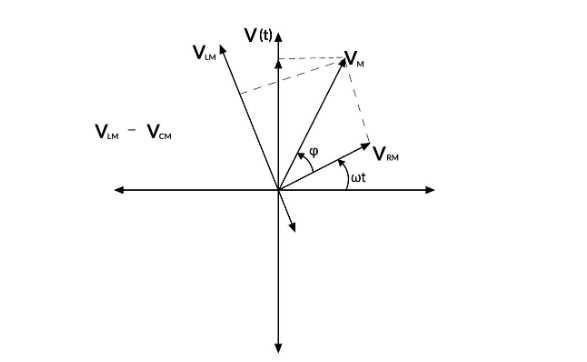
Start by representing each voltage and current as a rotating vector to clearly observe magnitude and phase differences. Assign the resistor voltage in phase with current, the inductor voltage leading by 90 degrees, and the capacitor voltage lagging by 90 degrees.
Measure peak values accurately to calculate the resulting vector sum. Use trigonometric addition to determine the total voltage across all elements and identify the net phase angle between input and output.
Apply the angle and magnitude calculations to predict how the system responds to varying frequencies. Note that resonance occurs when the inductive and capacitive reactances cancel, resulting in the maximum current aligned with the resistor voltage.
Verify calculations with a vector plot to ensure each component aligns correctly. This visual check helps detect errors in phase assignments and confirms the overall system behavior matches theoretical predictions.
Vector Representation of Voltage and Current in a Resistive Inductive Capacitive Setup
Assign each voltage vector carefully by following the standard phase relationships: voltage across the resistor aligns with current, voltage across the inductor leads current by 90 degrees, and voltage across the capacitor lags current by 90 degrees. This ensures accurate visualization of total voltage.
Calculate magnitudes using RMS values and apply trigonometric addition to combine vectors. For example, total voltage can be found using the square root of the sum of squares of individual component voltages and their relative phase differences.
Step by Step Vector Construction
- Draw the resistor voltage along the horizontal axis representing the reference current direction.
- Add the inductor vector perpendicular and upward to reflect a 90-degree lead over current.
- Add the capacitor vector downward to indicate a 90-degree lag relative to current.
- Complete the total voltage vector by connecting the start of the resistor vector to the tip of the resulting combined inductive and capacitive vector.
Label all angles and lengths clearly to show magnitude and phase differences. This step helps in visual verification and ensures calculations match the expected behavior of the system at a given frequency.
Analyzing Frequency Effects
Observe changes in vector length and orientation as frequency varies. Inductive reactance increases with frequency while capacitive reactance decreases, shifting the total voltage vector and altering the phase relationship with current.
- At resonance, inductive and capacitive vectors cancel, aligning total voltage with resistor voltage and maximizing current.
- Below resonance, capacitive effect dominates, causing current to lead voltage.
- Above resonance, inductive effect dominates, causing current to lag voltage.
Use vector addition to predict system response under different operating conditions. This allows engineers to anticipate voltage drops, phase shifts, and power factor changes without physically testing the setup.
Check consistency with theoretical formulas such as total impedance, phase angle, and resonance frequency. Comparing the constructed vectors with calculated values ensures accuracy in analysis and planning for load handling.
Identifying Voltage and Current Vectors in a Resistive Inductive Capacitive Setup
Start by aligning the voltage across the resistor with the reference current. This serves as the baseline for all subsequent vector measurements and ensures accurate representation of phase relationships.
Measure the voltage across the inductor and represent it leading the current by 90 degrees. This lead is proportional to the inductive reactance and should be scaled according to the actual RMS voltage value.
Represent the capacitor voltage lagging behind the current by 90 degrees. Ensure the vector length corresponds to the capacitive reactance at the operating frequency to maintain correct magnitude ratios.
Combining Vectors to Determine Total Voltage
Add the inductor and capacitor vectors algebraically to find the net reactive component. Connect this result to the resistor vector to obtain the total applied voltage and its phase angle relative to current.
Label each vector clearly with its magnitude and phase angle. Include RMS values and angular displacement to simplify calculations for power factor, impedance, and resonance analysis.
Adjusting for Frequency Changes
Observe how vector lengths shift as supply frequency changes. Increasing frequency enlarges the inductive voltage vector while reducing the capacitive vector, altering total voltage orientation and phase relationship.
Verify the alignment at resonance where inductive and capacitive voltages cancel. At this point, the total voltage aligns with the resistive voltage, and the current reaches its maximum amplitude in the setup.