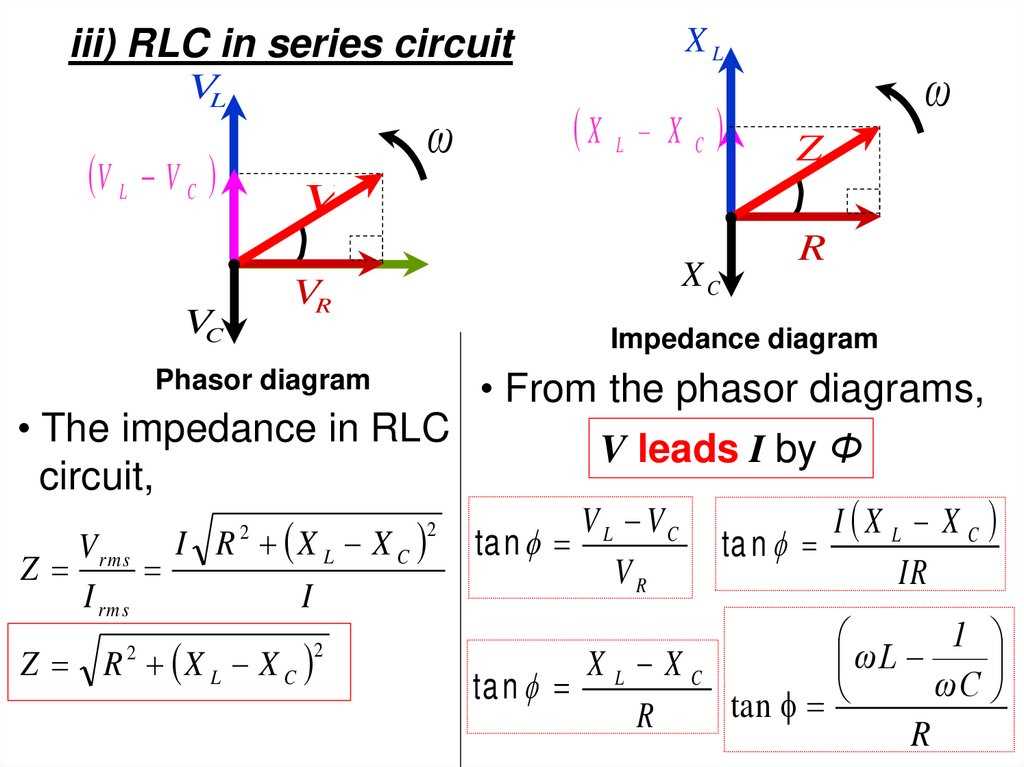
Use a vector-based representation of alternating quantities to compare voltage and current phase angles before calculating impedance or power factor. Draw the current reference vector along the horizontal axis, then place voltage vectors for resistance, inductance, and capacitance relative to that reference. This method allows direct measurement of phase displacement using geometric angles.
In an AC network containing a resistor, inductor, and capacitor, each component shifts voltage relative to current. The resistive element keeps both quantities aligned, meaning a 0° phase difference. The inductive element pushes voltage ahead of current by about 90°, while the capacitive element places voltage roughly 90° behind the current reference.
Represent these relationships with rotating vectors drawn from a common origin. The resistive voltage lies on the same horizontal axis as the current reference. The inductive voltage extends upward at a right angle, while the capacitive voltage extends downward. The vector sum of these three voltages forms the total supply voltage.
Accurate scaling improves analysis. For example, if the resistive drop equals 40 V, inductive drop 60 V, and capacitive drop 20 V, the vertical component becomes the difference between inductive and capacitive values. This leaves 40 V upward as the net reactive voltage. Combining horizontal and vertical components with vector addition gives the total supply magnitude and the phase angle between supply voltage and current.
Phasor Diagram of RLC Circuit Showing Voltage Current and Phase Relationships
Place the alternating current vector along the horizontal axis and scale voltage vectors according to measured values across the resistor, inductor, and capacitor. The resistive drop stays aligned with the current reference, while the inductive drop appears 90° ahead and the capacitive drop 90° behind. For example, if the resistive voltage equals 30 V, the inductive drop 50 V, and the capacitive drop 20 V, subtract the capacitive value from the inductive value to obtain a net reactive component of 30 V. Combine the horizontal resistive component and the vertical reactive component through vector addition to obtain the total supply magnitude and the phase displacement between current and supply voltage.
- Resistor voltage vector aligned with current reference
- Inductor voltage vector positioned 90° above the horizontal axis
- Capacitor voltage vector positioned 90° below the horizontal axis
- Net reactive component calculated as inductive value minus capacitive value
- Total supply magnitude determined by vector sum of resistive and reactive components
How to Construct a Phasor Diagram for a Series RLC Circuit Step by Step
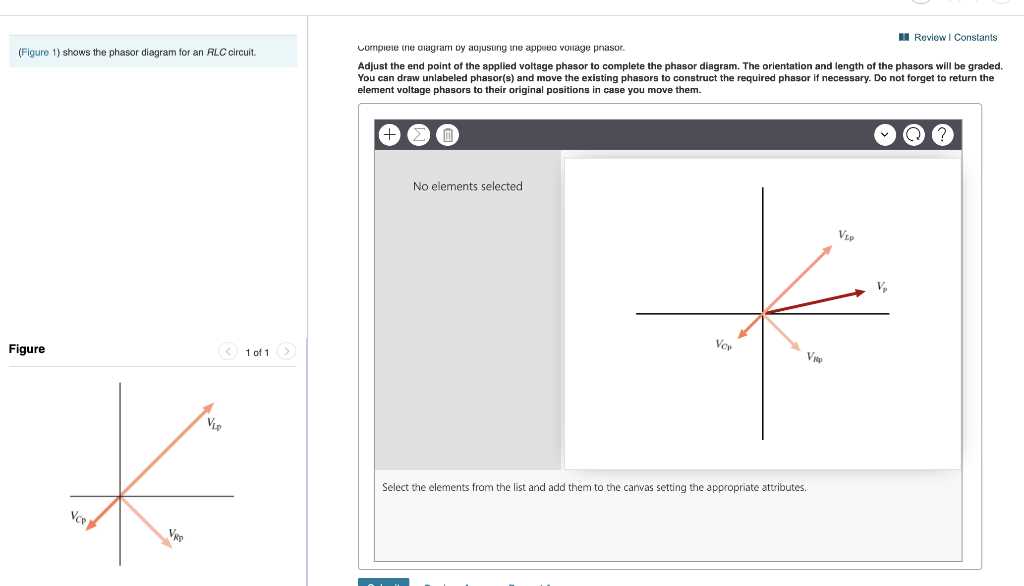
Draw the current reference vector horizontally and set a scale before placing voltage vectors. A common scale is 1 cm = 10 V or 1 cm = 20 V, depending on the measured values. The horizontal line represents the current flowing through the series network because the same current passes through the resistor, inductor, and capacitor.
Place the resistive voltage along the same horizontal axis as the current reference. Measure the voltage drop across the resistor using Ohm’s law VR = I × R. For instance, with current equal to 2 A and resistance 15 Ω, the resistive drop becomes 30 V, so draw a vector with the chosen scale along the horizontal direction.
Add the inductive voltage as a vertical vector pointing upward from the end of the resistive component. Its magnitude comes from VL = I × XL, where inductive reactance equals XL = 2πfL. If the current is 2 A and inductive reactance equals 20 Ω, the inductive voltage becomes 40 V. Draw this vector at a right angle above the horizontal axis.
Draw the capacitive voltage downward from the same origin point because it shifts opposite to the inductive component. Use the expression VC = I × XC, where capacitive reactance equals XC = 1 / (2πfC). For example, with current 2 A and capacitive reactance 10 Ω, the capacitive drop equals 20 V. This vertical vector points downward.
Combine the vertical inductive and capacitive components to obtain the net reactive value. Subtract the smaller value from the larger one and keep the direction of the dominant component. Join the horizontal resistive vector with the resulting vertical vector using vector addition. The line drawn from the origin to the final endpoint represents the total supply voltage and forms the angle between supply voltage and current.