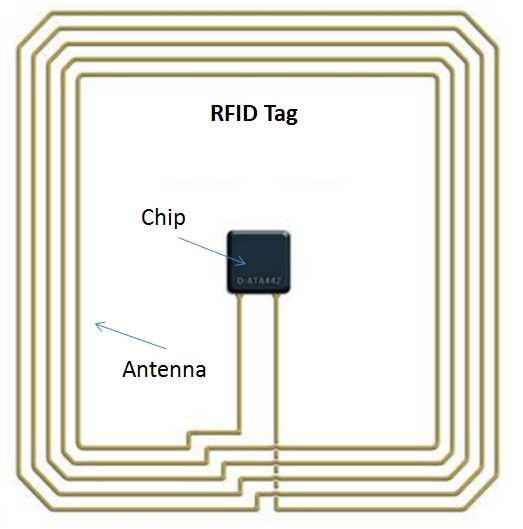
Connect the antenna coil directly to the reader controller through a tuned matching network designed for the 13.56 MHz operating frequency. The antenna inductance usually ranges between 1 µH and 3 µH, depending on coil size and trace geometry. Proper tuning with parallel capacitors keeps the resonant frequency aligned with the communication band used by contactless cards and mobile devices.
The hardware layout normally includes several key elements: a reader controller chip, an antenna loop, tuning capacitors, and communication lines linked to a microcontroller. The antenna loop generates a magnetic field that powers passive tags placed within a distance of roughly 2 to 5 centimeters. When a tag enters this field, it modulates the signal, allowing data exchange with the reader.
Stable operation depends on careful placement of passive components. Tuning capacitors adjust the resonance of the antenna loop and compensate for trace capacitance on the PCB. Designers commonly select capacitor values between 20 pF and 220 pF depending on coil inductance and board layout.
Power and communication interfaces also require attention. The reader controller typically runs from 3.3 V and connects to a host microcontroller through I2C, SPI, or UART lines. Short signal traces and solid ground planes reduce electromagnetic noise and maintain stable communication with contactless cards and tags.
NFC Circuit Diagram Showing Antenna Coil Controller Chip and Connection Layout
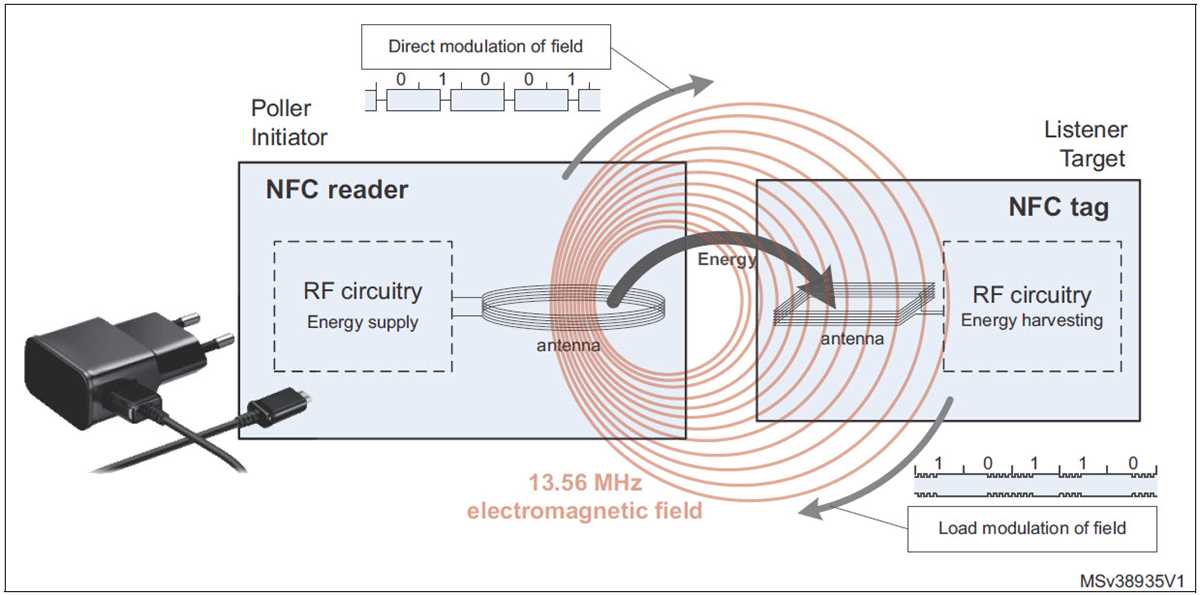
Place the antenna loop close to the reader controller and keep the connection traces short. The inductive loop generates the magnetic field used for contactless communication at 13.56 MHz. Typical inductance ranges from 1 µH to 3 µH, depending on coil diameter, number of turns, and PCB trace width.
The reader controller integrates modulation, demodulation, and signal processing functions. It drives the antenna through differential outputs often labeled TX1 and TX2. These outputs feed a matching network that tunes the antenna loop to the required resonance frequency.
Tuning components connect between the controller and the antenna loop. Their values depend on coil inductance and board capacitance.
- Parallel capacitors normally range from 22 pF to 220 pF
- Series capacitors help adjust resonance and impedance
- Damping resistors may appear between the antenna lines
- Small RF capacitors compensate for trace capacitance
The power section typically runs from 3.3 V supplied by a voltage regulator. Decoupling capacitors such as 100 nF and 10 µF are placed close to the controller power pins. These capacitors filter noise and stabilize voltage during high frequency signal transmission.
Communication between the reader controller and the host microcontroller uses digital interfaces. The most common options include SPI, I2C, or UART connections. Signal traces for these interfaces should remain short and routed away from the antenna area to prevent interference.
Board layout affects signal stability. Keep a solid ground plane under the controller area, avoid routing digital traces through the antenna loop region, and maintain symmetrical routing for antenna connections. Proper placement improves signal strength and ensures reliable detection of contactless cards and tags within a distance of several centimeters.
How to Connect an NFC Antenna Coil to the Controller Chip and Matching Network
Connect the inductive loop directly to the transmitter pins of the contactless reader controller and keep both traces symmetrical. The two antenna terminals must have nearly identical length and width so that the RF signal at 13.56 MHz remains balanced.
Measure the inductance of the loop before selecting the matching components. PCB loops usually fall between 1 µH and 2.5 µH. A handheld LCR meter set to 100 kHz provides accurate readings for calculating the required capacitors.
The connection path normally follows this structure: controller output pins → tuning capacitors → antenna loop → return path. Capacitors form a resonant LC network that aligns the antenna frequency with the reader transmitter frequency.
Calculate the resonance using the standard LC relation. For example, a 1.6 µH loop requires roughly 86 pF total capacitance to reach 13.56 MHz. The capacitance is often split into two identical parts placed on each antenna line.
Series capacitors may also appear between the controller and the loop. Their role includes impedance adjustment and transmitter protection. Typical values fall between 10 pF and 47 pF, depending on the controller output stage and antenna inductance.
Keep the antenna traces wide. PCB implementations usually use 0.5–1.5 mm copper width with spacing between turns around 0.5 mm. Wider traces reduce resistance and improve magnetic field strength.
Avoid routing digital signals under the loop area. High-speed logic lines can couple noise into the RF path and reduce reading distance. Place the reader controller just outside the antenna boundary while maintaining short RF connections.
Add damping resistors only when ringing appears on the RF waveform. Values between 2 Ω and 10 Ω are commonly inserted in series with the antenna path. Oscilloscope measurement at the antenna pins confirms whether the transmitter signal remains stable and properly tuned.