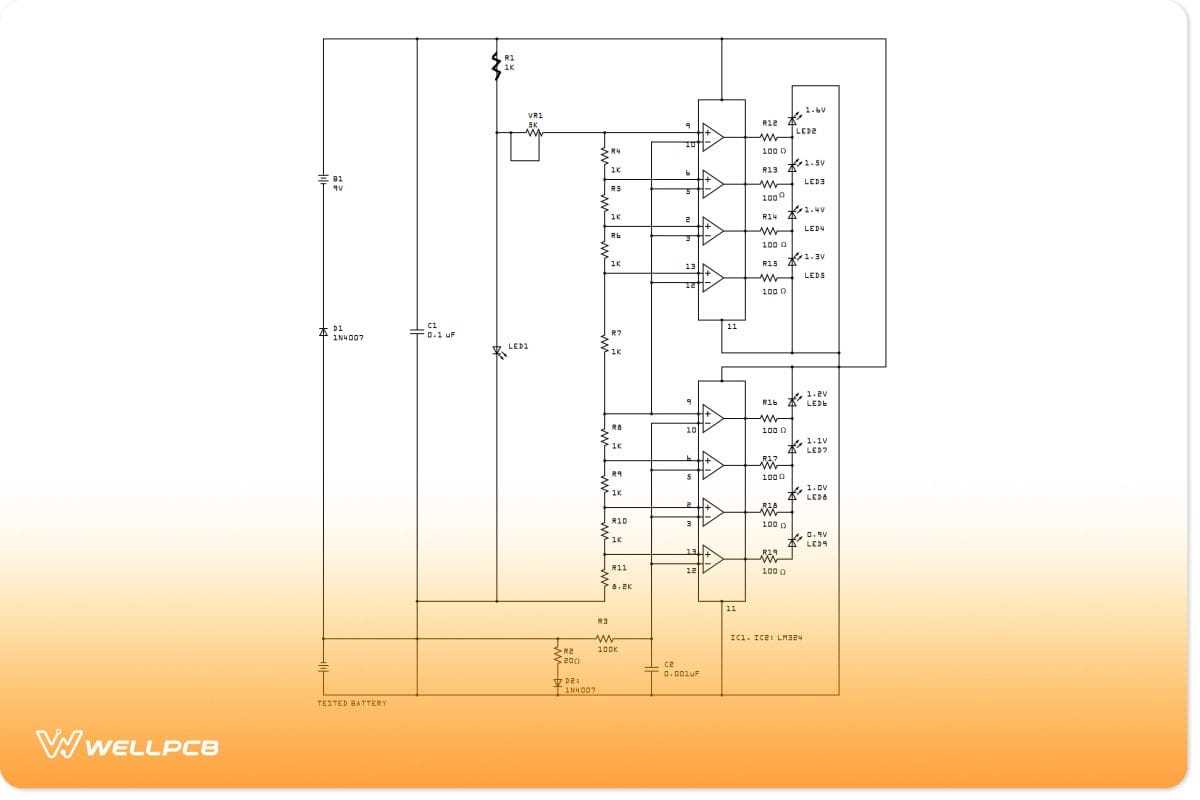
Use a clear pin-to-component layout before assembling any analog prototype. The well-known quad operational amplifier in DIP-14 format integrates four independent amplifying stages powered from a single supply ranging roughly from 3 V to 32 V. Each stage contains a non-inverting input, an inverting input, and an output node. Accurate wiring between these pins and surrounding resistors, capacitors, or sensors determines whether the amplifier behaves as a comparator, active filter, signal conditioner, or low-frequency oscillator.
Inside the 14-pin package, the four amplifiers share common power rails. Pin 4 typically connects to the positive supply while pin 11 connects to ground or the negative rail. The remaining pins form four groups of three terminals representing individual amplification blocks. A practical connection scheme places feedback resistors between output and inverting input, while the signal source enters the non-inverting input. For stable gain control, select resistor ratios carefully; for example, a 10 kΩ feedback resistor paired with a 1 kΩ input resistor yields a voltage gain near 11.
Decoupling capacitors improve stability in breadboard or PCB implementations. A 100 nF ceramic capacitor placed close to the supply pins reduces high-frequency noise entering the amplifier core. When the device processes slow sensor signals such as temperature probes or light detectors, adding a small capacitor (10–100 pF) across the feedback resistor suppresses oscillation. Short signal paths and proper grounding also prevent unwanted interference, especially when multiple amplifier sections operate simultaneously.
The internal architecture supports single-supply operation, allowing input voltages near ground without a negative rail. Because the output cannot reach the positive rail completely, designers often reserve at least 1.5 V of headroom. Careful mapping of each pin connection–inputs, outputs, feedback components, and supply rails–ensures predictable amplification, stable filtering, or precise threshold detection across all four channels contained in the package.
Lm324n IC Circuit Diagram: Practical Design and Connection Guide
Connect pin 4 to the positive supply (3–32 V range) and pin 11 to ground before adding any signal paths; this quad operational amplifier works reliably with a single supply and does not require a negative rail for many analog tasks. Place a 100 nF ceramic bypass capacitor between the supply pin and ground within 1–2 cm of the package to suppress noise and prevent oscillation. For stable amplification stages, keep feedback traces short and route the reference ground directly to the same node as the signal source.
Each internal amplifier block has three terminals: non-inverting input, inverting input, and output. Configure gain using a feedback resistor network; for example, a typical non-inverting stage uses a ratio such as R1 = 10 kΩ from output to the negative input and R2 = 1 kΩ from that node to ground, producing a gain close to 11. Input signals should remain about 0–1.5 V below the positive rail to avoid output saturation. When working with sensors or microphones, add a coupling capacitor (1–10 µF) and a bias divider such as two 47 kΩ resistors that create a mid-supply reference.
Trace arrangement strongly affects stability. Keep feedback components near the chip pins, avoid long parallel runs between input and output conductors, and separate high-current loads from the analog path. Output stages can typically source around 20 mA, yet continuous heavy loading raises temperature and distortion. If driving LEDs or relays, place a transistor buffer between the amplifier output and the load. For measurement systems, shield the input line and include a small capacitor (10–47 pF) across the feedback resistor to limit high-frequency noise.
For multi-channel designs, use the four internal amplifiers for different roles: one stage for signal conditioning, another for filtering, a third for comparison, and the last for buffering. Passive low-pass filtering can be formed with a resistor of 10 kΩ and capacitor of 0.1 µF, yielding a cutoff near 160 Hz. Maintain clear ground routing and dedicate a single reference node for all analog returns; this prevents drift and unwanted coupling between stages.
Pin Configuration and Power Supply Wiring in a Quad Operational Amplifier DIP-14 Layout
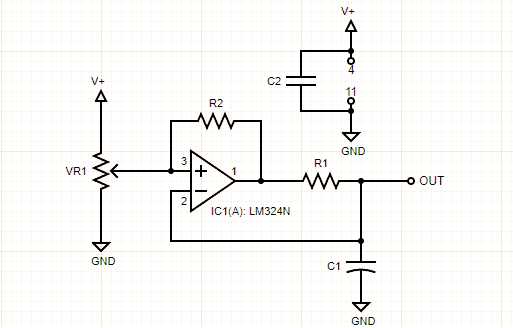
Connect the supply rails first: pin 4 to the positive rail (+3 V to +32 V single supply) and pin 11 to ground or the negative rail when a dual source is used (down to −16 V). This 14-pin analog chip contains four independent amplifying stages sharing common power connections. Decoupling capacitors should sit within 2–5 mm of the package pins to reduce oscillation and noise. A typical arrangement places a 100 nF ceramic capacitor directly between pins 4 and 11, sometimes paired with a 4.7–10 µF electrolytic for low-frequency ripple filtering.
The package organizes four amplifier blocks in a symmetrical structure. Each block contains three terminals: non-inverting input, inverting input, and output. The pin mapping follows a consistent sequence across the body of the IC:
- Pin 1 – Output of amplifier A
- Pin 2 – Inverting input of amplifier A
- Pin 3 – Non-inverting input of amplifier A
- Pin 4 – Positive supply rail
- Pin 5 – Non-inverting input of amplifier B
- Pin 6 – Inverting input of amplifier B
- Pin 7 – Output of amplifier B
- Pin 8 – Output of amplifier C
- Pin 9 – Inverting input of amplifier C
- Pin 10 – Non-inverting input of amplifier C
- Pin 11 – Ground or negative supply
- Pin 12 – Non-inverting input of amplifier D
- Pin 13 – Inverting input of amplifier D
- Pin 14 – Output of amplifier D
Power routing on a schematic drawing should keep supply traces wider than signal lines to reduce impedance. Analog sections benefit from star-ground routing where pin 11 connects directly to the main ground node rather than passing through long traces shared with digital loads. Recommended wiring practices include:
- Place bypass capacitors between pins 4 and 11.
- Keep input traces away from output pins to limit feedback coupling.
- Use a ground plane beneath the IC when placed on a PCB.
- If a split supply is used (for example ±12 V), connect pin 4 to +12 V and pin 11 to −12 V, allowing output swing around 0 V.
- For single-supply systems, bias inputs above ground because the input common-mode range usually begins near the negative rail.
Correct pin orientation is verified by locating the notch or dot marking pin 1 on the package body; numbering proceeds counter-clockwise around the chip when viewed from above.