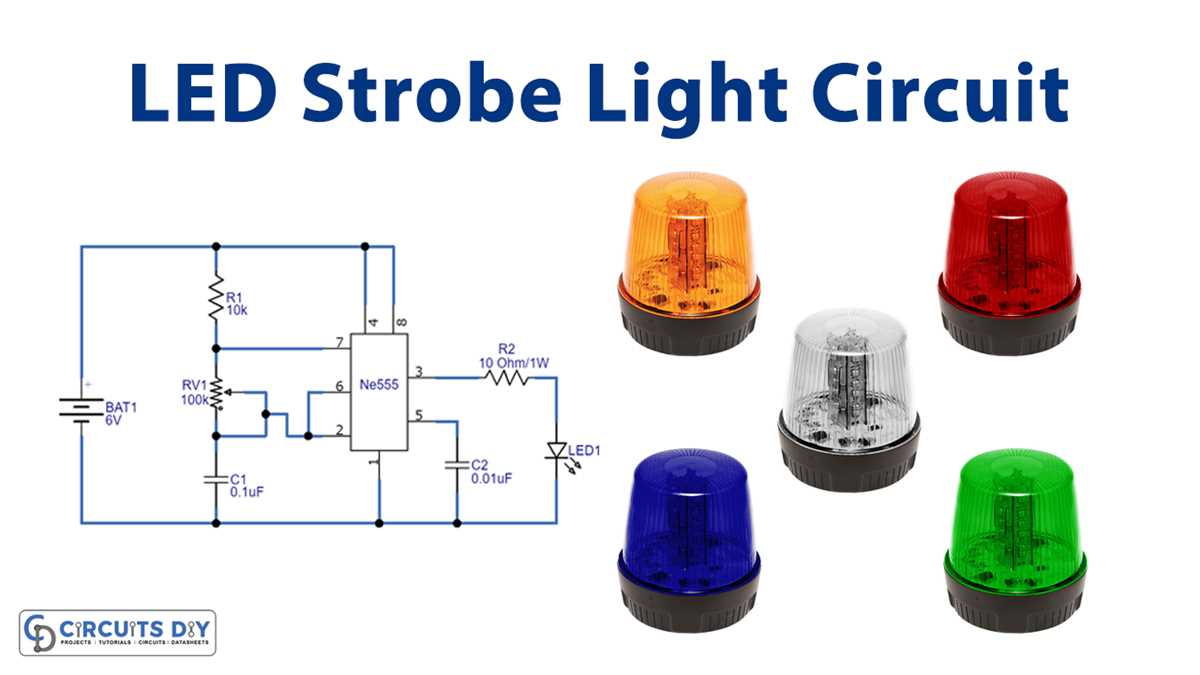
Connect a 555 timer in astable mode with a 10 kΩ potentiometer and a 10 µF capacitor to generate repeating pulses that drive a flashing light module. This arrangement produces short bursts of illumination at adjustable rates between roughly 2 and 20 flashes per second. The timer output controls a transistor switch that delivers current to the light emitters only during pulse intervals.
Place a resistor between the transistor collector and the light emitter chain to limit current. For a 12-volt supply and three high-brightness emitters in series, a value near 150–220 Ω keeps current near 20 mA. Accurate current limiting protects the emitters and stabilizes flash brightness during rapid pulse operation.
Include a small electrolytic capacitor across the supply rails to smooth voltage fluctuations produced by repeated switching. A 100 µF capacitor located close to the timer package reduces unwanted triggering and keeps pulse spacing consistent. This layout produces sharp light bursts useful for motion analysis, rotating machinery inspection, and timing experiments.
LED Stroboscope Circuit Diagram With 555 Timer Pulse Generator and Flash Control
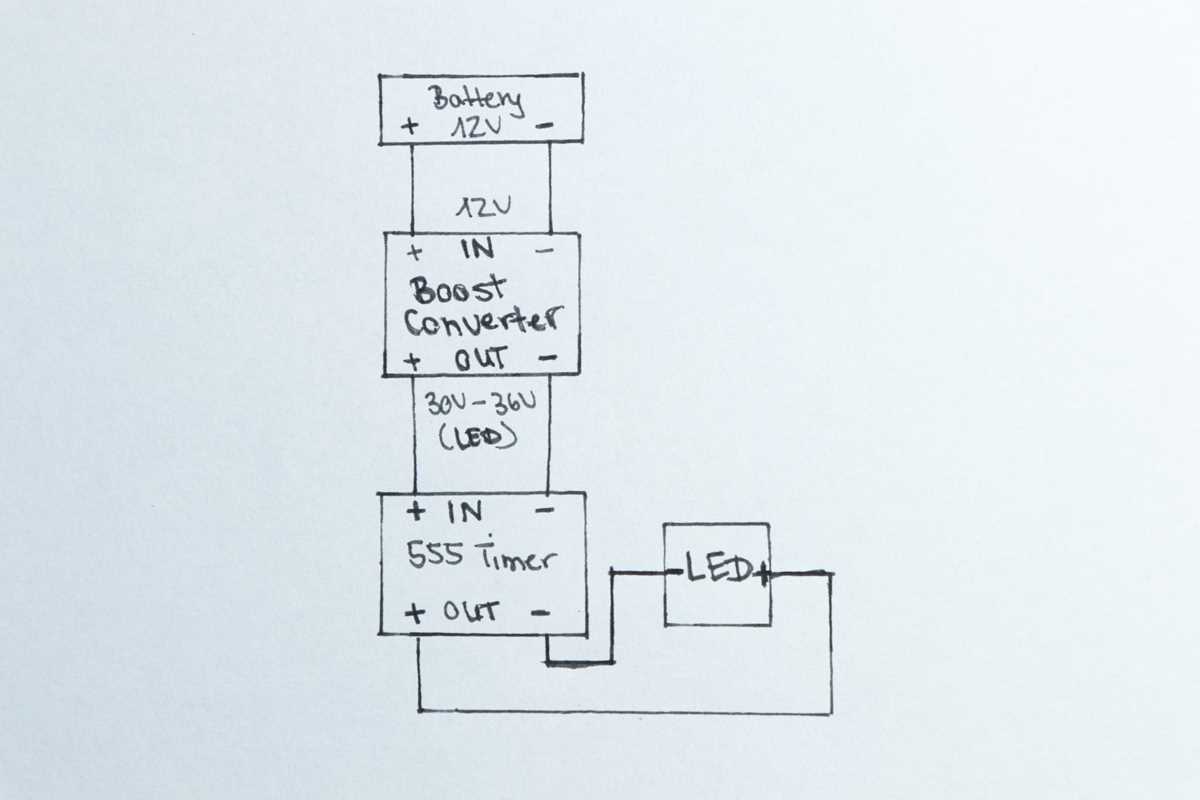
Configure the 555 timer in astable mode so the output repeatedly switches between high and low states. Connect pin 8 to the positive supply, pin 1 to ground, and place a timing network between pins 6, 7, and 2 using a resistor pair and capacitor. A common setup uses a 4.7 kΩ resistor, a 100 kΩ variable resistor, and a 10 µF capacitor, producing adjustable flash intervals from about 1 to 25 pulses per second.
Route the timer output from pin 3 to the base of an NPN switching transistor through a 1 kΩ resistor. This transistor acts as the driver stage, allowing the timer to control a higher current load without stress on the integrated timer package.
Connect the transistor collector to the negative side of the light emitter chain while the emitters receive power from the positive supply rail through a current limiting resistor. When the timer output rises, the transistor saturates and current flows through the emitters, producing a short burst of light.
Adjust flash frequency by rotating the potentiometer in the timing network. Increasing resistance lengthens the charge time of the capacitor between pins 6 and 2, which lowers pulse frequency. Decreasing resistance shortens charge time and produces faster bursts.
Install a 0.01 µF capacitor between pin 5 and ground to stabilize the timer reference voltage. This small component reduces unwanted jitter and keeps pulse spacing consistent.
Place a 100 µF electrolytic capacitor across the supply rails near the timer package. Rapid switching of the driver stage can introduce voltage dips; the capacitor buffers these variations and stabilizes the pulse generator.
Use high brightness light emitters rated for pulse operation when strong flashes are required. Devices designed for short duty cycles tolerate higher peak current than continuous illumination types.
Maintain short connection paths between the timer, driver transistor, and emitter array. Compact layout reduces electrical noise and preserves clean switching transitions between each flash pulse.
Component Layout for LED Strobe Circuit Using 555 Timer and Current Limiting Resistors
Place the 555 timer near the center of the board and keep the timing components close to pins 2, 6, and 7. Short connection paths reduce electrical interference and keep pulse intervals stable. Mount the timing capacitor directly beside the timer package and connect the potentiometer through short traces to avoid unwanted resistance variations.
Timer and Timing Network Placement
The pulse generator relies on a resistor pair and capacitor that control charge and discharge cycles. Position these parts together as a compact group.
- Resistor R1 between VCC and pin 7
- Variable resistor between pin 7 and pins 2–6 junction
- Electrolytic capacitor from pins 2–6 junction to ground
- 0.01 µF capacitor from pin 5 to ground for reference stabilization
Locate the switching transistor close to the light emitter array rather than next to the timer. This arrangement shortens the high-current path that flows through the transistor collector and the emitter chain. Lower trace resistance reduces voltage drop during short flashes.
Current Limiting Resistor Arrangement
Each emitter chain must include a resistor calculated from the supply voltage and forward drop. For example, a 12-volt supply with three emitters at roughly 3 volts each leaves about 3 volts across the resistor.
- Determine total forward voltage of the emitter chain
- Subtract that value from the supply voltage
- Divide remaining voltage by target current
- Select the closest standard resistor value
Place supply filtering capacitors close to the timer package and power input terminals. A 100 µF electrolytic capacitor across the supply rails helps maintain stable operation during repeated switching pulses.