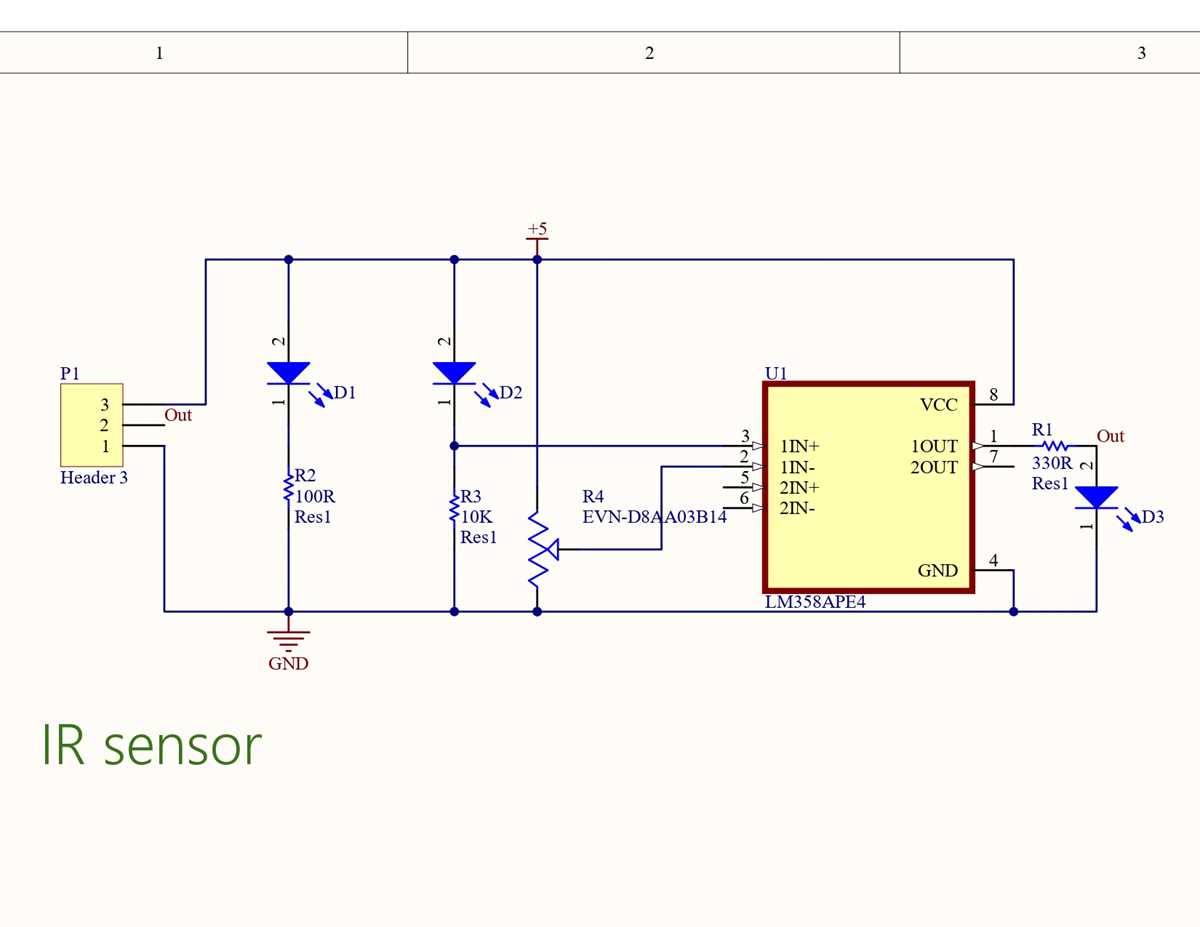
Connect the infrared emitter through a 220–330 Ω resistor to a 5 V supply so the diode current remains near 15–20 mA. This value protects the emitter and keeps radiation stable. Position the emitter and the receiving element facing the same direction when building a reflective detection module; spacing of 10–25 mm between them reduces direct optical interference.
The receiving component, typically a photodiode or phototransistor, should link to a voltage divider network. A 10 kΩ pull-up resistor tied to the supply rail allows the output node to shift voltage when infrared radiation reflects from an object. When radiation reaches the receiver, conductivity inside the device rises, causing the output node to drop from roughly 5 V toward ground.
Place a small signal transistor such as 2N2222 or BC547 after the receiver stage if the output must drive LEDs, buzzers, or microcontroller inputs. Connect the base through a resistor between 1 kΩ and 4.7 kΩ. The emitter goes to ground, while the collector connects to the load path. This arrangement amplifies the tiny current produced by the photodiode stage.
Keep conductor paths short and route power rails with a 100 nF ceramic bypass capacitor positioned close to the receiver stage. This capacitor filters electrical noise from nearby motors or digital boards. Stable voltage improves detection distance, which commonly ranges from 2 cm to 30 cm depending on emitter power and surface reflectivity.
Infrared Sensor Circuit Layout and Connection Guide for Object Detection Systems
Connect the infrared emitter diode to a 5 V rail through a 220 Ω resistor to maintain forward current near 18 mA. This current level provides stable radiation without overheating the emitter. Place the emitter and receiving phototransistor parallel on the board, pointing toward the detection zone. Maintain spacing between 10 and 20 mm to prevent direct optical leakage.
The receiving phototransistor should link to a pull-up network using a 10 kΩ resistor tied to the positive rail. The collector connects to the resistor while the emitter goes to ground. The output node between these elements provides the signal level that changes during object reflection.
Add a small NPN transistor stage when the output must drive external loads. A BC547 or 2N2222 transistor works well. Route the output node through a 2.2 kΩ base resistor, connect the emitter to ground, and place the load between collector and supply.
Install a 100 nF ceramic capacitor between supply and ground close to the receiving element. This bypass component suppresses electrical noise from nearby motors, switching regulators, or microcontroller boards.
Use short copper paths on the board and keep the emitter path separated from the receiving stage. Crossing traces or running them in parallel may introduce interference that alters detection distance.
Typical reflection detection distance ranges from 2 cm to 30 cm depending on emitter power, surface color, and ambient illumination. Dark or matte objects reduce reflected radiation, while white surfaces increase response strength.
Infrared Emitter and Photodiode Connection Layout for Basic Detection Modules
Connect the infrared emitter diode to the positive supply through a 220 Ω to 330 Ω resistor so forward current remains between 15 and 20 mA. The cathode goes to ground. This arrangement stabilizes radiation intensity and prevents overheating during continuous operation.
Place the photodiode facing the same direction as the emitter when building a reflective detection module. The anode connects to ground while the cathode links to the signal node through a 10 kΩ pull-up resistor tied to the supply rail. When infrared radiation reflects from an object, the photodiode conducts and the voltage at the signal node drops. Keep the spacing between the emitter and photodiode around 10–20 mm; shorter distances may cause direct radiation leakage that triggers constant output changes.
Route copper paths separately for the emitter drive and the photodiode stage. Install a 100 nF ceramic capacitor across supply and ground close to the photodiode node to reduce electrical noise from nearby digital boards or motors. Maintain short conductor paths and avoid parallel routing between emitter drive and detection traces to prevent interference.