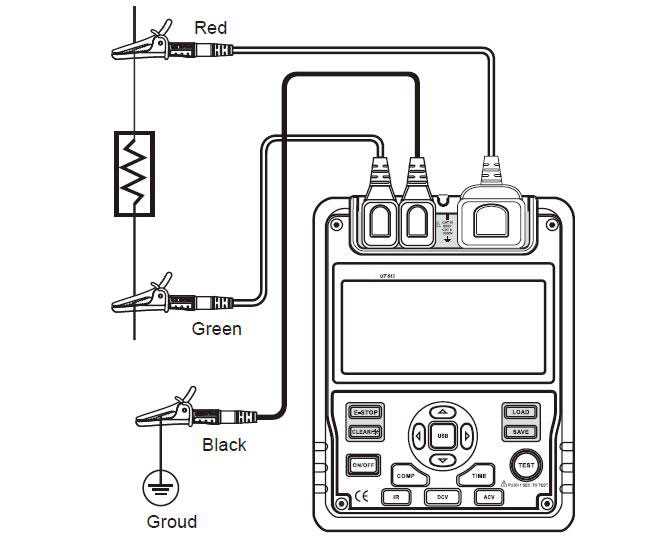
Use a high-voltage resistance measurement assembly based on a DC boost stage producing 250–1000 V and a microamp-range sensing network. This arrangement allows precise evaluation of leakage between conductors and grounded metal parts in motors, transformers, and long cable runs. A stable oscillator feeding a step-up transformer followed by a rectifier stack creates the required potential, while a calibrated megaohm divider converts leakage flow into a measurable voltage.
The power stage commonly relies on a blocking oscillator with a ferrite transformer. A switching transistor drives the primary winding at 15–40 kHz, producing several hundred volts after rectification with high-voltage diodes rated above 2 kV. A capacitor bank of 10–100 nF smooths ripple and maintains a steady output level. A series resistor chain totaling 5–20 MΩ restricts current so that accidental shorting does not damage the measuring stage.
Measurement accuracy depends on the sensing path. Leakage from the tested object flows through a precision reference resistor (typically 1 MΩ–10 MΩ with 1 % tolerance). The resulting drop feeds an analog meter movement or an ADC input through a buffer amplifier using a low-bias operational amplifier such as JFET-input types. With a 500 V applied potential, a leakage of 1 µA corresponds to roughly 500 MΩ, allowing evaluation of degraded cable jackets or contaminated motor windings.
Protection elements should include a spark gap or MOV across the output terminals, plus a discharge resistor around 1 MΩ that drains stored charge once the device is switched off. Clear spacing between high-potential traces–at least 6–8 mm on fiberglass boards–prevents surface tracking. With these structural choices, the measurement assembly delivers reliable detection of weak dielectric barriers in industrial wiring and rotating machinery.
High-Resistance Measurement Layout: Practical Design and Implementation
Use a DC source between 500 V and 1000 V generated by a compact boost stage built around a PWM controller such as MC34063 or a small flyback module. Output ripple must stay below 3 % to avoid unstable readings. Place a high-value limiting resistor (typically 1–10 MΩ) directly after the high-voltage output to restrict current below 1 mA during fault conditions.
A measurement path based on a megaohm divider provides stable scaling for very large resistance values. Typical configuration includes a 100 MΩ reference branch and a sensing branch connected to the device under examination. Voltage drop across the reference element feeds a precision amplifier with input bias current below 50 pA; devices like OPA129 or LMC6001 handle this requirement.
- High-voltage generator: 500–1000 V DC
- Current limiting element: 1–10 MΩ
- Reference resistor: 100 MΩ ±1 %
- Input amplifier bias current: <50 pA
- Measurement range: 100 kΩ to 5 GΩ
Guarding techniques reduce leakage on the PCB surface. Route the sensing node through a guard ring driven by the same potential as the amplifier input. Use PTFE standoffs for nodes above 200 MΩ. Standard FR-4 without cleaning may introduce leakage near 10–50 MΩ under humid conditions.
Analog indication may rely on a microammeter scaled for 0–50 µA. For digital output, feed the amplifier output into a 12-bit ADC such as ADS1115. Calibration requires two reference loads: 1 MΩ and 100 MΩ. Record ADC values and compute a linear conversion factor stored in microcontroller memory.
- Apply reference load 1 MΩ.
- Record voltage from ADC.
- Repeat using 100 MΩ standard.
- Compute slope and offset.
- Store parameters in firmware.
Protection components prevent damage during accidental short connection. Add a 600 V transient suppressor across the output and a series ceramic capacitor (100 pF–470 pF rated for 1 kV) to suppress switching spikes from the boost stage. A bleeder resistor around 20 MΩ safely discharges the high-voltage node within roughly 15 s after power removal.
PCB spacing must exceed 8 mm between high-voltage nodes and low-level analog traces. Apply conformal coating after cleaning flux residues with isopropyl alcohol. Field prototypes built with these parameters typically achieve repeatability within ±3 % across the full resistance range.
Step-by-Step Breakdown of a High-Resistance Measurement Wiring Scheme with Key Components and Voltage Generation Stage
Place the voltage generation block at the left side of the layout and verify that the supply stage can elevate a low DC source (typically 3–12 V) to 250 V, 500 V, or 1000 V depending on the measurement range. A compact oscillator built with a transistor pair or a timer IC produces a square waveform around 1–5 kHz. This waveform feeds a miniature step-up transformer with a turns ratio commonly between 1:20 and 1:40. The secondary winding then passes through a fast high-voltage rectifier stack and a smoothing capacitor rated above the target output level, often 1–10 nF at 2 kV. The result is a stable DC source used to stress cable dielectric or equipment windings while leakage current remains extremely small.
Key Structural Blocks and Component Roles
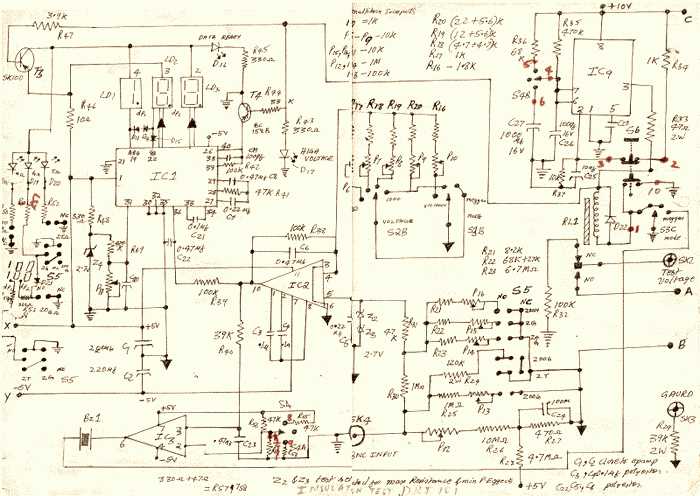
The measurement path begins with a protective series resistor between 500 kΩ and 2 MΩ that limits current during accidental shorting. After this resistor, the high-voltage node connects to the test probes. The return path flows through a sensing network composed of a precision resistor ladder that converts nanoamp or microamp leakage into a measurable voltage. A moving-coil meter or high-impedance ADC input then interprets that drop. Guard terminals are frequently added around the sensing path to shunt surface leakage away from the main measurement node, preventing false readings when humidity contaminates probe surfaces.
The oscillator stage can use a simple multivibrator formed by two NPN devices such as BC547 equivalents with collector resistors around 4.7 kΩ and timing capacitors between 10 nF and 47 nF. Frequency stability matters because transformer efficiency peaks within a narrow band. Designers often select ferrite cores sized roughly 10–15 mm with primary windings of 20–40 turns and secondary windings exceeding 800 turns of fine enamel wire. Rectification normally uses a chain of fast diodes rated above 1 kV each, sometimes arranged as a multiplier when transformer output remains modest.
Voltage Elevation and Measurement Conversion
After rectification, a filter capacitor smooths the pulsating output. A bleeder resistor around 10–50 MΩ discharges stored charge once the device powers down, preventing hazardous residual potential. The generated high DC potential is applied across the test leads while the sensing resistor network monitors leakage. For example, if 500 V is applied and the measured current equals 1 µA, the computed resistance equals 500 MΩ. Analog scales often mark values from 0.1 MΩ up to several gigaohms using logarithmic spacing.
Shielding and spacing between conductors inside the assembly must support at least twice the peak output voltage. Tracks carrying several hundred volts should maintain gaps of 5–10 mm on standard FR-4 boards. High-value resistors should be metal-film types with voltage ratings above 500 V per element; designers often connect multiple units in series to distribute stress. Accurate readings depend on clean probe surfaces, guarded measurement nodes, and stable high-voltage generation that does not sag under microamp-level load.