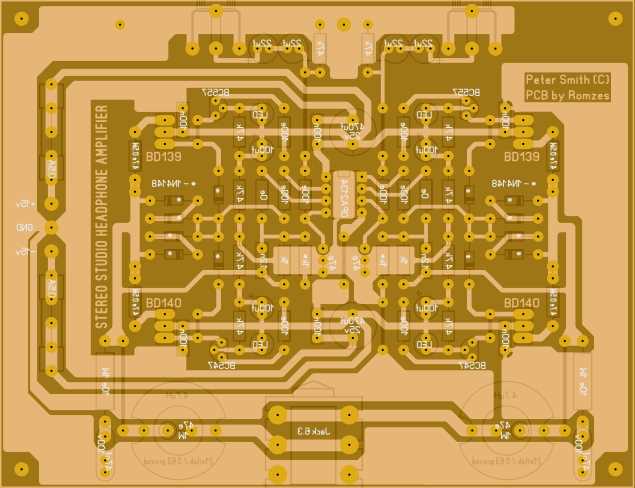
Choose a low-noise audio driver stage based on an operational amplifier with rail-to-rail output if the goal is clear sound from portable listening gear. A common configuration uses an op-amp such as OPA2134, NE5532, or LM4562 paired with a dual power supply of ±12 V or a single 9–12 V source with a virtual ground node. Place a 100 kΩ feedback resistor and a 10 kΩ input resistor to obtain a gain factor close to 11, which suits most mobile players and DAC outputs delivering 0.5–1 Vrms.
The layout should include output current buffering capable of 50–100 mA, because small listening transducers often present loads from 16 Ω to 300 Ω. Add a pair of complementary transistors such as BD139/BD140 or a dedicated buffer IC like BUF634. This stage reduces distortion during strong bass passages and prevents the op-amp from operating at its current limits. Place a 100 Ω resistor in series with the output to suppress oscillation and protect the driver.
Power filtering strongly affects background noise. Install electrolytic capacitors of 470 µF–1000 µF on each supply rail and parallel them with 100 nF ceramic capacitors positioned within a few millimeters of the amplifier pins. For single-supply builds, create a midpoint reference using two 10 kΩ resistors and stabilize it with a 220 µF capacitor. This node functions as a pseudo-ground that keeps the audio waveform centered.
Input protection also improves reliability. Insert a 1 µF–2.2 µF film capacitor before the gain stage to block DC from the source device. Pair it with a 50 kΩ potentiometer acting as a level control. With these component values, the cutoff frequency stays below 5 Hz, which preserves deep bass while preventing offset voltage from reaching the output driver.
Portable Audio Driver Schematic for Low-Noise Output
Use a dual low-noise operational stage such as NE5532 or OPA2134 powered from a ±12 V rail to obtain clean output for 16–300 Ω ear speakers. Place a 10 kΩ logarithmic volume potentiometer at the input, followed by a 1 µF polypropylene coupling capacitor that blocks DC from the source. Configure the gain stage with a feedback network of 10 kΩ and 2.2 kΩ resistors, producing a voltage gain close to 5.5×. Add a 100 Ω resistor in series with the output line to stabilize the load and suppress oscillation. Each power pin of the IC should include local decoupling: 100 nF ceramic placed within 5 mm of the package plus a 47 µF electrolytic per rail. Route the signal ground separately from the power return until both meet at a single star point near the supply filter capacitors; this layout sharply reduces background hiss.
Component Layout and Signal Path
The input line should remain short and shielded; a twisted pair connected to the ground star prevents hum pickup from nearby transformers. For portable builds running from a single 9 V source, create a virtual midpoint using two 4.7 kΩ resistors and a 220 µF capacitor tied between the supply and ground; feed that midpoint into the non-inverting reference node of the gain stage. Output coupling can be handled with a 220–470 µF electrolytic capacitor rated above 16 V when the load impedance drops below 32 Ω. Keep feedback resistors within 1 cm of the IC pins to maintain stable phase behavior at frequencies above 100 kHz. A small 22 pF capacitor across the feedback resistor pair can further limit high-frequency ringing produced by long cables or low-impedance transducers.
How to Read and Interpret a Headphone Amplifier Circuit Diagram for DIY Builds
Trace the signal route from the audio input jack to the output connector and mark every gain stage along the path. A typical personal audio driver schematic shows input coupling capacitors (often 1–10 µF), a voltage gain block built around an operational amplifier or discrete transistor pair, and an output buffer that drives loads between 16 Ω and 300 Ω. Follow the line symbol carrying the signal and separate it from supply rails; power lines normally connect to ±9 V, ±12 V, or a single 5–15 V rail with virtual ground. Component labels such as R1, C3, or Q2 define function: resistors around the op-device set gain through the ratio Rf/Rin, while capacitors near the input define low-frequency cutoff using f = 1/(2πRC).
Identify Functional Blocks
Divide the schematic into logical sections rather than reading every symbol sequentially. The input conditioning stage usually contains a capacitor blocking DC offset from a source player and a resistor to ground that sets input impedance, often between 10 kΩ and 100 kΩ. The amplification stage follows, typically built around parts like NE5532, OPA2134, or a discrete differential pair; feedback components determine voltage multiplication, for example 4.7 kΩ over 1 kΩ producing a gain close to 5. Output sections frequently use emitter followers or dedicated buffer ICs to deliver current above 50 mA without distortion. Look for protection parts such as small resistors (1–10 Ω) placed in series with the output to stabilize reactive loads and prevent oscillation.
Interpret Power and Ground Strategy
Check how supply rails and reference nodes are arranged. Portable audio driver layouts often simulate a midpoint reference using a resistor divider and buffer so single-supply systems behave like ± rails. Decoupling capacitors (100 nF ceramic paired with 10–220 µF electrolytic) should appear close to active devices; their placement on the schematic hints at noise control and stability.