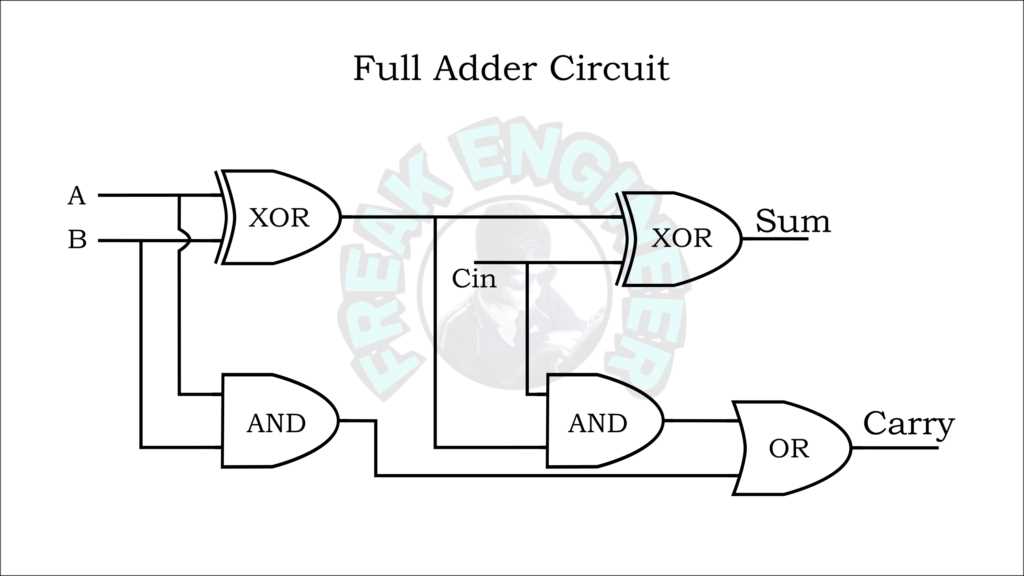
For accurate binary addition, the structure combining three variables and a carry input is a fundamental building block. The logic behind such a combination enables computing with minimal complexity while offering high performance. This approach is designed to handle both sum and carry outputs based on the input values of two binary digits and a carry-in.
The key components that facilitate the addition process include XOR gates, AND gates, and OR gates. By organizing these logic gates in a certain sequence, it’s possible to generate a reliable sum and carry-out. This arrangement ensures that even in the case of multiple binary values, the result remains consistent and precise.
When configuring the logic for each part of the addition process, it’s important to ensure that each bit is treated independently, while still accounting for the carry-over from previous calculations. This modular approach leads to an optimized design capable of handling high-speed calculations.
For anyone involved in digital system design or binary arithmetic, understanding this model provides the necessary framework for creating complex computational circuits. From basic operations to advanced arithmetic functions, this setup plays a crucial role in simplifying and streamlining the process.
Logic Gate Design for Addition Operations

To create a reliable binary addition system, begin with XOR and AND gates for computing individual sum and carry outputs. A XOR gate handles the sum of two binary digits, ensuring that only one of them can be “1” to produce a “1” result. The sum is generated by connecting the inputs of these gates in the correct order to avoid errors in the result.
The first logic element for the sum output is the XOR gate. The sum output of two inputs, A and B, will give a true value when exactly one input is true. This structure is ideal for binary arithmetic, where such a calculation forms the basis for the least significant bit in addition.
Carry generation requires the use of an AND gate. By applying the same inputs A and B to an AND gate, it will produce a “1” only when both inputs are “1.” This gate is used to detect when a carry-over is necessary in binary addition. The carry output is crucial to handle multiple bits in larger arithmetic operations.
To finalize the process, an additional XOR gate is introduced to combine the sum output and the carry-in value, ensuring the final sum result is correct. This step is essential for handling the propagation of carries from previous stages and ensuring that higher bits in the addition process are accurately computed.
The carry-out is produced by an OR gate that combines the results from the first AND gate and the second AND gate that involves the carry-in. This design allows for the correct propagation of carry values between different stages of the addition process, making it suitable for more complex binary calculations.
The three primary logic gates–XOR, AND, and OR–are organized efficiently to produce the desired results. Understanding how each gate contributes to the overall operation will help avoid unnecessary complexity in designing larger systems for multi-bit operations.
When designing these systems, it is critical to use the correct order of gates to prevent errors in the output. Gate arrangement and optimization will have a direct impact on the speed and reliability of the addition process, making these details essential to the design’s success.
For efficient implementation, these logic gate designs can be simplified using Boolean algebra. Minimizing the number of gates used in the design reduces power consumption and increases speed, key factors in improving the performance of digital systems built for arithmetic operations.
Components and Logic Gates in a Binary Addition Unit
The basic components required for this arithmetic operation include XOR gates, AND gates, and OR gates. These elements work together to generate the correct sum and carry outputs. The XOR gate handles the sum calculation, producing a “1” when only one of the inputs is true. The AND gate checks for carry conditions by outputting a “1” only when both inputs are true.
Two XOR gates are used in this configuration. The first XOR gate computes the sum of the two input bits, while the second XOR gate combines this result with the carry-in value. This ensures that the sum output reflects both the input bits and any carry-over from previous additions.
Carry generation is handled by two AND gates. The first AND gate detects whether both input bits are “1”, generating a carry. The second AND gate checks if one of the inputs and the carry-in are both “1”. The output from both AND gates is then fed into an OR gate, which finalizes the carry-out result.
This arrangement of gates is optimized for minimal complexity while ensuring reliable performance in binary addition. By focusing on the correct sequencing and usage of these gates, the system can efficiently perform addition tasks without redundancy or delay.