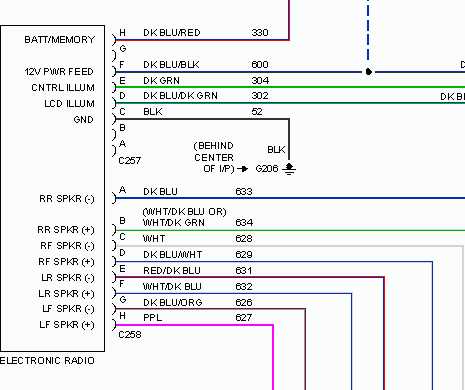
Match each harness lead by insulation shade before connecting the head unit. Most aftermarket audio receivers follow a standardized harness scheme where yellow carries constant battery power, red receives ignition-switched power, and black connects to chassis ground. Confirm these leads with a multimeter before attaching the unit to avoid memory loss or blown fuses.
Speaker channels usually appear as paired conductors with the same base shade and a stripe marking the negative line. For example, white and white with black stripe serve the front left speaker, while gray and gray with black stripe serve the front right. Rear channels commonly use green and purple pairs following the same stripe pattern. The striped lead normally connects to the negative terminal of the speaker.
Additional leads control auxiliary functions. A blue or blue with white stripe lead activates external amplifiers or power antennas by sending a 12-volt trigger once the receiver powers on. An orange or orange with white stripe lead connects to the dashboard illumination circuit so the display brightness adjusts when the vehicle lights turn on.
Secure connections with crimp connectors or solder joints rather than twisting wires together. Insulate each joint using heat-shrink tubing or electrical tape. Loose connections cause intermittent sound, background noise, or shutdown of the head unit during driving.
Color Code Car Stereo Wiring Diagram With Power Ground and Speaker Connections
Connect the constant battery lead before attaching any speaker lines. The memory supply line normally uses yellow insulation and remains connected to the battery at all times through a fused path. This line maintains saved stations, equalizer settings, and clock data inside the head unit.
The ignition-switched power line activates the receiver only when the key turns to ACC or ON. This lead usually appears red and links to the ignition harness inside the dashboard. If this line connects directly to battery power, the receiver stays active and drains the battery after several hours.
Speaker connections follow paired conductors with a solid shade for positive and a matching shade with a black stripe for negative. Each pair feeds a single channel from the internal amplifier.
- White pair – front left speaker
- Gray pair – front right speaker
- Green pair – rear left speaker
- Purple pair – rear right speaker
The striped conductor usually attaches to the negative terminal on each speaker. Maintaining correct polarity keeps all speakers moving in the same direction, preventing phase cancellation that weakens bass response and stereo imaging.
A black lead connects the head unit chassis to the vehicle body ground. Scrape paint from the grounding point on the metal frame before attaching the terminal. Poor grounding introduces background noise or causes the receiver to restart during engine cranking.
Additional control leads support accessories. A blue or blue with white stripe line activates external amplifiers or powered antennas with a 12-volt trigger signal once the receiver turns on. An orange illumination lead connects to the dashboard light circuit so the display brightness adjusts automatically when interior lights activate.
Identifying Constant Power Ignition Power and Ground Wires by Color in Car Audio Harness
Check the battery supply lead with a multimeter before connecting the head unit. This conductor normally carries 12 V at all times, regardless of ignition position. In many aftermarket harness standards it uses yellow insulation and links directly to a fused battery source. This line maintains memory functions such as stored stations and clock settings.
Turn the ignition key to ACC and locate the switched supply lead. This conductor often appears red and becomes energized only when the key moves to ACC or ON. When the key returns to OFF, the line loses power and shuts down the receiver automatically.
Main power leads found in a typical dashboard audio harness
Three conductors manage power delivery to the head unit:
Battery supply lead – permanent 12 V feed maintaining memory
Ignition-switched lead – activates the receiver during vehicle operation
Chassis ground lead – completes the electrical return path through the body frame
The ground conductor usually uses black insulation and connects to the metal body structure behind the dashboard. A ring terminal often fastens under a bolt attached to the frame or support bracket. Clean bare metal contact improves current flow and prevents noise interference.
Verify the ground connection by measuring resistance between the conductor and the metal frame. A reading near zero ohms indicates a solid connection. Higher resistance may cause the receiver to reboot during engine start or introduce background noise through the audio output.
Quick testing steps using a digital multimeter
Follow these checks before attaching the head unit:
Measure the permanent battery feed with the key removed
Turn the key to ACC and measure the switched supply line
Confirm ground continuity between the black conductor and the vehicle frame
Correct identification of these three conductors prevents fuse damage, battery drain, and malfunction of the audio receiver. Proper connections allow stable operation during engine start and normal driving conditions.