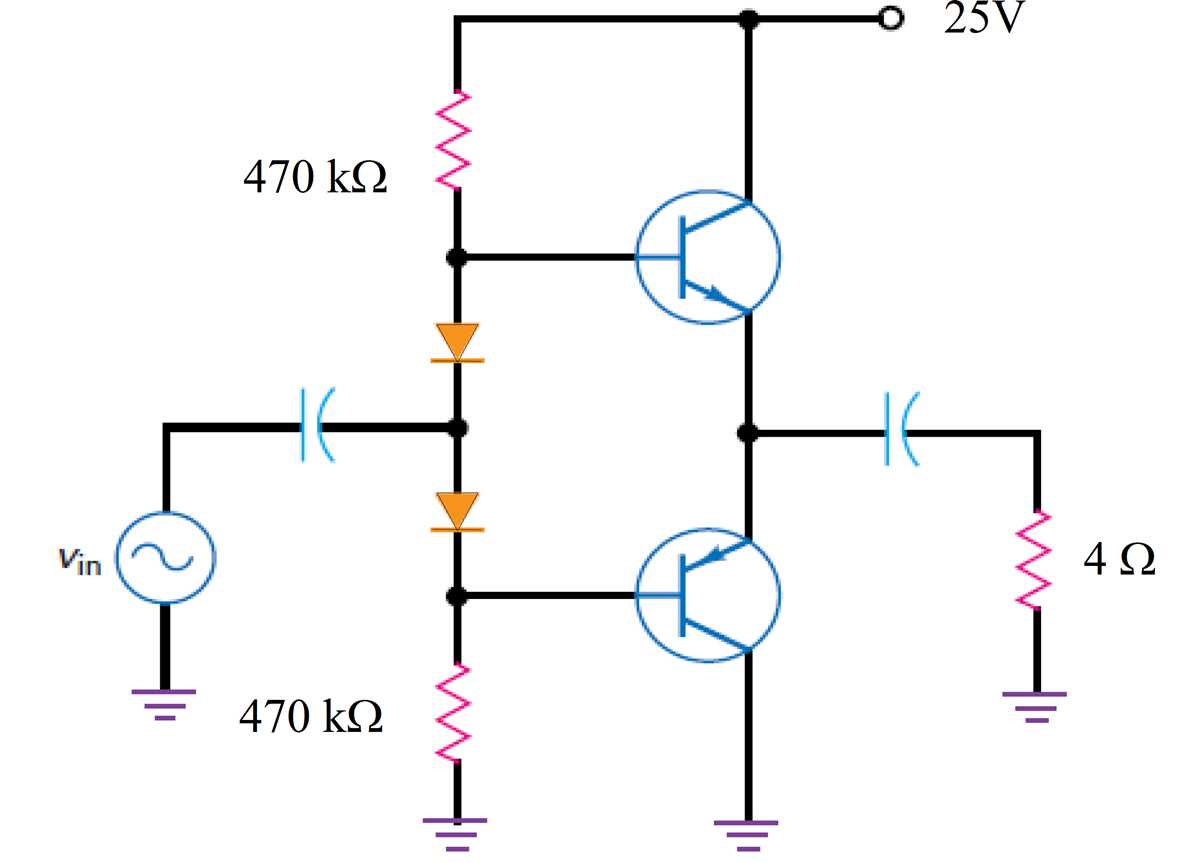
Begin by selecting matched output transistors and a stable bias network. Complementary NPN and PNP pairs are commonly used to handle positive and negative halves of an audio waveform. Proper matching reduces crossover distortion and keeps the signal clean at low levels.
Use a driver stage between the input section and the output transistors. This stage supplies enough current to control the larger devices connected to the load. Small signal transistors or dedicated driver pairs are typically mounted close to the output devices to reduce parasitic effects.
Set the idle current with a bias control network. A diode chain or a transistor-based Vbe multiplier maintains the correct voltage between the bases of the output devices. This adjustment prevents dead zones between waveform halves and keeps heat generation within safe limits.
Include thermal tracking components near the output transistors. Mounting the bias transistor or diodes on the same heat sink allows the bias voltage to change with temperature, preventing runaway current during prolonged audio playback.
Use adequate heat dissipation and proper supply filtering. Large electrolytic capacitors smooth the supply rails, while aluminum heat sinks remove excess heat from the output devices. These steps maintain stable signal reproduction and reduce distortion under heavy load.
Class AB Power Amplifier Circuit Structure and Operation Guide
Use a complementary push-pull output stage with controlled idle bias. Two large transistors share the audio waveform: one handles the positive half, the other the negative half. Maintaining a small standing current through both devices removes the dead zone that appears near the zero-crossing point.
Signal Flow Through the Amplification Stages
The input signal first enters a small-signal voltage gain stage built with a differential transistor pair. This section compares the incoming audio with feedback taken from the output node. The difference is amplified and forwarded to a driver stage that supplies enough current to control the large output devices connected to the speaker load.
A driver pair sits between the voltage stage and the output transistors. These medium-current devices buffer the signal and prevent the input section from being overloaded. Designers typically use emitter followers so the signal voltage is preserved while current capability increases.
Bias control is implemented through a Vbe multiplier or a diode chain mounted on the same heat sink as the output devices. This network sets a base-to-base voltage usually between 1.1 V and 1.4 V for silicon transistor pairs. The adjustment trimmer is tuned while monitoring idle current through emitter resistors.
Output Stage Stability and Thermal Control
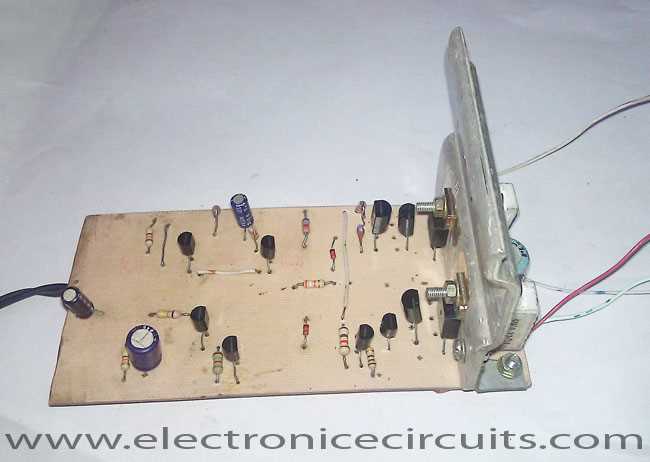
Install low-value emitter resistors between each output transistor and the load node. Values around 0.22 Ω to 0.47 Ω help balance current sharing and limit runaway conditions. These resistors also make it easier to measure idle current during setup.
Large aluminum heat sinks remove thermal buildup generated by the output pair. During extended high-level audio playback, junction temperature can rise rapidly. A shared heat sink with the bias transistor allows voltage compensation to track temperature changes.
Supply rails normally use symmetrical voltages such as ±25 V, ±35 V, or ±50 V depending on output requirements. Each rail is filtered by electrolytic capacitors ranging from 4700 µF to 10 000 µF. Proper filtering reduces hum and keeps the signal clean.
Negative feedback from the output node back to the differential input pair stabilizes gain and lowers distortion. A resistor network sets the gain ratio while a small capacitor across the feedback path limits high-frequency oscillation.
Identifying Transistor Stages and Signal Path in Class AB Amplifier Layout
Locate the input differential pair first. This transistor pair usually sits near the signal entry point and receives both the incoming audio and the feedback line from the output node. Its task is voltage gain and error comparison.
The signal path typically follows this order:
- Input differential pair
- Voltage gain transistor
- Driver stage
- Complementary output pair
- Speaker or load connection
The differential stage usually uses two matched small-signal transistors. Their emitters share a constant current source created by a resistor or current mirror. One base receives the audio input while the other base receives feedback, allowing the stage to control overall gain.
The next section is the voltage gain transistor. This device produces a large voltage swing that drives the following stage. It normally connects to a collector load resistor and includes a small compensation capacitor between collector and base to prevent high-frequency oscillation.
After the voltage gain stage, identify the driver pair. These medium-current transistors buffer the signal before it reaches the large output devices mounted on a heat sink. Their purpose is to supply sufficient base current.
Typical driver connections include:
- Emitter follower configuration
- Direct coupling from the voltage stage
- Bias network connection between bases
- Short trace routing to the output transistors
The output stage uses a complementary NPN and PNP pair connected in push-pull form. Each transistor conducts during one half of the waveform. Small emitter resistors help balance current and allow measurement of idle bias.
Trace the signal physically across the board. The path begins at the input connector, passes through small-signal stages, reaches the driver pair, then arrives at the large transistors attached to the heat sink before reaching the speaker terminal.