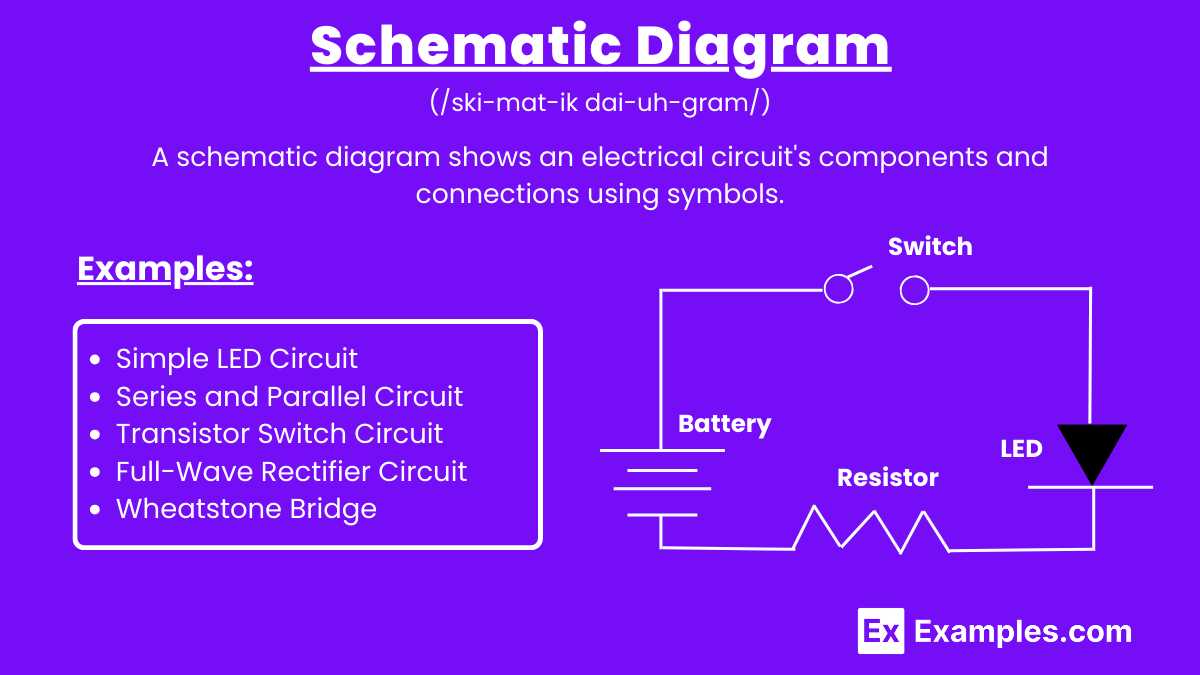
Identify power sources and ground points before interpreting any electrical layout drawing. Most electronic plans place the voltage supply at the top or left side and the return path at the bottom. Following this orientation helps trace how current moves through resistors, capacitors, coils, and semiconductor devices.
Each component appears through a standardized symbol rather than a physical picture. A resistor appears as a zigzag or rectangular block, a capacitor as two parallel plates, and a diode as a triangle pointing toward a line. These symbols create a simplified electrical map that shows how parts connect without displaying the physical board arrangement.
Voltage values, reference labels, and component numbers provide technical detail required during assembly or troubleshooting. For example, a resistor labeled R3 10 kΩ indicates the third resistor in the layout with a resistance of ten kilo-ohms. A marking such as VCC 5V indicates a five-volt supply rail feeding multiple components across the electrical plan.
Follow the connection lines carefully to track signal paths. Straight lines represent conductive paths linking components. When two lines intersect with a filled dot, the conductors join electrically. Crossing lines without a dot normally remain isolated. This convention prevents confusion when several conductors pass close together on the page.
Clear labeling and logical placement reduce errors during circuit assembly. Group related components, keep signal flow moving in a consistent direction, and separate power lines from signal paths. Such structure allows technicians and engineers to analyze electrical behavior quickly during testing, repair, or modification.
Circuit Schematic Diagram Symbols Components and Electrical Connection Layout
Place the power source symbol at the top or left edge of the electrical drawing so the current path can be traced clearly through every component. A battery appears as long and short parallel plates, while a DC supply may be marked with a labeled voltage rail such as +5V or +12V. Position the ground reference at the bottom of the layout to show the return path used by the entire electrical network.
Use standardized graphical marks to represent hardware. A resistor appears as a zigzag or rectangular block, a capacitor as two parallel plates, and an inductor as a series of curved loops. Semiconductor devices include diode arrows, transistor three-terminal symbols, and integrated block rectangles with labeled leads. Each element should include an identifier such as R1, C2, Q3, or U1 so that assembly documentation and parts lists match the electrical plan.
Connection paths must be drawn with straight lines and right-angle turns. A filled dot indicates conductors joined together, while two crossing lines without a dot remain electrically separate. This convention prevents accidental interpretation errors in dense electrical layouts where multiple paths pass close to one another.
Label component values directly beside each symbol. Resistance may appear as 4.7 kΩ, capacitance as 100 nF, and inductance as 10 µH. Active devices often include reference voltages or signal names such as VIN, VOUT, CLK, or DATA. These markings allow technicians to verify signal paths and electrical behavior during testing and troubleshooting.
Arrange components according to signal flow rather than physical board placement. Inputs appear on the left side of the drawing, processing stages remain in the center, and outputs move toward the right. Power rails should run horizontally across the page while signal routes travel vertically between stages. This structure keeps the electrical map readable during analysis, modification, or repair work.
Standard electrical symbols used in circuit schematic diagrams and their functions
Use standardized graphical marks to represent electronic parts so any technician can interpret the electrical layout without confusion. A resistor appears as a zigzag line in ANSI notation or a rectangular block in IEC style, representing a component that limits current. Capacitors appear as two parallel plates; polarized versions include one curved plate or a plus sign indicating the positive terminal.
Semiconductor devices rely on directional symbols. A diode shows a triangle or arrow pointing toward a vertical line, indicating current direction from anode to cathode. Light-emitting variants add two outward arrows representing emitted light. Transistors appear with three terminals labeled base, collector, and emitter in bipolar designs, or gate, drain, and source in field-effect devices.
Inductive components appear as a series of curved loops or arcs. This symbol represents coils used in filters, transformers, and energy storage stages. A transformer uses two inductive symbols placed side by side with parallel lines between them representing a magnetic core that transfers energy between windings.
Power references appear through specific icons. A ground reference usually appears as three descending horizontal bars or a triangle pointing downward. Voltage supplies may appear as battery plates, circular generator marks, or labeled rails such as +12V or 3.3V feeding several nodes across the electrical layout.
Connection points also follow defined rules. Conductive paths appear as straight lines; a filled dot marks an electrical junction joining multiple conductors. Lines that cross without a dot remain separate. This visual rule prevents misinterpretation where many signal paths pass near each other.
Integrated devices appear as rectangles containing labeled terminals around the edges. Each lead receives a number or name such as VCC, GND, IN, OUT, CLK, or RESET. This style allows complex microcontrollers, amplifiers, and logic devices to be represented clearly while maintaining a readable electrical plan.