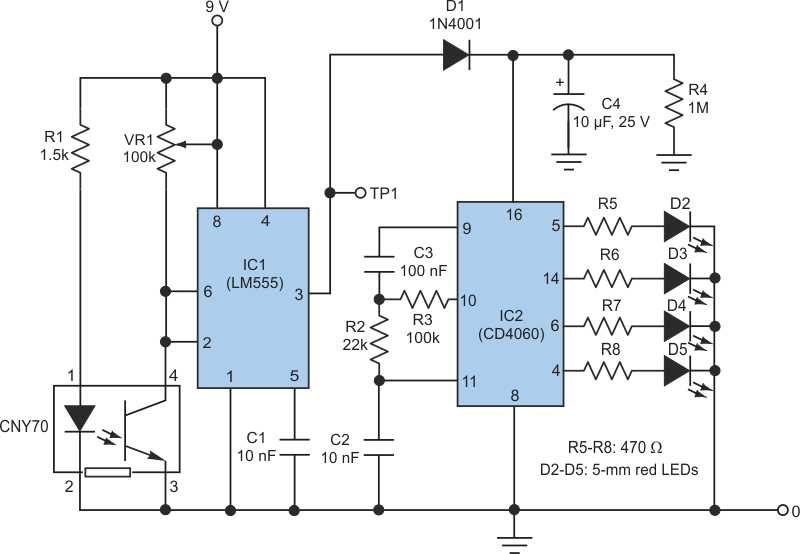
Connect a 14-stage binary counter with an integrated oscillator directly to a precise resistor-capacitor network to generate stable timing pulses. Use low-tolerance resistors and high-quality ceramic capacitors to minimize frequency drift and maintain accurate pulse intervals over extended operation.
For extended timing periods, cascade the output of higher-stage flip-flops back to subsequent stages. Ensure proper decoupling by placing 0.1 µF capacitors near the power pins to suppress voltage spikes and reduce high-frequency noise, which can otherwise disturb the counting sequence.
Drive LEDs or relay modules directly from buffered outputs to monitor or trigger events without introducing additional oscillation errors. Limit the current with series resistors matching the load requirements to protect both the IC and peripheral devices.
For variable frequency applications, implement a potentiometer in series with the timing capacitor. Adjust incrementally while monitoring the pulse period with an oscilloscope to achieve precise timing adjustments without overloading the oscillator stage.
When combining multiple stages for sequential switching, carefully plan the output connections to avoid simultaneous triggering. Use Schmitt-trigger inputs for interfacing with logic modules to maintain clean transitions and prevent false counts under noisy conditions.
CD4060 Circuit Diagram
Connect the 14-stage binary counter directly to a 3–15 V supply, ensuring pin 16 receives the positive voltage and pin 8 is grounded. Use a 10 kΩ resistor with a 0.01 µF capacitor for the oscillator to achieve a base frequency near 1 Hz.
For timing outputs, tap the Q4–Q14 pins. Each output doubles the period of the previous stage, allowing precise interval generation from milliseconds to hours. Avoid loading more than 10 mA per output to maintain stability.
Use a 470 Ω series resistor if driving LEDs directly from outputs. For mechanical relays, insert a transistor driver such as BC547 and a flyback diode across the coil to prevent voltage spikes from damaging the chip.
- Oscillator component suggestions: Resistors 10 kΩ–1 MΩ, capacitors 100 pF–1 µF, depending on desired frequency.
- Power decoupling: 0.1 µF ceramic capacitor between supply pins reduces noise.
- Reset function: Connect a push-button between pin 12 and Vcc for manual restart.
- Optional frequency adjustment: Replace one fixed resistor with a 100 kΩ potentiometer for fine-tuning.
For extended timing, cascade multiple chips by connecting the Q14 output of the first stage to the oscillator input of the next. This multiplies the timing interval by 16, enabling multi-day delays without additional microcontrollers.
Connecting for Precise Time Delay
Use a resistor in the 10 kΩ–1 MΩ range between pin 11 and the positive rail, and pair it with a capacitor from pin 10 to ground. For a 1-second interval, start with 100 kΩ and 10 µF; for longer delays, increase the resistor proportionally while keeping the capacitor under 100 µF to avoid leakage issues. Ensure the supply voltage remains stable within 3–15 V to maintain timing accuracy.
Tap the desired output stage directly for your delayed pulse, as the internal 14-stage divider provides multiple intervals. For millisecond-level precision, select the Q4–Q7 outputs; for multi-minute delays, use Q10–Q14. Decouple the power with a 0.1 µF ceramic capacitor near the IC pins to reduce timing drift caused by transient spikes.
Fine-tune the interval by adjusting the series resistor in small steps, measuring the output with an oscilloscope or logic probe. Avoid paralleling capacitors of different types, since dielectric absorption can introduce irregularities. Ground all unused inputs to prevent false triggering and maintain consistent time intervals across multiple cycles.