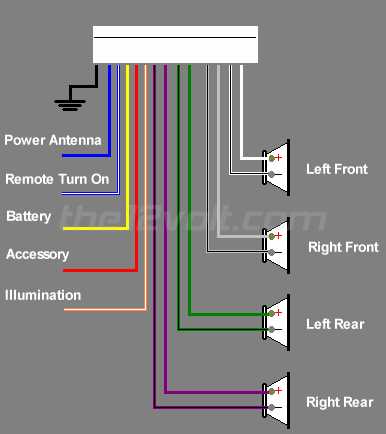
Choose a clear connection layout before installing any audio components inside a vehicle dashboard or trunk compartment. The head unit should send low-level signal through RCA interconnects toward an external power amplifier, while a dedicated 12V supply line runs directly from the battery through a fuse located about 20–30 cm from the positive terminal. Ground should attach to bare chassis metal using a short cable, typically under 50 cm, which reduces noise and voltage drop.
Speaker channels from the power amplifier must route separately toward door or rear deck drivers. Use oxygen-free copper conductors rated around 16 AWG for standard speakers and 12–14 AWG for subwoofer loads. Keep signal cables away from the battery feed line; parallel placement often introduces alternator noise. A remote turn-on lead from the head unit (usually a thin blue control wire) activates the amplifier only after the receiver powers up.
Fuse rating depends on amplifier current demand. For example, a unit rated near 400–500 watts RMS often requires a 40–60A inline fuse on the main power line. Distribution blocks help when several amplifiers share the same battery source. Secure every connection using crimped ring terminals or soldered joints, then protect them using heat-shrink tubing to prevent oxidation.
Placement also affects performance. Mount the amplifier on a rigid panel inside the trunk or under a seat where airflow remains unobstructed. Leave several centimeters around cooling fins so heat dissipates properly. This layout supports stable voltage delivery, cleaner signal transfer, and balanced output across all speaker channels.
Head Unit and Power Booster Connection Layout
Use a fused 4-gauge power lead from the vehicle battery to an external power booster mounted near the rear seats. Place the fuse within 30 cm of the battery terminal; rating 60–80 A suits systems above 500 W RMS. Route the positive lead along one side of the cabin and secure it every 20–30 cm using plastic clips to stop vibration damage. Ground cable length should stay under 45 cm and attach directly to bare chassis metal after paint removal and bolt tightening.
Signal path between head unit and booster
Low-level audio travels through shielded RCA interconnects from the dashboard receiver to the power module. Run these cables along the side opposite the battery lead to reduce electromagnetic noise. Interconnect length usually ranges from 3 m to 5 m depending on cabin size. Choose double-shielded models rated below 50 pF per meter to limit signal degradation and background hiss.
Output terminals on the power module feed door or rear deck drivers through thicker copper conductors. For speakers rated 60–120 W RMS, 16-gauge copper performs reliably up to 6 m. Higher output installations above 150 W RMS benefit from 14-gauge conductors. Maintain polarity: positive terminal on the module connects to positive terminal on each driver; reversed polarity weakens bass response and shifts phase alignment.
Remote activation circuit

A thin blue or blue-white control lead from the dashboard receiver triggers the external power stage during system activation. This conductor carries low current, normally under 0.5 A, so 18-gauge copper remains sufficient. Connect the lead to the booster “REM” terminal; the device powers down automatically once the receiver shuts off, preventing battery drain.
Noise reduction improves further through star-style grounding: head unit ground point, signal processor ground point, and booster ground point meet at nearby chassis locations free of rust or paint. Voltage drop across the power lead should stay below 0.5 V during heavy bass playback; larger cable diameter solves drops beyond that threshold.
Identifying Power, Ground, and Remote Turn-On Lines in a Vehicle Audio Connection Schematic for External Amplifier
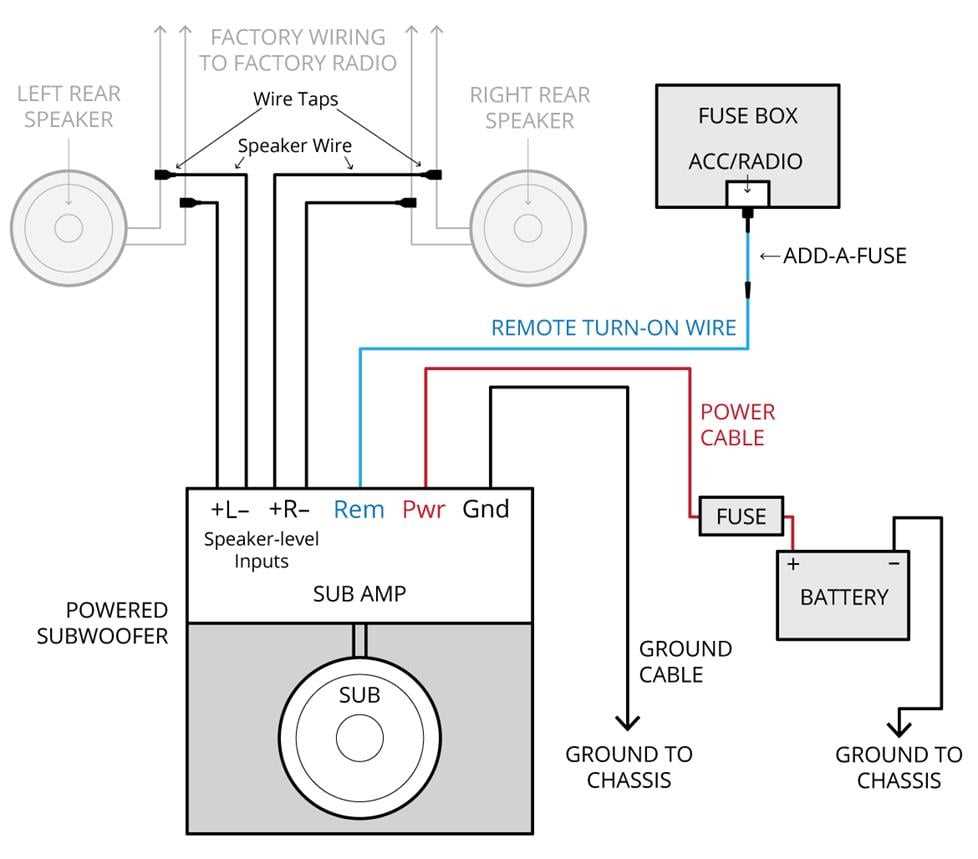
Locate the constant 12-volt supply first: in most head unit harnesses this conductor uses yellow insulation and links directly to battery positive through a fuse rated around 10–20 A. Measure voltage using a multimeter; reading should remain near 12.4–12.8 V while ignition remains off. If voltage disappears after key removal, the line belongs to accessory power rather than permanent supply. Route this feed toward the external amplification module through a dedicated fused lead positioned within 30 cm of the battery terminal to limit fault current.
Ground Identification
Ground returns normally appear as black or brown conductors tied to chassis metal. Confirm continuity between this conductor and bare vehicle body using resistance measurement; acceptable value sits below 0.3 Ω. Paint, corrosion, or thin sheet metal often increases resistance and causes noise or voltage drop. A stable grounding point usually involves a sanded metal surface, ring terminal, star washer, and bolt tightened directly into structural metal. Cable gauge for this return should match the main positive feed powering the external amplification unit.
Remote Trigger Lead
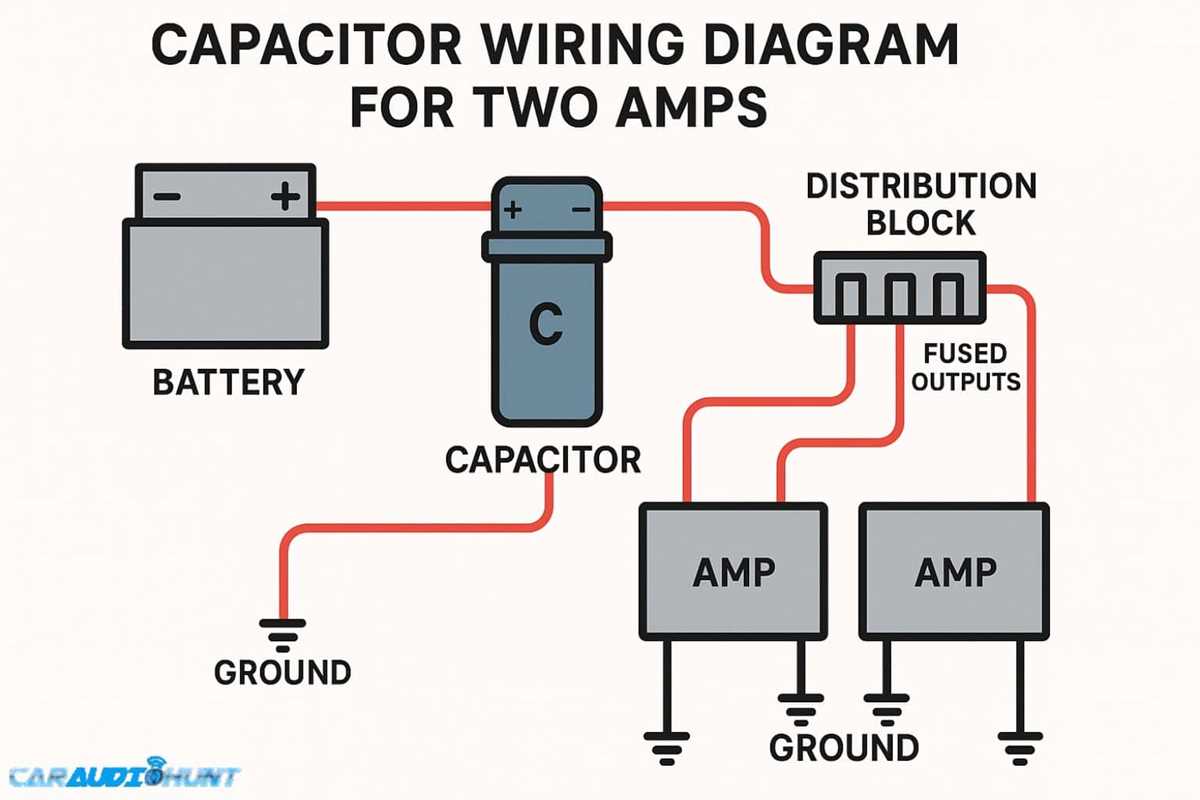
The remote activation conductor typically uses blue or blue-white insulation. Voltage appears only after the head unit powers on, usually between 11 V and 14 V. This signal does not carry load current; it functions as a control trigger allowing the external amplification stage to wake from standby. Current draw rarely exceeds 200 mA, therefore thin 18–22 AWG cable remains adequate. If several signal boosters operate in the same installation, distribute the trigger through a relay so the head unit output transistor avoids overload.
Trace each conductor along the harness path rather than relying solely on insulation color. Manufacturers occasionally change color codes between production years. Voltage measurement, resistance testing, and fuse tracking provide reliable confirmation. Correct identification prevents blown fuses, unwanted battery drain, and turn-on pops in the speaker system.