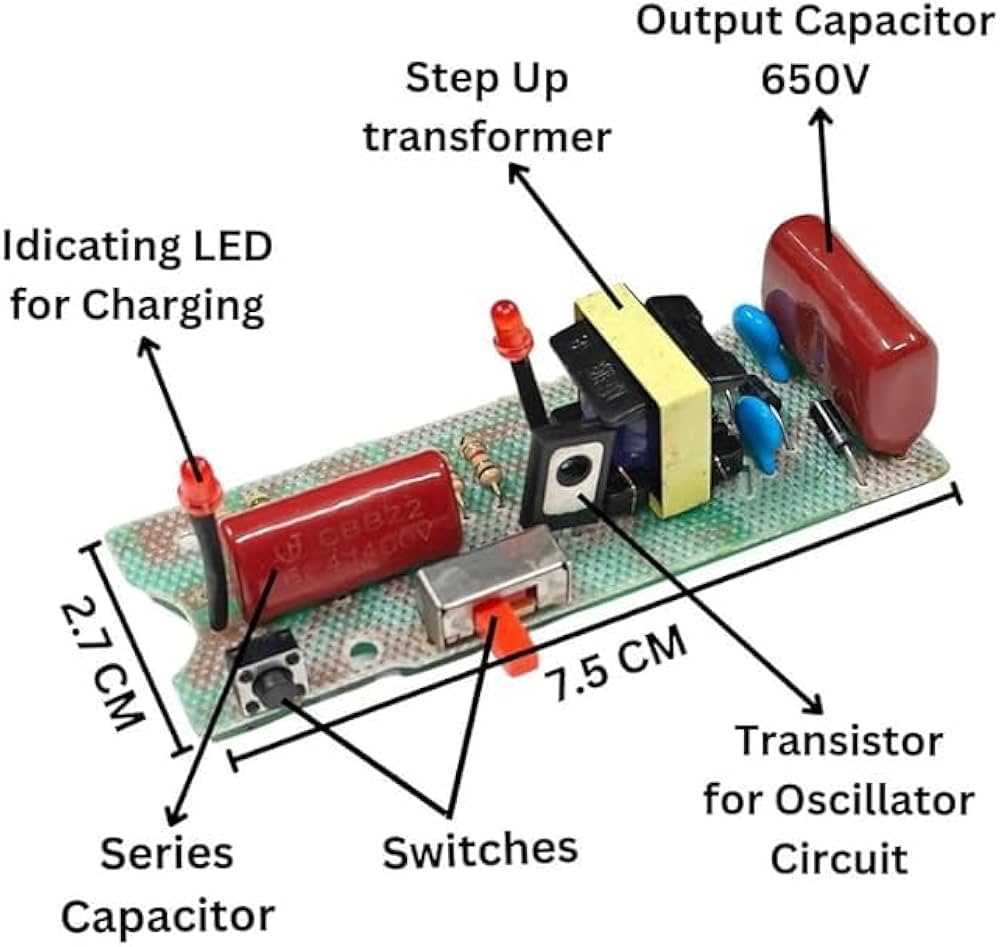
Use a step-up transformer combined with a rectifier stage and storage capacitors to generate a discharge potential between 1.5 kV and 3 kV; this range reliably neutralizes flying insects that touch a metal grid. A practical electrical layout includes a low-voltage input (typically 220 V AC or 120 V AC), a transformer raising the potential to about 800–1200 V AC, followed by a diode bridge and a capacitor bank rated above 2 kV. The charged output feeds two parallel conductive meshes spaced 4–8 mm apart, forming the active contact zone.
The connection scheme should include a current-limiting resistor between 1 MΩ and 5 MΩ placed after the rectifier stage. This component reduces surge intensity and prevents overheating of the transformer. Capacitors between 0.47 µF and 2 µF with a voltage rating above the peak output stabilize the discharge pulses. For household devices powered from 220 V mains, a fuse rated 250 mA–500 mA protects the primary side and prevents transformer damage during short events.
The electrode assembly strongly influences performance. Stainless steel or nickel-plated wires spaced evenly across an insulating frame produce stable sparks while resisting corrosion. The outer mesh connects to ground reference, while the inner mesh links to the high-potential output from the rectifier section. Maintaining equal spacing prevents continuous arcing and ensures that contact occurs only when an insect bridges both layers.
Housing design also affects reliability. Install the electrical components inside a ventilated enclosure with ceramic or high-grade polymer standoffs rated above 5 kV. Keep transformer leads short and separated from the grid wiring to reduce leakage paths. A small ultraviolet lamp positioned near the mesh improves attraction; lamps rated 4 W–10 W with a wavelength near 365 nm are widely used for this purpose.
Insect Electrocutor Wiring Plan: Practical Guide to Building and Understanding the System
Use a step-up transformer delivering 1.5–3 kV at low current and connect it to a dual-grid metal frame separated by 2–4 mm; this spacing allows flying insects to bridge the gap while preventing constant arcing. Power from a 220–240 V AC source should pass through a fuse rated around 250 mA and a rectifier stage that converts AC into pulsating DC before reaching the high-voltage section. Stainless steel rods or galvanized mesh reduce corrosion and keep the discharge consistent during humid nights.
Main Electrical Layout
The structure relies on several clearly separated modules that regulate power flow and voltage multiplication.
- Input protection: fuse (200–300 mA) and switch
- Voltage conversion unit: step-up transformer or oscillator transformer
- Rectification: four-diode bridge rated above 1 kV
- Energy storage: capacitors between 1 nF and 10 nF rated above 3 kV
- Output grids: two conductive meshes isolated with ceramic spacers
Spacing between conductive meshes strongly influences discharge behavior. A gap narrower than 2 mm creates continuous sparks, draining energy and heating components. Distances above 5 mm reduce strike probability because small insects fail to connect both electrodes. Laboratory tests with aluminum mesh show that 3 mm separation combined with 2 kV potential produces rapid ionization while limiting sustained arcs.
Component Selection Tips
Choose parts with margins above expected electrical stress; cheap elements fail quickly in outdoor environments exposed to moisture and dust.
- Diodes: minimum reverse voltage 1000 V, preferably UF4007 or similar
- Capacitors: ceramic high-voltage types rated 3–6 kV
- Transformer core: ferrite EE-type when using an oscillator driver
- Mesh wire thickness: 0.8–1.2 mm for mechanical stability
- Insulators: ceramic or PTFE spacers placed every 6–8 cm
For battery-powered builds, replace the mains transformer with a transistor oscillator using a ferrite transformer and a switching transistor such as MJE13003. The oscillator typically runs between 18–40 kHz and feeds the high-voltage stage through a secondary coil containing 600–900 turns of 0.1 mm copper wire. Output voltage rises above 1800 V once rectified and stored in high-voltage capacitors.
Testing requires a high-voltage probe or a neon indicator lamp connected through a 1 MΩ resistor. Never touch the mesh while energized; capacitors can retain charge for several seconds after shutdown. Discharge them through a resistor before maintenance. Mount the frame inside a plastic or powder-coated metal housing with ventilation slots so heat from the transformer and diodes dissipates without exposing conductive elements.