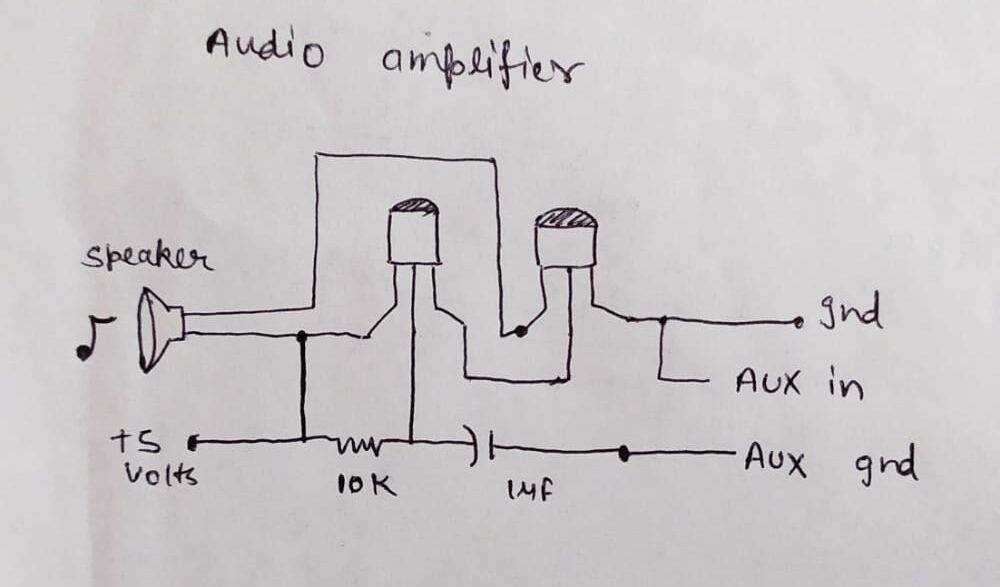
Use a single NPN transistor to drive small loads with minimal distortion. For optimal results, configure the base resistor around 1 kΩ and connect the collector through a 470 Ω resistor to the supply voltage of 9V. This ensures stable current flow while preventing thermal runaway.
Input coupling with a 10 µF capacitor improves frequency response and blocks DC components, maintaining signal clarity. Pair the emitter with a 100 Ω resistor to ground to control gain precisely without introducing noise.
Output stage can include a 100 µF capacitor to drive headphones or small speakers, smoothing voltage variations. Keep wiring short and solder points clean to reduce parasitic capacitance, which can attenuate high frequencies.
For higher gain without feedback issues, add a bypass capacitor of 100 µF across the emitter resistor. This configuration boosts the voltage swing while preserving linearity, making it ideal for audio pre-boost applications.
Supply decoupling is recommended using a 100 nF ceramic capacitor near the transistor. This prevents oscillations caused by sudden load changes, ensuring the setup remains stable during signal peaks.
Bc547 Amplifier Circuit Diagram
Use a single NPN transistor as the core for voltage gain in low-power audio applications. Connect the collector to a 9V supply through a 4.7kΩ resistor, while the emitter should have a 1kΩ resistor to ground for stability.
Input signals should pass through a 10µF capacitor to the base, which is biased using a voltage divider of 10kΩ and 22kΩ resistors. This configuration ensures proper linear operation without distortion at small signal levels.
- Output is taken from the collector via a 100µF coupling capacitor.
- Load impedance can range between 8Ω and 32Ω, suitable for headphones or small speakers.
- Optional bypass capacitor of 100µF across the emitter resistor increases gain by reducing negative feedback.
For higher frequency response, keep wiring short and avoid unnecessary parasitic capacitance. Using a small perf board is recommended instead of long jumper wires.
- Verify transistor pinout: Base, Collector, Emitter orientation must match the schematic.
- Check all resistor values with a multimeter before soldering to prevent overheating.
- Power supply should be regulated to avoid hum or signal instability.
This setup can amplify signals in the range of 20Hz to 20kHz with minimal noise, making it suitable for simple preamp tasks or small tone control projects. Adjust emitter resistance to fine-tune gain without compromising linearity.
Choosing the Right BC547 Configuration for Audio Amplification
For low-power signal boosting, a common-emitter layout delivers strong voltage gain with minimal component count. Select a 1 kΩ to 10 kΩ collector resistor paired with a 470 Ω to 1 kΩ emitter resistor to balance gain and thermal stability. Capacitive coupling at the input ensures clean signal transfer without DC offset.
Alternatively, a common-collector setup provides impedance matching with unity voltage gain, ideal for driving headphones or small speakers. Use a low-value emitter resistor, around 100 Ω to 220 Ω, to stabilize current without sacrificing linearity.
Biasing Strategies
Proper biasing guarantees low distortion across the frequency range. Apply a voltage divider from the supply to the base, targeting 0.6 V above the emitter. For a 9 V supply, typical resistor pairs are 22 kΩ and 4.7 kΩ, ensuring consistent quiescent current around 2–3 mA.
For higher-fidelity applications, add a bypass capacitor across the emitter resistor. A 100 µF electrolytic cap boosts gain at low frequencies without affecting midrange response, smoothing the signal for natural audio reproduction.
Consider a Darlington-like configuration if the source has extremely weak output. Connecting two transistors in cascade can increase input sensitivity while maintaining low output impedance, suitable for microphone preamplification or sensor signals.
Check thermal behavior under continuous operation. Heat buildup can shift the operating point and reduce lifespan. A small heatsink or additional spacing between components helps maintain consistent performance in prolonged use.