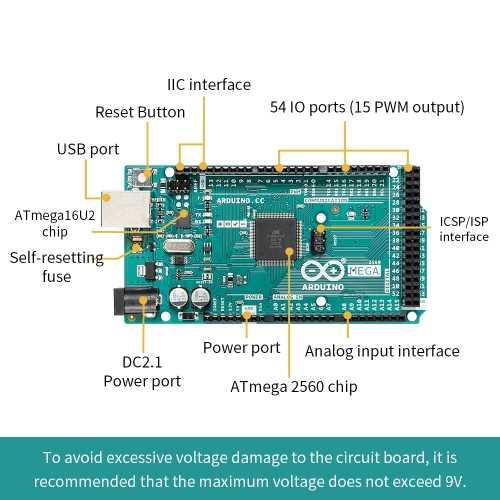
Ensure stable voltage supply by connecting the 5V and GND pins correctly before powering the board to prevent component damage and erratic behavior.
Map digital and analog inputs accurately using labeled ports to maintain signal integrity when interfacing with sensors and switches across multiple expansion shields.
Use serial communication ports to link external modules like displays and motor drivers, assigning TX and RX pins according to the microcontroller’s port configuration to avoid data collisions.
Double-check PWM outputs for controlling LEDs, motors, and servos, ensuring proper pin assignments and grounding paths to prevent overheating or inconsistent performance.
Microcontroller Pinout and Connections
Verify all power rails before attaching modules. Connect the 5V and GND pins to a stable power source to prevent voltage drops that could damage sensitive components.
Assign digital and analog pins precisely when linking sensors or switches. Digital pins handle high and low signals, while analog pins read voltage variations; misplacement can lead to false readings or nonresponsive devices.
Use designated serial and SPI ports for communication with displays, memory chips, or motor controllers. Align TX/RX and MOSI/MISO connections according to the microcontroller’s layout to avoid data collisions and communication errors.
Test PWM-enabled outputs carefully for controlling LEDs, servo motors, or fans. Confirm proper pin selection and ground continuity to maintain stable operation and prevent overheating of both the board and attached components.
Power Supply and Ground Connections for Stable Operation
Connect the main voltage input to a regulated power source rated for 5V and 3.3V where required. Ensure the current capacity exceeds the total load of connected modules to prevent brownouts during high demand.
Establish a solid ground plane by linking all GND pins directly to a common point. This prevents voltage fluctuations caused by long or thin wires and stabilizes the microcontroller’s logic levels across sensors and actuators.
Include bypass capacitors near the power input pins. Place 0.1µF ceramic capacitors across each voltage rail to filter high-frequency noise and 10µF electrolytic capacitors to smooth low-frequency variations, maintaining steady operation under dynamic loads.
Separate analog and digital grounds when connecting sensitive analog sensors. Tie them together at a single star point to reduce interference, ensuring accurate ADC readings without cross-talk from switching components.
Double-check polarity and connections before powering on. Reverse connections or floating grounds can damage the microcontroller, reset peripherals unexpectedly, or introduce unstable behavior that complicates debugging.