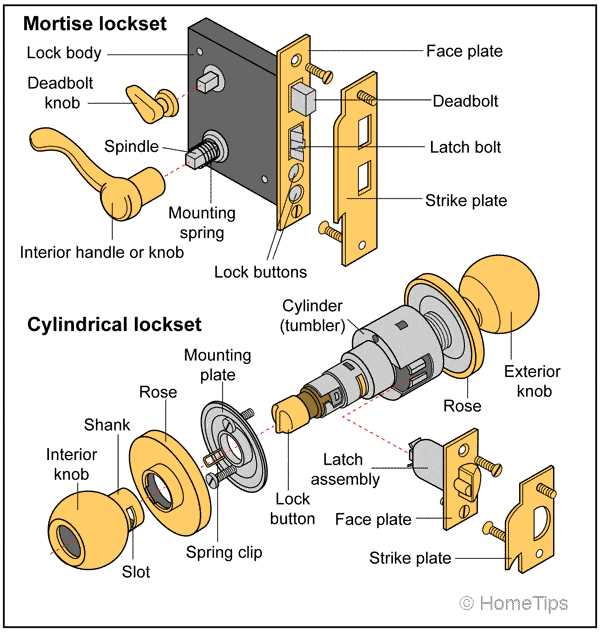
Label each element on the schematic before installation to avoid misalignment and premature wear. The spindle, latch bolt, return spring, and faceplate must align within ±0.5 mm to keep the assembly quiet and smooth. A clear illustration that shows relative spacing helps verify that the square shaft rotates freely without rubbing the housing.
Focus on the interaction points between the fastening unit and the frame strike. The beveled tongue should project 10–12 mm for residential entry panels, while the compression spring must retract fully under moderate handle torque. A visual layout clarifies how the cam transfers motion from the handle to the tongue, reducing trial-and-error during fitting.
Pay attention to materials shown in the schematic. Zinc alloy cases handle indoor humidity, while stainless steel tongues resist corrosion near exterior openings. Hardened steel pins improve resistance against forced rotation. Seeing these elements mapped in one illustration helps select compatible replacements without disassembling the entire unit.
Use the visual layout as a checklist during maintenance. Confirm that the retaining clip seats flush, the follower rotates without binding, and fasteners match the specified thread pitch. A precise illustration shortens service time and prevents damage to the entry panel surface.
Parts of Door Lock Diagram
Use a labeled schematic to identify each element before installation or repair, as visual mapping reduces alignment errors and speeds troubleshooting.
The keyed core sits at the center of the securing unit; its pin stacks interact with the key profile, while the cam at the rear transfers rotation into linear motion.
The latch bolt extends from the case to engage the strike plate; a beveled face allows smooth closing, and a square shoulder resists forced entry.
A return spring restores the bolt after actuation; weak tension here causes sagging or delayed retraction, signaling replacement.
The spindle links the handle set to the internal mechanism; correct length prevents binding and ensures consistent rotation.
Mounting screws pass through the housing to clamp both sides of the entry panel; uneven torque leads to misalignment and premature wear.
An escutcheon covers the cutout, protects the finish, and stabilizes the cylinder; metal trim outperforms plastic under repeated use.
The strike plate anchors to the frame and absorbs impact; hardened steel with elongated holes allows fine adjustment during fitting.
Weather seals around the case limit dust and moisture ingress; degraded seals correlate with corrosion inside the housing.
For maintenance, compare the schematic against the assembly to verify orientation of springs and cams before reassembly.
Identifying Cylinder, Plug, and Pins on a Door Lock Diagram
Locate the cylindrical housing first: it appears as a fixed outer shell with a straight axial bore that never rotates.
This housing can be recognized by these markers:
- Uniform wall thickness around the bore.
- Side chambers drilled perpendicular to the axis.
- No connection to the keyway profile.
Find the plug next by tracing the rotating core seated inside the housing.
- It contains the keyway cut matching the blade profile.
- Its outline follows the housing bore with minimal clearance.
- A cam or tail section extends from its rear.
Identify pin stacks by focusing on the vertical channels intersecting the plug.
- Lower pins sit inside the plug and rest directly on the key blade.
- Upper pins remain in the housing and apply downward force.
- Small coil springs cap each stack from above.
The shear line is visible where the plug boundary meets the housing wall; correct pin alignment clears this boundary and permits rotation.
Understanding Latch, Deadbolt, and Strike Plate Placement in the Schematic
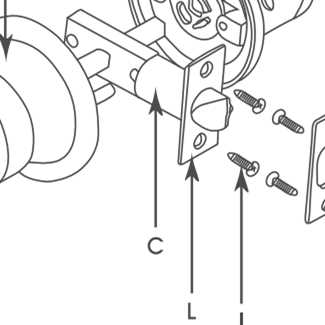
Align the spring-loaded latch so its beveled face meets the receiving lip at a 2–3 mm clearance, preventing scrape marks and rebound during closure.
Set the backset for the latch housing at 60 mm or 70 mm from the front edge of the entryway leaf, matching the cutout shown in the schematic to avoid binding under pressure.
Position the deadbolt cylinder with a straight throw of 25 mm (1 inch) into the frame cavity; anything shorter reduces resistance, while longer throws risk misalignment if the frame shifts.
Keep the vertical centerlines of latch tongue and deadbolt within ±1 mm of each other so both engage the steel receiver without torsion.
Mount the strike plate flush with the jamb surface and reinforce it with 75 mm screws driven into the stud, not just the trim, to handle repeated impacts.
Chamfer the receiver opening by 1–2 mm to guide the latch tongue smoothly while maintaining a snug fit that limits rattle.
Verify spacing by closing the entryway panel slowly; contact should occur first at the latch, followed by full deadbolt extension without resistance or metal-on-metal noise.
Reading a Door Lock Diagram to Match Parts During Repair or Replacement
Match each component by measuring first: confirm backset distance (60 mm or 70 mm), spindle thickness (7 mm or 8 mm), and faceplate shape before selecting replacements.
Use the schematic to trace motion from the handle to the latching tongue; this reveals whether the setup relies on a spring-driven latch, a deadbolt throw, or a combined assembly. A mismatched throw length causes binding against the frame opening.
Check handing by observing the latch bevel orientation in the illustration. If the bevel points toward the closing edge shown, the assembly suits that swing direction; reversing it without confirmation leads to poor closure.
Identify the cylinder format by cross-section: pin-tumbler profiles show stacked chambers, while wafer styles display flat plates. Match cam shape and tailpiece length exactly; minor variance prevents engagement.
Compare fastener spacing on the mounting plate using the scale marks in the chart. Common centers include 38 mm and 44 mm; drilling new holes weakens the entry panel.
Verify strike alignment through the illustrated centerline. The tongue should meet the jamb plate opening with 1–2 mm clearance; adjust by selecting a plate with the correct offset rather than bending hardware.
During replacement, mirror the order shown in the blueprint: housing, latch, spindle, handles, cylinder. Reversing the sequence increases wear and causes inconsistent return.
Finish by checking tolerances highlighted in the schematic notes. Acceptable play at the spindle is under 0.5 mm; exceeding this leads to rattle and premature failure.