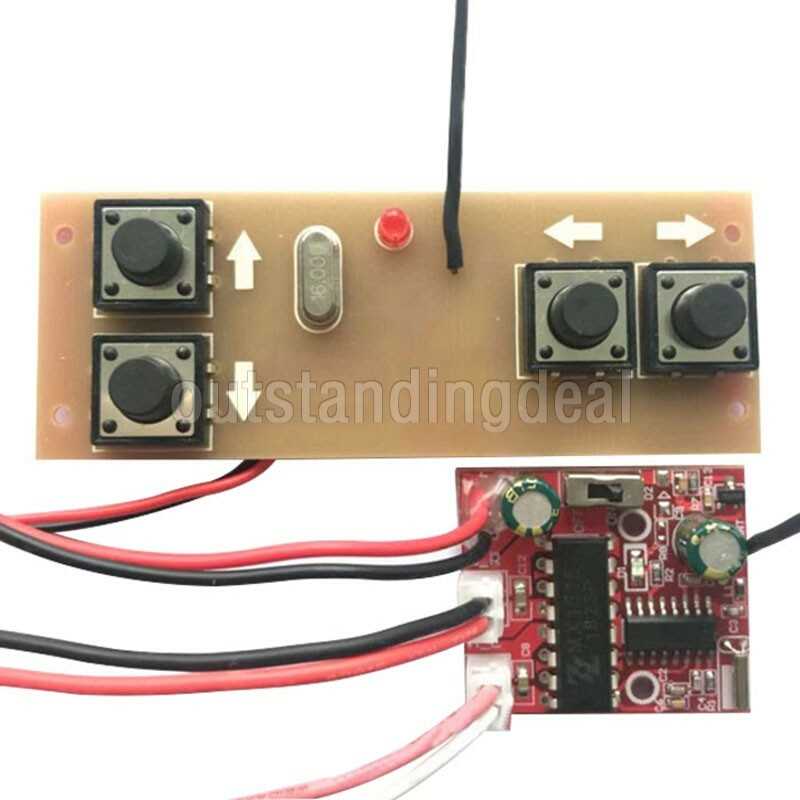
Use an RF control set built around an encoder IC such as HT12E paired with a matching decoding chip like HT12D. This combination allows four separate control lines to travel over a small radio link using a compact 315 MHz or 433 MHz module. Push buttons connect to the encoder inputs, while decoded outputs drive relays, motor drivers, or logic inputs on the remote side.
The control unit usually operates from 5 V to 12 V DC. Each input pin on the encoding chip links to a momentary switch. When pressed, the IC converts parallel logic states into a serial RF data stream sent through a small radio module. A short wire antenna, typically 17 cm for 433 MHz, increases range. With stable power filtering, control distance can reach 30–100 meters in open space.
On the remote board, the decoding chip monitors the incoming RF data stream. Once the address bits match the programmed pattern, four output pins switch high or low according to the pressed button. Each output can control a relay module, L298N motor driver, LED indicator, or logic gate. Pull-down resistors between 10 kΩ–47 kΩ help maintain stable logic levels while no signal is present.
Stable operation depends on proper grounding, short signal traces, decoupling capacitors near IC power pins (typically 100 nF ceramic), plus a regulated supply such as a 7805 voltage regulator. Without clean power, RF noise may trigger unwanted switching. With correct layout, the four-line radio control link becomes reliable for robotics, model vehicles, gate control units, or small automation projects.
4 Channel RC Transmitter and Receiver Circuit Diagram with Encoder Decoder and RF Link
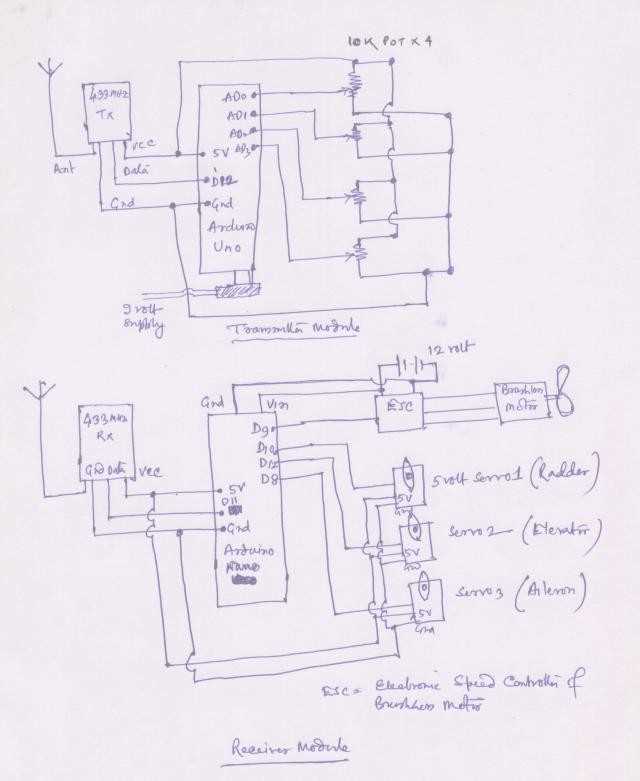
Use an HT12E encoder paired with an HT12D decoding IC plus a 433 MHz RF module for a four-line radio control link. The encoding chip converts button states into serial data sent through the RF stage. Each input pin connects to a push switch tied to ground, while internal pull-ups keep logic high during idle state. A stable 5 V supply regulated by a 7805 prevents false triggering. Place a 100 nF ceramic capacitor directly across the IC power pins.
Typical hardware layout includes several parts arranged in a clear signal path:
- Input switches linked to D0–D3 pins on the encoder IC
- Address resistor between OSC1 plus OSC2 pins (usually 1.1 MΩ)
- RF sending module connected to the data output pin
- Matching radio module on the remote board feeding the decoding IC
- Output pins from the decoding IC connected to relays, LEDs, or motor driver inputs
- Wire antenna about 17 cm for 433 MHz operation
Signal flow follows a simple sequence. A pressed button pulls one encoder input low, creating a digital code frame. That frame travels through the RF stage as modulated data. The decoding IC checks address bits before activating its output pins. Four separate control lines appear at D0–D3 outputs. Stable operation improves with short ground paths, a 10 µF electrolytic near the RF module, plus spacing between radio section traces and switching loads such as relay coils.
Component List and Pin Connections for 4 Channel RC Transmitter Using Encoder IC
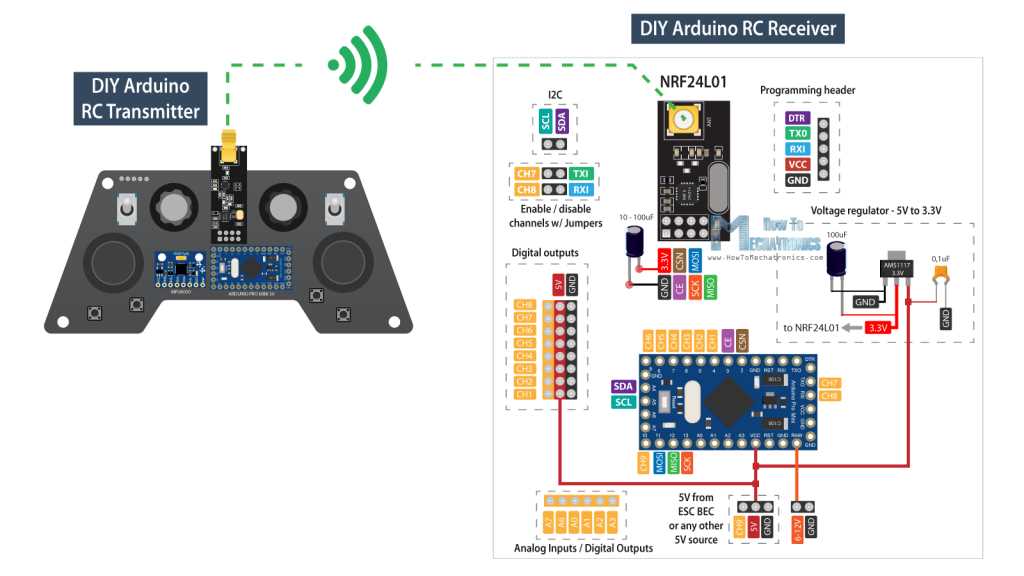
Use an HT12E encoder IC for four separate input lines. Each input pin (AD0–AD3) connects to a normally open push-button switch tied to ground. Internal pull-up resistors maintain high logic when buttons are not pressed. This ensures stable serial data output from the DOUT pin.
Power the encoder with a regulated 5 V DC supply. Place a 100 nF ceramic capacitor close to the VCC and GND pins to suppress voltage spikes. For longer runs, a 10 µF electrolytic near the supply input improves stability.
Connect pins OSC1 and OSC2 with a 1.1 MΩ resistor to set the internal clock frequency. This timing affects the data frame rate sent through the RF module. Incorrect values may cause signal corruption at the decoding end.
Address pins (A0–A7) allow setting a unique code for the transmitter. Tie unused pins to ground or VCC to prevent floating inputs. Matching the same address on the decoding IC ensures the remote board only responds to this unit.
The DOUT pin links directly to the data input of the 433 MHz RF module. A short wire antenna of approximately 17 cm improves range. Avoid running high-current traces close to the data line to minimize interference.
Include a small LED on the output line with a 330 Ω resistor for visual feedback of button presses. This helps verify operation without connecting the remote hardware. The LED should connect between DOUT and ground through the resistor.
For reliable performance, keep ground paths short and consistent. Place the encoder IC away from large switching components, such as motors or relays, to reduce noise pickup. Using this layout ensures stable transmission across all four input lines over 30–50 meters in open space.