Turn off power at the circuit breaker and confirm zero voltage with a tester before touching any conductor. Most household lighting circuits operate on 120 volts AC, where a hot conductor carries power from the breaker panel to the control device, while the neutral line returns current to the panel. Only the hot line should pass through the wall control unit.
A standard single control device has two brass terminals and one green ground screw. The incoming hot conductor attaches to the line terminal, while the outgoing conductor connected to the lamp attaches to the load terminal. The ground conductor connects to the green screw and then continues to the metal electrical box or grounding conductor in the cable.
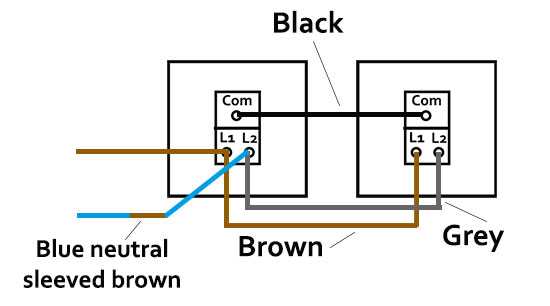
For installations that control one lamp from two locations, a pair of three-terminal control devices is used. Each unit contains one common terminal and two traveler terminals. The common terminal connects either to the incoming hot supply or to the conductor leading to the lamp. The traveler conductors link both control units together and redirect current depending on handle position.
Use cable sizes rated for the circuit breaker protecting the branch circuit. Residential lighting circuits commonly use 14 AWG copper with a 15 amp breaker or 12 AWG copper with a 20 amp breaker. Mixing conductor sizes or misplacing terminals may cause overheating, nuisance breaker trips, or a lamp that never turns off.
Light Switch Wiring Diagram With Line Load Terminals and Three Way Connection Layout
Disconnect the circuit breaker and verify zero voltage using a tester before opening the wall box. Household lighting circuits normally carry 120 volts AC, and the hot conductor must be the only line interrupted by the control device.
Identify the incoming hot conductor first. This line arrives from the breaker panel and connects to the line terminal on the control unit. The outgoing conductor that leads to the lamp attaches to the load terminal. Reversing these connections may still operate the lamp but complicates troubleshooting and future maintenance.
The neutral conductor should bypass the control device entirely and run directly to the lamp holder. In many installations the neutral lines are joined inside the box with a wire connector. The lamp receives constant neutral while the hot path opens or closes through the control handle.
Attach the grounding conductor to the green screw on the device frame. This conductor connects to the grounding system of the building and reduces shock risk if a metal housing becomes energized.
For circuits that control a lamp from two locations, install two three-terminal control units connected by traveler conductors. Each unit contains one common terminal and two traveler terminals. The common terminal of the first unit receives the incoming hot supply.
The common terminal of the second unit connects to the conductor feeding the lamp. Two traveler conductors run between both devices and redirect current depending on handle position. A cable containing three insulated conductors plus ground usually links these two boxes.
Use conductor sizes that match the branch circuit rating. Residential lighting commonly uses 14 AWG copper with a 15 amp breaker or 12 AWG copper with a 20 amp breaker. Smaller conductors may overheat if the circuit carries higher current.
After completing all connections, restore power and measure voltage between the hot terminal and neutral at the lamp holder. The meter should show about 120 volts when the control handle closes the circuit and zero volts when the path opens.
Single pole light switch wiring with line and load terminal identification
Turn off the breaker and confirm zero voltage with a tester before touching conductors. A single pole control device contains two brass terminals and one green ground screw. One brass terminal receives the incoming hot conductor from the electrical panel, while the second brass terminal sends power to the lamp fixture.
Identify the supply conductor first. This line usually enters the wall box through a cable from the panel and connects to the line terminal. The conductor leading to the lamp attaches to the load terminal. Neutral conductors remain joined together with a connector inside the box and do not attach to the control unit. Ground conductors connect to the green screw and the metal box when present.
Use 14 AWG copper for a 15 amp branch circuit or 12 AWG copper for a 20 amp branch circuit. After connections are tightened, restore power and measure voltage between the hot terminal and neutral at the fixture. The meter should show about 120 volts when the handle closes the circuit and zero volts when it opens.