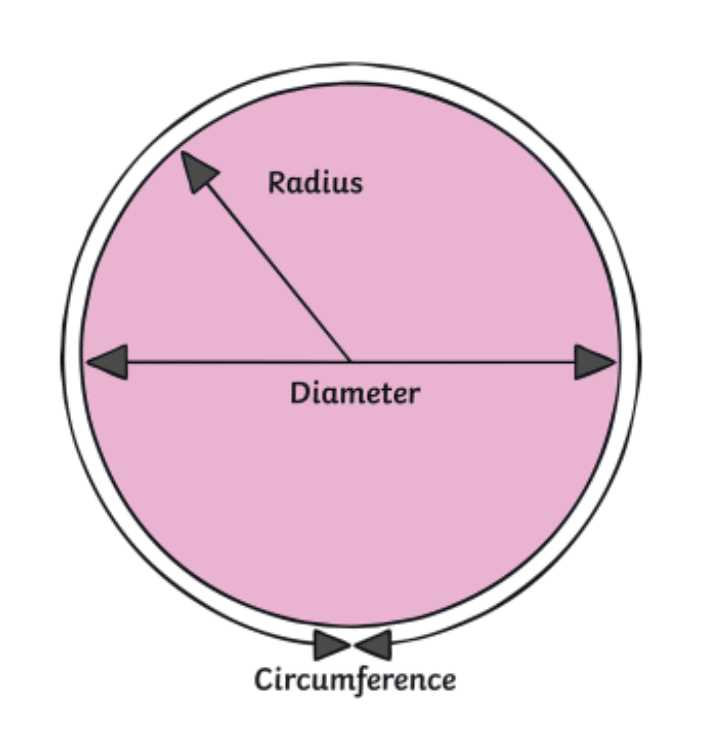
To understand the fundamental elements that make up a round figure, it’s important to familiarize yourself with the specific segments that define its structure. Key aspects such as the center, radius, diameter, and circumference all play unique roles in describing the figure’s properties. These segments help calculate various measurements and solve geometrical problems. Understanding how they are represented visually can make solving related problems much easier.
In any circular figure, the radius and diameter are foundational. The radius connects the center of the figure to any point along its boundary, while the diameter spans the entire width of the figure through its center. Additionally, the circumference represents the outer edge, which can be calculated using the diameter or radius, depending on the specific formula applied. Understanding these interrelations and how to use them in calculations is key to mastering circular geometry.
Having a visual guide that breaks down these parts can significantly aid in comprehension. By consulting accurate representations, it’s easier to pinpoint the precise measurements and their connections. This visual approach not only simplifies understanding but also helps in applying mathematical principles to real-world scenarios.
Understanding the Elements of a Circle
The key elements that define a circular shape include the center, radius, diameter, and circumference. Each of these components has a specific role and is crucial for various geometric calculations. The center is the exact middle point, and all other points on the boundary are equidistant from it. The radius, a line drawn from the center to any point on the edge, is essential for determining the figure’s size. The diameter, which is twice the length of the radius, spans the full width through the center. Finally, the circumference measures the outer boundary and is directly related to the diameter.
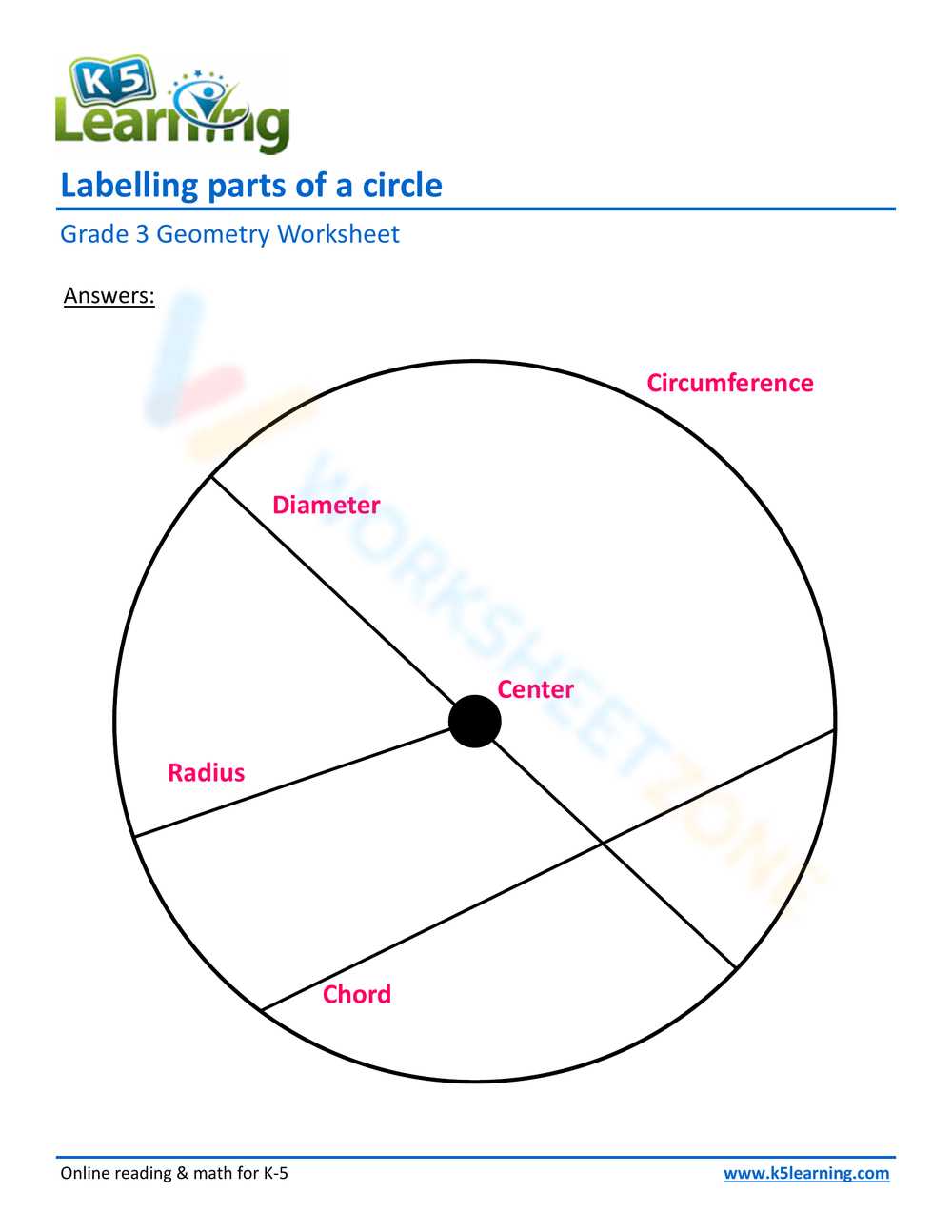
To grasp these concepts fully, using visual aids that clearly label each element will help. The lines representing the radius and diameter should be easy to identify, and the central point should always be highlighted to avoid confusion. A clear illustration showing how these elements interconnect allows for better understanding and application of the formulas used for calculations.
For practical use, knowing how to quickly identify these components in any given figure is key for solving problems. Whether you’re calculating the area, finding the perimeter, or solving for missing values, a clear diagram can provide the guidance needed to apply the correct formulas. By recognizing these elements and understanding their relationships, solving geometry problems becomes a more straightforward task.
Identifying the Key Components of a Circle in a Diagram
To correctly identify the key elements in a circular shape, focus on the following components:
- Center: The exact middle point from which all other parts are measured.
- Radius: A line drawn from the center to any point on the boundary. This length is crucial for size-related calculations.
- Diameter: The line that passes through the center and connects two points on the boundary. The diameter is always twice the length of the radius.
- Circumference: The outer boundary of the shape, representing the total distance around the figure. It’s related to the diameter through a mathematical constant.
- Chord: Any line that connects two points on the boundary but does not necessarily pass through the center.
- Arc: A segment of the circumference, typically defined by two points on the boundary.
- Sector: The area enclosed by two radii and the arc between them. It’s useful for calculating areas and angles.
Understanding these components helps with both basic and complex geometric operations. Properly labeling and identifying each part in a visual representation aids in calculations such as area and perimeter, as well as in solving trigonometric problems involving angles or sector areas.
How to Use a Circle Diagram for Geometrical Calculations
To find the area inside the boundary, use the formula A = πr², where r is the radius. Ensure the radius is measured correctly as this determines the total area.
For the perimeter, apply the formula C = 2πr. Accurate measurement of the radius is needed to calculate the full length around the figure.
To calculate the area of a sector, use the formula A = (θ/360) × πr², where θ is the central angle. This formula gives the area of the portion of the figure enclosed by the angle.
For the arc length, use the formula L = (θ/360) × 2πr. As with the area of the sector, the angle and radius are key to determining the correct length of the arc.
Double-check all measurements, especially the radius and angles, for accuracy. Small errors can lead to significant differences in the final results.
Understanding the Relationship Between Circle Parts and Formulas
The radius is the key factor for calculating the area and circumference of the figure. For area, use the formula A = πr², and for perimeter, apply C = 2πr, where r is the radius.
The central angle is integral when calculating the area of a sector or the length of an arc. The formula for sector area is A = (θ/360) × πr², and for the arc length, use L = (θ/360) × 2πr. Here, θ is the angle between the two radii.
The relationship between the radius, diameter, and circumference also plays a crucial role. The diameter is simply twice the radius, d = 2r, and the circumference formula can also be written as C = πd, where d is the diameter.
Understanding these relationships allows for accurate geometric calculations, whether you’re working with sectors, arcs, or the entire figure. Always ensure precise measurements to get reliable results.