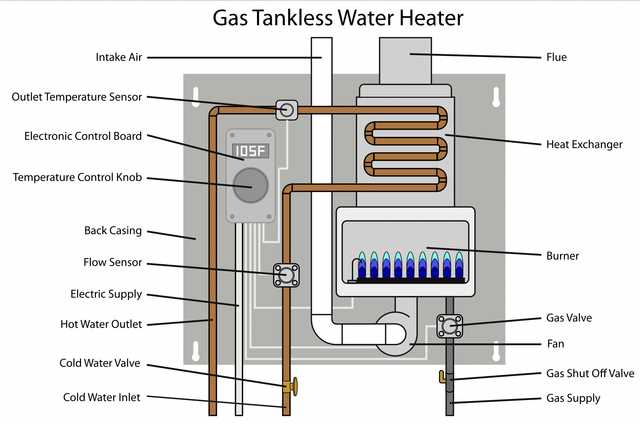
Use a labeled layout before any service task: it pinpoints each assembly, shows flow direction, and reduces trial-and-error. The burner tray sits beneath the combustion chamber, the pilot assembly aligns near the ignition port, and the flue baffle runs vertically to control exhaust velocity. Clear identification of the draft hood, safety valve, and thermostat probe prevents mismatched reconnections and unstable temperature control.
The fuel train deserves close attention. A shutoff cock feeds a control valve that meters supply to the main flame and pilot; upstream sediment traps catch debris that causes weak ignition. Downstream, the mixing tube balances air intake for a clean burn, while the heat exchanger walls transfer energy to the liquid stored in the tank. Marking sensor locations–thermocouple tip, limit switch, and pressure relief outlet–helps verify shutdown logic during testing.
For diagnostics, follow the layout from inlet to outlet. Trace the cold feed through the dip tube to the base, then up past the exchanger surfaces toward the hot outlet nipple. Note insulation gaps, anode rod placement for corrosion control, and access panels for inspection. This approach shortens downtime, supports accurate replacement choices, and keeps safety checks consistent.
Fuel-Fired Hot Fluid Tank Unit Schematic
Verify ignition and venting first: confirm the pilot assembly or electronic igniter sits clear of debris and aligns with the combustion port to prevent delayed lighting.
Combustion chamber houses the burner tray and flame spreader; steel thickness commonly ranges from 1.2–1.6 mm to resist warping under continuous heat.
Ignition module appears as either a standing pilot with thermocouple (20–30 mV output) or a spark system paired with a flame sensor rod calibrated near 3–5 µA.
Heat exchanger coil transfers thermal energy to the stored fluid; copper tubing often measures 3/4 in outer diameter, while glass-lined steel tanks use a welded flue baffle to boost transfer.
Draft hood and flue channel exhaust upward; recommended rise is at least 1/4 in per foot to sustain proper draw and limit backflow.
Control valve block regulates fuel flow and temperature; setpoints usually span 120–140 °F, with an internal pressure regulator tuned around 3.5 in WC for stable burn.
Relief valve protects the vessel; typical ratings are 150 psi and 210 °F, with a discharge line routed within 6 in of the floor.
Service tip: match each labeled element on the schematic to its physical location before maintenance, ensuring fast isolation of faults and accurate replacement selection.
Identifying the Burner, Fuel Control Valve, and Pilot Assembly on a Fuel-Fired Storage Unit Schematic
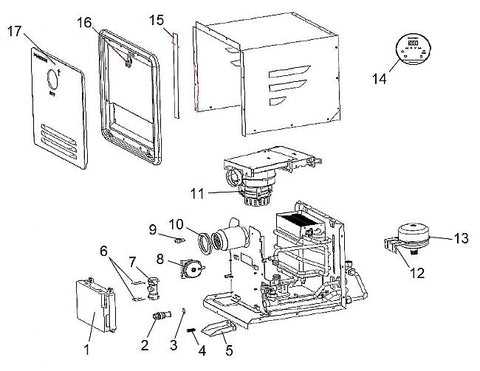
Locate the combustion head first: it sits directly beneath the storage tank base, aligned with the exhaust flue, and appears as a circular or rectangular element with multiple flame ports feeding upward.
Trace the fuel line from the supply inlet to the control block; the fuel control valve is mounted inline, typically featuring adjustment knobs, a safety cutoff, and a thermocouple connection port.
Confirm the ignition pilot by finding the narrow tube branching from the control block toward the combustion head; it ends in a small nozzle paired with a flame sensor positioned at the edge of the main flame zone.
Use connector geometry to differentiate assemblies: the combustion head links to the air intake and exhaust path, the control block anchors to rigid piping, and the pilot set relies on thin tubing and a sensor lead.
Check labeling conventions on the layout: abbreviations like “BT” for the combustion head, “FCV” for the control block, and “PIL” for the ignition pilot are common markers.
Verify orientation arrows and flow indicators to avoid misidentification; fuel direction always points toward the combustion head, while sensor wiring routes back to the control block.
Cross-reference mounting brackets: the combustion head uses heat-resistant supports, the control block bolts to the frame, and the pilot set clips near the flame edge for stable ignition.
Locating Heat Exchanger, Flue, and Safety Components Using a Parts Diagram
Use the manufacturer’s schematic layout to trace the combustion path before touching the unit: identify the thermal transfer core directly above the burner chamber, then follow the exhaust channel upward to the vent stack, and confirm all protective devices along this route.
The heat exchanger is shown as a finned or coiled block positioned between the flame source and the storage vessel. On the layout, it connects to the burner assembly below and the exhaust outlet above. Match the shape and mounting brackets on the page with the metal block inside the cabinet to avoid confusion with insulation panels.
The flue appears as a vertical duct leading from the top of the combustion zone to the draft hood or vent collar. On the schematic, arrows usually indicate airflow direction. Inside the casing, this channel stays centered and clear of wiring; any deviation suggests a misidentified component.
Safety elements cluster around ignition and exhaust areas. Look for labels tied to temperature limits, pressure relief, and flame monitoring. These symbols correspond to small inline devices mounted near the burner, along the exhaust path, or on the vessel wall. Cross-check connector types and wire colors shown on the layout with the physical unit.
Confirm placement by counting fasteners and ports shown on the page. The exchanger typically uses multiple mounting points, the vent path has a single continuous outlet, and protective switches rely on threaded or clipped fittings. This comparison reduces errors during inspection or replacement.