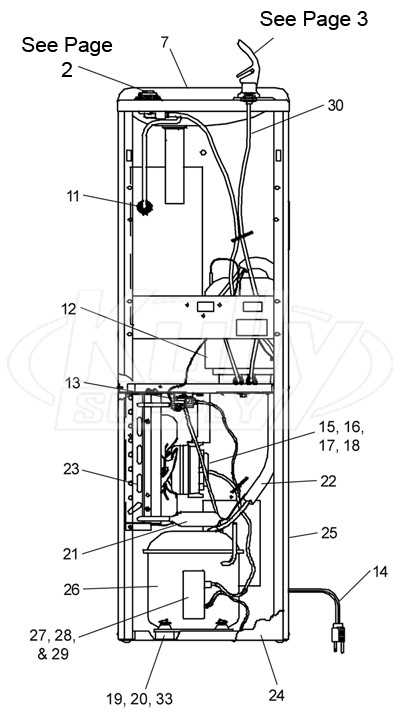
Use an exploded layout from the manufacturer’s service manual before replacing any module–it shows the exact order of seals, valves, and fasteners, preventing leaks and misalignment during reassembly. This approach reduces trial-and-error and cuts repair time by aligning each element with its mounting depth and torque point.
A clear schematic helps identify key modules such as the push actuator, flow regulator, bubbler head, drain trap, and supply inlet. Pay attention to thread types (NPT vs. compression), gasket materials (EPDM vs. neoprene), and orientation arrows on check valves; mismatches here commonly cause backflow and inconsistent stream height.
For maintenance, match the layout to the unit’s production year and finish. Stainless housings often pair with different fastener grades than powder-coated shells, while older revisions may use legacy springs or orifice sizes. Cross-referencing the schematic with serial ranges avoids ordering incompatible replacements.
During installation, follow the sequence shown in the layout: seat gaskets dry, align the regulator before tightening, and verify drain slope after securing the basin. This order maintains proper pressure balance and ensures hygienic drainage without pooling.
Drinking Unit Component Schematic

Use the manufacturer’s schematic to trace the flow path from inlet fitting to outlet nozzle, then label each component with torque values and service intervals; this prevents cross-threading and reduces leak points during maintenance.
Identify the inlet strainer, pressure regulator, and shutoff valve as the first service cluster. Clean the strainer every 6–12 months, set the regulator to 20–35 psi for a stable stream, and verify the shutoff seals without seepage.
Locate the actuator assembly that controls dispensing. Inspect the spring rate and cam wear, replace elastomer seals showing flat spots, and apply food-grade lubricant sparingly to pivot pins.
Map the outlet section: nozzle, guard, and splash shield. Adjust nozzle angle to 35–45° for a consistent arc, tighten the retaining collar to spec, and replace the anti-splash insert if erosion appears.
Find the cooling module and heat-exchange coil. Vacuum condenser fins quarterly, confirm fan clearance, and flush the coil with approved cleaner to restore chill recovery time.
Review the filtration cartridge position relative to the inlet. Track capacity in gallons, swap media at the rated threshold, and purge air from the line after installation to avoid sputter.
Document fastener sizes and materials directly on the schematic. Stainless hardware suits humid rooms; nylon spacers isolate vibration near the compressor mount.
Keep a revision note beside the schematic after any retrofit. Record date, component code, and torque used so future service follows the same reference without guesswork.
Identifying Individual Components and Their Functions in a Halsey Taylor Water Fountain Parts Diagram
Verify each element on the schematic against the installed drinking dispenser before any service work to prevent mismatched replacements.
The activation assembly includes a push pad, linkage rod, and return spring; pressing the pad transfers force through the rod, while the spring restores neutral position after release. Weak rebound signals spring fatigue and causes delayed shutoff.
The flow-control module consists of a valve body, diaphragm, and adjustment screw. The diaphragm flexes under line pressure to regulate output, and the screw fine-tunes volume. Uneven stream height usually indicates debris trapped beneath the diaphragm.
A cooling section may be present, featuring a heat exchanger coil, thermostat, and compressor relay. The thermostat cycles the relay to maintain target temperature; inaccurate cooling points to sensor drift or poor coil contact.
Delivery hardware includes a spout tube, bubbler insert, and diffuser screen. The insert shapes the arc, while the screen stabilizes spray. Distorted flow often results from mineral buildup within the insert.
Drainage hardware comprises a basin outlet, trap, and vent path. The trap blocks sewer gases, and the vent equalizes pressure for smooth runoff. Slow emptying suggests a partially obstructed vent path.
Electrical support elements cover the power cord, ground lead, and internal switch. The ground lead protects users from fault conditions; continuity loss here demands immediate correction.
Mounting hardware features brackets, anchors, and isolation pads. Isolation pads reduce vibration transfer from the compressor to the cabinet, lowering noise levels during operation.
Using a Manufacturer Schematic to Diagnose Faults and Choose Correct Replacement Components
Match the symptom to the exact assembly shown in the exploded view, then confirm dimensions and materials before ordering replacements.
Trace the flow path on the schematic to isolate leaks: seepage at the spout usually maps to the outlet seal stack, while constant flow points to the control cartridge or inlet valve seat. Cross-check callout numbers to ensure the gasket profile and thickness align with the illustrated stack order.
Use the labeling to verify thread standards and sizes. Many housings use NPT at the supply side and straight threads at the actuator; mixing them leads to cross-threading. Confirm male/female orientation and pitch with the callout table rather than measuring by eye.
Select seals by compound and hardness noted in the reference sheet. EPDM handles chlorinated supply lines better than nitrile, and a 70A durometer compresses correctly under the depicted clamp force. Swap only the seal shown at the failure point instead of rebuilding the entire assembly.
Confirm regulator ratings shown near the inlet section. Choose a flow limiter that matches the specified GPM at the listed PSI to avoid splash-back or weak stream. If the drawing lists multiple options by region, pick the one aligned with local code.
Check revision markers on the schematic footer. Mid-cycle updates often change stem length or spring rate; ordering by revision avoids fit issues. If the unit predates the update, use the backward-compatible callout noted in the margin.
Follow the assembly order arrows during reinstallation. Torque values and washer orientation shown beside fasteners prevent cracked housings and uneven compression. Shutoff location icons indicate where to isolate supply before disassembly, reducing mess and downtime.