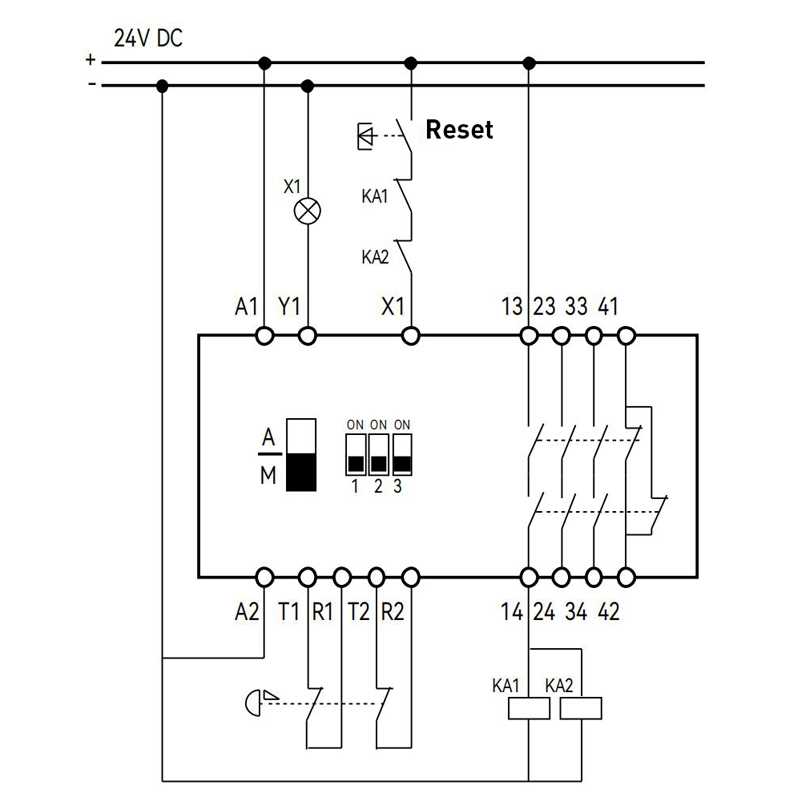
Use a clear terminal layout with marked coil contacts and load terminals; this approach prevents polarity mistakes and protects control circuits. A typical electromagnetic switching unit contains two main sections: control coil terminals and power contact pairs. The coil usually operates at a defined control voltage such as 5 V, 12 V, or 24 V DC, while contact groups handle higher current paths connected to lamps, motors, or heating elements.
Place the control voltage across the coil pins and route the load line through the normally-open contact pair. Once voltage reaches the coil, an internal magnetic field pulls the armature and closes the contact set. Current then flows through the load circuit. Normally-closed contacts operate in reverse: the path stays active until the coil becomes energized.
Accurate terminal identification avoids damage. Coil pins often appear on opposite sides of the component body, while switching contacts sit in a separate row labeled COM, NO, and NC. The COM terminal receives the incoming supply line; NO connects the device that should activate after coil energizing; NC connects equipment that must remain powered until activation occurs.
Install a protection diode across the coil when DC control voltage is used. The diode suppresses inductive voltage spikes generated during magnetic field collapse. Without this component, transistors, microcontroller outputs, or driver modules may experience voltage peaks exceeding safe limits.
During installation maintain separation between low-voltage control paths and high-current switching lines. Use conductors sized according to load current ratings; typical miniature switching modules support 5–10 A at 250 V AC. Solid terminal tightening and insulation sleeves reduce overheating and accidental short circuits.
Connection Layout of an Electromagnetic Switching Module
Connect the control coil directly to the rated supply shown on the device case–commonly 12 V DC, 24 V DC, or 230 V AC. Attach one lead of the coil to the control source and route the second lead through a control element such as a push button or transistor output. Place a flyback diode across DC coils: cathode on the positive side, anode on the negative terminal. This small component suppresses voltage spikes that appear when the magnetic field collapses.
Main contacts handle the load path. Use the COM terminal as the incoming line, then select NO (normally open) when power must pass only after coil activation, or NC (normally closed) when current must flow during idle state. Example: a 24 V coil unit switching a 10 A lamp circuit–phase conductor enters COM, exits through NO toward the lamp, while neutral runs directly to the lamp socket. Contact rating printed on the housing (e.g., 10 A 250 V AC) must exceed load demand.
Maintain conductor sizing consistent with current draw. A control coil typically consumes 30–200 mA in DC variants, allowing thin conductors such as 0.5 mm² copper. Load contacts demand thicker paths; a 10 A branch commonly uses 1.5 mm² copper. Keep coil lines separate from high-current traces to limit electromagnetic interference and heating near terminals.
Verify terminal numbering before energizing the assembly. Industrial modules often mark coil pins as A1 and A2, while contact groups appear as 11–12–14 or COM–NC–NO. A quick continuity test using a multimeter confirms switching behavior: idle state shows continuity between COM and NC; energized state shifts continuity toward COM and NO. This check prevents incorrect load routing and contact damage.
Connect Coil Terminals to Power Source and Control Switch
Connect one coil terminal directly to the positive line of the power supply that matches the rated coil voltage printed on the component body, commonly 5 V, 12 V, or 24 V. The second coil terminal should route through a control switch before reaching the negative supply line. This layout allows the switch to complete or break the circuit that energizes the electromagnetic actuator. Maintain correct polarity when the module contains an internal suppression diode; the terminal marked “+” must receive the positive supply.
Typical connection sequence:
- Positive supply → coil terminal A
- Coil terminal B → control switch input
- Control switch output → negative supply (ground)
The control element can be mechanical or electronic. A small toggle, push-button, or transistor stage performs the same task: closing the circuit so current flows through the coil. Mechanical switches are suitable when current remains below the switch rating, usually 100–300 mA in small modules. Semiconductor control becomes preferable when a microcontroller or logic circuit triggers the device.
Recommended electrical limits help prevent overheating:
- 5 V coil: ~70–100 mA current
- 12 V coil: ~30–50 mA current
- 24 V coil: ~15–25 mA current
- Minimum wire cross-section: 0.22 mm² (AWG 24) in control circuits
Place a flyback diode across the coil terminals when the circuit includes semiconductors. The diode cathode connects to the positive side, while the anode attaches to the side returning toward ground. This small component absorbs the high-voltage spike generated when the magnetic field collapses after the switch opens.
Switch placement affects system behavior. A switch positioned between the coil and ground forms a “low-side control.” Positioning the switch between the supply and the coil forms a “high-side control.” Both operate correctly, yet low-side control appears more often in transistor circuits because NPN transistors or N-channel MOSFETs handle ground-side switching with simpler biasing.
Verify operation with a multimeter after assembly. Measure supply voltage across the coil while the switch is closed; the reading should remain within ±10 % of the rated value. If voltage drops significantly, inspect contact resistance, loose terminals, or undersized conductors. Stable voltage ensures reliable magnetic activation and long component life.