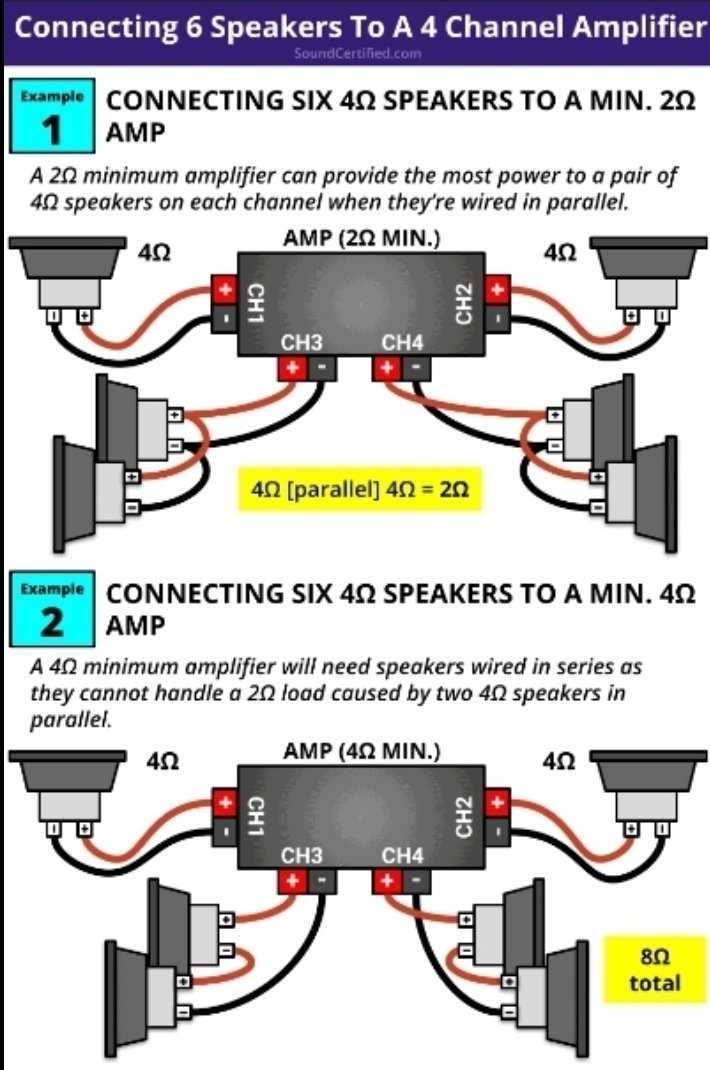
Connect six audio drivers to an amplifier only after calculating total impedance. Most home and car amplifiers operate safely between 4 and 8 ohms. Incorrect connection of multiple sound units can drop resistance too low, forcing the amplifier to overheat or shut down. Combine pairs in series and then join those pairs in parallel to maintain a safe load.
A practical layout uses three pairs of sound drivers. Join two units in series by linking the positive terminal of the first to the negative terminal of the second. Each pair then behaves like a single higher-impedance load. After forming three pairs, connect their remaining terminals in parallel at the amplifier outputs. This arrangement balances load distribution and prevents excessive current draw.
Use cable with a cross-section of 1.5–2.5 mm² for runs longer than three meters. Thin conductors increase resistance and reduce audio power delivered to each unit. Maintain consistent polarity across all drivers so that cones move in the same direction. Reversed polarity between units causes phase cancellation, which reduces bass response and overall sound pressure.
6 Speaker Wiring Diagram for Amplifier With Series and Parallel Connection Methods
Combine the six audio drivers into three pairs connected in series, then join those pairs in parallel at the amplifier output. This arrangement keeps total impedance within a safe range for most amplifiers rated at 4–8 ohms. Each pair behaves as a single load with doubled resistance, which prevents excessive current draw.
Connect the positive terminal of the first sound unit to the amplifier positive output. Link its negative terminal to the positive terminal of the second unit. The remaining negative terminal becomes the pair output. Repeat this process three times to create three identical series pairs. After that, join all pair positives together and all pair negatives together at the amplifier terminals. Three series pairs of 8-ohm drivers typically produce a load close to 5.3 ohms, which remains safe for many home and car amplifiers.
Maintain identical polarity across every audio driver. All positive terminals must face the same signal direction so the cones move together. If one unit is reversed, low-frequency output weakens due to phase cancellation and uneven acoustic pressure.
How to Connect Six Speakers to One Amplifier Using Series and Parallel Layouts
Create three pairs of audio drivers linked in series, then combine those pairs in parallel at the amplifier outputs. This layout keeps load resistance within the safe operating range of most amplifiers rated between 4 and 8 ohms. Directly attaching six units in parallel may drop resistance close to 1.3 ohms when each driver is 8 ohms, which can damage the amplifier.
Forming Series Pairs
Build three identical pairs before connecting them to the amplifier. Each pair doubles the impedance of the individual driver.
- Connect the positive terminal of the first sound driver to the amplifier positive line.
- Attach the negative terminal of that driver to the positive terminal of the second unit.
- The remaining negative terminal becomes the output of the pair.
- Repeat the process until three identical pairs exist.
Each pair of 8-ohm drivers now behaves as a 16-ohm load. Three of these pairs connected in parallel produce a combined resistance close to 5.3 ohms, a value acceptable for many home or car amplifiers.
Parallel Connection of the Pairs
After forming the pairs, combine them at the amplifier terminals.
- Join the positive leads from all three pairs together.
- Connect that combined point to the amplifier positive output.
- Join all negative leads from the pairs.
- Attach the combined negative line to the amplifier ground output.
Use audio cable with a cross section between 1.5 mm² and 2.5 mm² when distance exceeds three meters. Thick conductors reduce power loss and prevent heat buildup along the line.
Verify polarity before powering the system. All positive terminals must face the same signal direction. A reversed connection causes phase cancellation, reducing bass output and overall sound pressure.