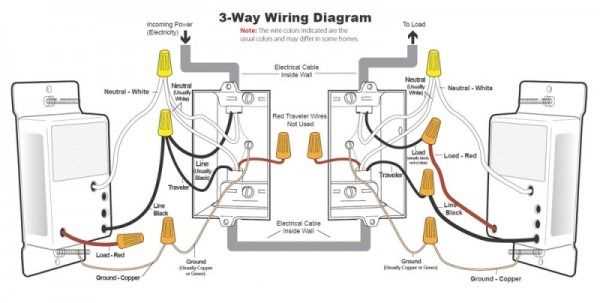
Turn off power at the breaker panel and confirm with a voltage tester before touching any conductors. Lighting control with brightness adjustment installed between two switch points requires accurate identification of the line conductor, load conductor, and traveler pair. Misplacing any of these leads often causes lights that flicker, stay permanently on, or fail to respond from one control location.
Most adjustable lighting controllers designed for multi-location circuits include one common terminal, two traveler terminals, and a grounding lead. The common terminal usually connects to the incoming hot feed or the cable running toward the lamp fixture, depending on the existing switch box layout. Traveler terminals carry the signal between the two control points through a pair of insulated conductors that alternate the current path.
Residential installations typically use 14/3 or 12/3 cable containing a black, red, white, and bare copper conductor. The black wire frequently carries the hot feed, the red and black pair often function as travelers, and the white wire serves as neutral for the fixture. Inside the wall box, these conductors must match the terminal labeling on the lighting controller to maintain correct operation from both switch positions.
Accurate conductor mapping before installation saves time and prevents repeated removal of the wall plate. Label each cable with tape, check continuity between switch boxes if the circuit layout is unclear, and inspect the grounding connection to the metal box or grounding bundle. Careful preparation ensures stable brightness control and smooth switching from either location in the room.
Lutron 3 Way Dimmer Wiring Diagram With Switch Connections and Traveler Wire Layout
Connect the incoming hot conductor to the common terminal on the brightness controller and attach the two traveler leads to the brass-colored terminals. The second switch in the circuit receives the same traveler pair, allowing current to move through alternate paths depending on switch position. The cable heading toward the lamp fixture must attach to the load terminal on the light control device.
Inside a typical residential wall box, the cable set often contains black, red, white, and bare copper conductors. The black wire usually carries the line feed from the breaker panel, while the red and another insulated conductor operate as travelers linking the two control points. The white conductor normally continues directly to the lamp as neutral and does not connect to the brightness regulator unless the device specifically requires a neutral terminal. Ground conductors must join the green screw on each control and the metal box when present.
If lights operate from only one switch location, inspect the traveler pair for reversed placement or loose terminal screws. Tight connections and clear conductor identification restore normal switching from both ends of the circuit.
Terminal Identification on Lutron 3 Way Dimmer and Function of Each Wire
Locate the common terminal on the light level controller before attaching any conductor. This terminal is usually marked with a darker screw or labeled “COM” and connects to the incoming hot feed or the conductor leading toward the fixture. Incorrect placement here prevents the circuit from switching properly between both control points.
Most brightness control units used in multi-location lighting circuits contain several clearly marked terminals. Each one serves a specific purpose:
- Common terminal – connects to the power feed from the breaker panel or to the conductor going to the lamp depending on the box layout.
- Traveler terminal 1 – carries switching current between the two control points through one conductor in the cable.
- Traveler terminal 2 – provides the alternate current path used when the switch position changes.
- Ground terminal – green screw connected to the bare copper or green insulated grounding conductor.
Conductor roles inside the cable typically follow this structure:
- Black conductor – often the incoming hot feed or load lead.
- Red conductor – commonly used as one of the travelers.
- White conductor – neutral running directly to the light fixture.
- Bare copper or green wire – grounding path connected to the device and metal box.
Verify each conductor with a voltage tester before connecting it to the control unit terminals.