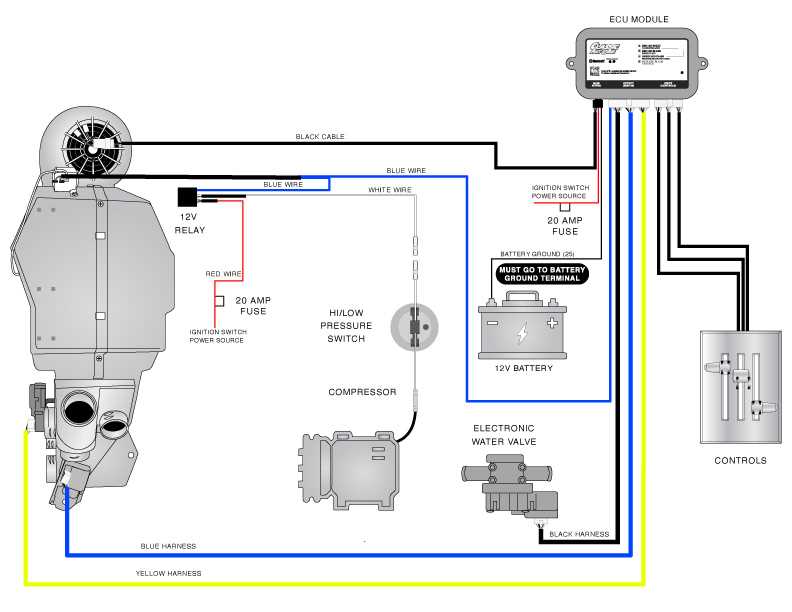
Ensure the relay and fuse locations are correctly identified before attempting any adjustments. A misrouted connector can lead to immediate system failure or trigger the thermal cutoff, causing unnecessary downtime.
Verify the voltage at the control terminals using a multimeter while the ignition is on and the climate control system is active. This confirms that the coil receives adequate current for engagement without overloading the circuitry.
Trace the signal path from the cabin switch to the rotary clutch unit and inspect for corroded terminals or brittle insulation. Damaged insulation can create intermittent operation and may eventually short to the chassis, resulting in blown fuses or erratic behavior.
Check the grounding points at the firewall and frame attachment for continuity. Weak grounding frequently causes delayed clutch response and reduces the efficiency of the cooling mechanism.
Label each connection during disassembly to prevent misalignment when reconnecting. Accurate reassembly ensures consistent engagement cycles and avoids the need for repeated troubleshooting.
AC Drive Connection Layout
Check the relay feed before attaching the control module; ensure the 12V supply is consistent and the grounding point is free from corrosion to avoid intermittent operation.
The coil activation line should pass through a fuse rated between 10A and 15A. Use ring terminals to secure connections and prevent voltage drops under load.
- Main power lead: typically red, connects directly to the battery positive terminal.
- Signal wire: often green or yellow, runs from the climate control unit to the relay input.
- Neutral line: black, must attach to a bare metal chassis point for stable return current.
In systems with dual-speed fans, the control harness may include a secondary output for speed modulation. Confirm pin numbers on the connector before insertion to prevent short circuits.
- Disconnect battery negative before starting work.
- Trace each line with a multimeter to verify continuity.
- Attach terminals securely and insulate exposed ends with heat shrink.
- Reconnect battery and test engagement via the climate control interface.
High-side protection can include a fusible link near the source; check amperage rating against the motor’s draw. Overrating can cause overheating, underrating may trigger false trips.
Label each terminal after connection for future troubleshooting. Color-coded sleeves simplify identification and reduce the risk of swapping lines during maintenance.
Identifying AC Compressor Terminals and Connector Pins
Locate the relay-controlled terminal first, usually marked with a single thick wire leading from the fuse box. This pin directly engages the clutch coil and is often color-coded yellow or red for high current paths.
Next, identify the ground connection. It is typically a smaller gauge wire attached to the body of the unit, frequently black or brown. Testing continuity to the chassis confirms proper grounding before any voltage tests.
The sensor pin, if present, monitors rotational speed or internal temperature. It is generally a two-wire connector, often white and blue. Use a multimeter in resistance mode to verify signal integrity; values under 500 ohms are common.
Control pins for the magnetic coil may appear in multi-pin plugs, usually 2 to 4 pins. Each has a specific function: one for voltage input, one for signal return, sometimes an auxiliary input for diagnostics. Labels may be embossed or printed on the plastic housing.
Inspect the connector for locking tabs or clips; many terminals cannot be removed without releasing the tab. Gently pry using a thin pick to avoid bending the pins or cracking the plastic shell.
After pin identification, trace wires back to their power source to verify circuit integrity. Look for frayed insulation or corrosion around connectors, as these can cause intermittent clutch engagement or false readings from sensors.
Mark each pin with tape or permanent ink before disconnecting for testing or replacement. This prevents misconnection during reassembly and ensures the actuator coil receives the correct voltage and grounding path.