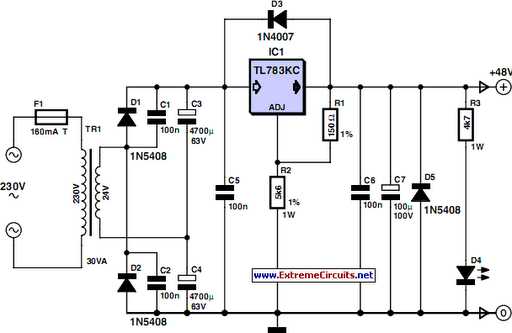
Feed condenser microphones through a balanced XLR input using a 48-volt DC bias line applied equally to signal conductors 2 and 3 through matched resistors. This method allows studio microphones with internal electronics to receive operating voltage without separate cables. Each line normally passes through 6.81 kΩ resistors that limit current and maintain balance in the audio path.
The voltage source usually comes from a small regulated stage inside a mixer, audio interface, or microphone preamp. Many designs generate the required level using a step-up converter or transformer-based stage that raises a lower rail to approximately 48 volts. After rectification and filtering with electrolytic capacitors around 47–100 µF rated above 63 V, the DC line becomes stable enough for microphone electronics.
Balanced audio remains isolated from the DC feed through coupling capacitors placed before the preamp input stage. These capacitors block the bias voltage while allowing the AC audio signal to pass to the amplifier. Typical values range from 10 µF to 47 µF depending on the input impedance of the preamp.
Check voltage across XLR contacts 2 and 1 as well as 3 and 1 using a multimeter before connecting a microphone. A properly operating system shows roughly 44–48 volts on both signal lines relative to ground, while the difference between pins 2 and 3 remains close to zero. Balanced distribution prevents hum and protects dynamic microphones connected to the same input.
48V Phantom Power Supply Circuit Diagram With XLR Connections and Component Values
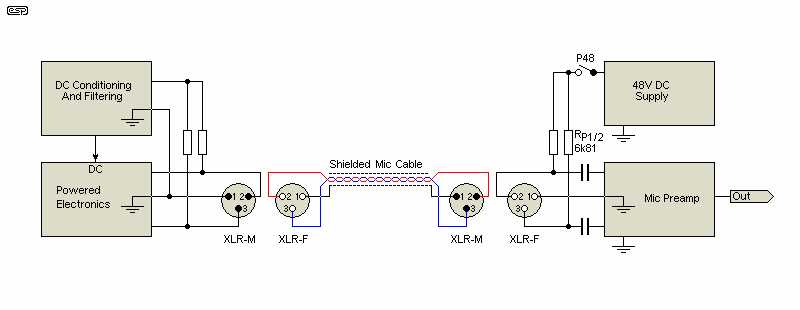
Apply the DC bias through two identical resistors connected to XLR contacts 2 and 3 while the shield on contact 1 remains ground. Standard microphone interfaces use 6.81 kΩ resistors on both signal lines so current flows evenly. Balanced distribution keeps the audio path stable and prevents noise caused by uneven voltage between the signal conductors.
The DC source inside many audio interfaces originates from a step-up stage that raises a lower rail to roughly 44–48 volts. This stage may use a switching converter or a transformer with rectifier diodes. After conversion, electrolytic capacitors smooth the output ripple before it reaches the XLR connector.
XLR Contact Functions
The three-contact connector used for studio microphones follows a simple structure. Contact 1 connects to shield and chassis ground. Contacts 2 and 3 carry the balanced audio signal and the bias voltage through matched resistors. A condenser microphone receives operating voltage internally while the audio signal travels back through the same conductors.
Filtering capacitors placed near the DC source typically range from 47 µF to 220 µF with voltage ratings above 63 volts. These components stabilize the rail and reduce ripple produced by the step-up converter. Smaller ceramic capacitors around 100 nF often appear in parallel to suppress high-frequency noise.
Typical Component Values
Common resistor pairs measure 6.81 kΩ each, providing balanced current delivery to both signal conductors. Some designs include additional resistors between the DC source and the main pair, often around 1 kΩ to 2.2 kΩ, which limit surge current during microphone connection.
Audio coupling capacitors between the XLR connector and the preamp input usually measure 10 µF to 47 µF. These parts block the DC bias from reaching the amplifier input stage while passing the microphone signal with minimal low-frequency loss.
Measure voltage between contacts 2 and 1 as well as 3 and 1 using a multimeter. Readings should appear near the nominal value while the difference between contacts 2 and 3 remains very small. Large imbalance indicates mismatched resistors or a damaged converter stage.
Keep conductor paths short and route the DC filtering components close to the converter stage. Long traces or poorly grounded shields may introduce hum into the microphone channel, especially in high-gain preamplifier designs used in recording equipment.
How 48V Phantom Power Is Distributed Through XLR Pins in Microphone Circuits
Feed the DC bias equally to XLR contacts 2 and 3 through identical resistors so the balanced audio path remains stable. Both signal conductors receive the same voltage relative to ground on contact 1, which prevents current from flowing through the microphone signal path. The distribution normally follows this structure:
- Contact 1 – shield and chassis ground
- Contact 2 – balanced audio positive plus DC bias through a 6.81 kΩ resistor
- Contact 3 – balanced audio negative plus DC bias through another 6.81 kΩ resistor
Verify correct voltage distribution with a multimeter by measuring each signal conductor relative to ground. Typical readings appear near the nominal bias level while the difference between contacts 2 and 3 remains close to zero. If measurements differ, inspect the resistor pair and connector solder joints. Correct distribution keeps condenser microphone electronics operating properly while allowing the audio signal to travel back through the same balanced conductors without interference.