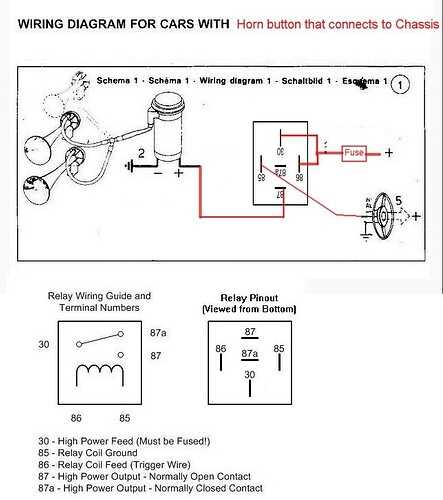
Use a relay with a dedicated fuse if installing an automotive sound signal unit connected to a 12 V battery. Direct connection through the steering wheel button forces the control contact to carry high load, often 4–8 A depending on the device type. A relay shifts that load away from the steering column contact assembly and increases reliability.
The power path normally begins at the battery positive terminal and passes through a fuse rated between 10 A and 15 A. From the fuse the conductor reaches relay terminal 30. Terminal 87 connects to the sound unit positive terminal. The negative terminal of the sound device attaches directly to the vehicle chassis, which acts as the ground return path.
The relay coil uses a low current control path. Terminal 85 usually connects to chassis ground, while terminal 86 receives voltage from the steering wheel push contact. Pressing the steering pad closes the control contact and energizes the relay coil, which then connects terminal 30 to terminal 87.
Correct conductor size prevents voltage drop. Copper conductors between battery, relay, and sound unit typically use 1.5 mm² to 2.5 mm² cross section in passenger vehicles. Smaller conductors may overheat or reduce output sound level due to resistance along the supply path.
Vehicle Sound Signal Electrical Layout with Relay Fuse and Steering Wheel Button Connection
Install a four-pin relay between the battery and the sound unit if the control button is located in the steering wheel. This arrangement prevents high load from passing through the steering column contact ring. A typical sound unit draws between 4 A and 8 A, which can quickly damage a small steering contact without relay isolation.
The supply path begins at the battery positive terminal and passes through a 10–15 A fuse. From the fuse the conductor connects to relay terminal 30. Terminal 87 feeds the positive terminal of the sound device. The negative terminal connects directly to the vehicle chassis, completing the electrical return path through the body ground.
Relay Control Path
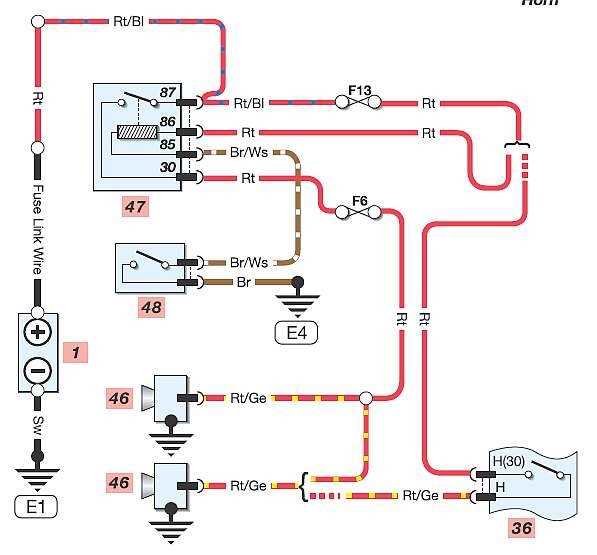
The coil side of the relay requires only a small control load. Terminal 85 normally connects to ground. Terminal 86 runs to the steering wheel push contact. Pressing the center pad closes the contact and sends voltage to the coil, pulling the relay armature and linking terminal 30 with terminal 87.
Recommended Conductor Sizes
Use copper conductors with cross-section between 1.5 mm² and 2.5 mm² along the battery to relay and relay to sound device path. Control conductors running from the steering wheel contact to the relay coil may use 0.5 mm² to 0.75 mm² because the coil typically draws less than 200 mA.
Mount the relay close to the sound unit or near the fuse block. Short power conductors reduce voltage drop and help the acoustic device reach its rated sound output level, typically between 105 dB and 118 dB in passenger vehicles.
Vehicle Sound Signal Connection Layout Using Relay Battery Fuse and Steering Wheel Button
Place a relay between the battery and the sound device if the steering wheel button acts as the control trigger. This arrangement keeps heavy electrical load away from the steering column contact assembly. Most vehicle sound units draw between 4 A and 8 A, which exceeds the safe load for small steering contacts.
Main Power Path
- Battery positive terminal connects to an inline fuse
- Fuse output connects to relay terminal 30
- Relay terminal 87 connects to the positive terminal of the sound device
- Negative terminal of the sound device attaches to vehicle chassis
This path carries the primary electrical load. A fuse rated between 10 A and 15 A protects the conductor and the relay contact from overload. The ground return flows through the vehicle body metal structure.
Control Path Through Steering Button
- Relay terminal 85 connects to chassis ground
- Relay terminal 86 connects to the steering wheel push contact
- The other side of the push contact receives battery voltage
- Pressing the steering pad energizes the relay coil
The coil typically draws less than 200 mA, which allows the steering contact assembly to operate without overheating.
Use copper conductors sized 1.5 mm² to 2.5 mm² between battery, relay, and sound device. Control conductors feeding the relay coil may use 0.5 mm² to 0.75 mm². Mount the relay near the sound unit or fuse block to reduce conductor length and voltage drop.