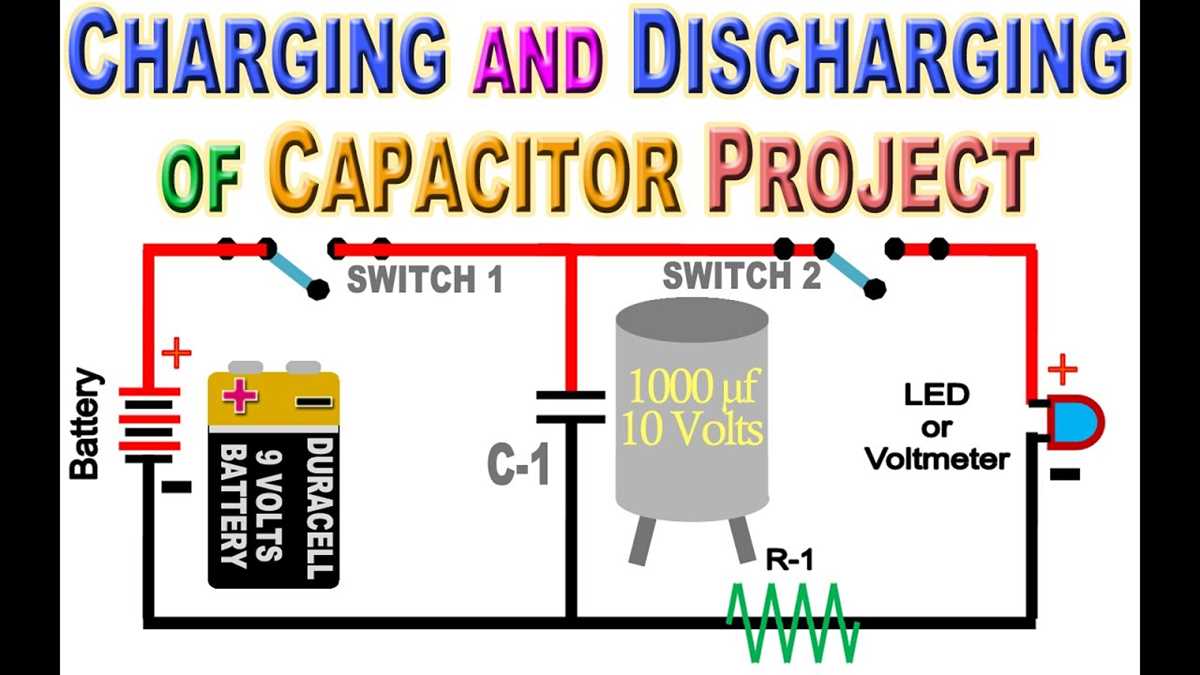
To understand the voltage and current behavior in a system, start by analyzing the time dependence of these quantities. The energy storage element in these setups follows a predictable pattern governed by exponential functions. The key factor affecting this behavior is the resistance in the loop, which directly influences how quickly the energy is transferred.
Begin by plotting the voltage curve over time for a fully charged element. The graph will reveal a smooth increase or decrease, depending on whether energy is being accumulated or released. The time constant, defined as the product of resistance and capacitance, plays a critical role in determining the rate of change.
For accurate analysis, use the voltage equation to calculate the value at any moment. This allows you to predict the state of the system at various time intervals, whether the system is in the process of being energized or losing stored energy.
Charging and Discharging of Capacitor Circuit Diagram
To draw a proper representation, focus on the relationship between resistance, voltage, and time. The process begins when a power source is connected to the energy storage component. As the component fills, the voltage rises, following an exponential growth pattern. The amount of time it takes to reach a significant percentage of the final voltage is determined by the time constant.
The key equation to use here is the exponential formula for voltage over time:
V(t) = V_max * (1 – e^(-t/RC)) for the energy accumulation phase. For the energy release phase, the formula changes slightly, with the voltage decreasing exponentially: V(t) = V_max * e^(-t/RC). These two equations should be used to predict the system’s behavior at any point.
In practical terms, understanding how long it takes to reach a given voltage is vital. For instance, if you need the system to be 90% charged, this will occur within 2.3 times the time constant. The closer you get to infinite time, the voltage will approach its maximum value, but for practical purposes, the system is considered “fully” filled long before that point.
- Time constant: It is the product of resistance (R) and the energy storage element’s value (C). The larger the constant, the slower the process.
- Initial voltage: At time zero, the voltage across the element is zero, and it increases as the system becomes energized.
- Decay behavior: Upon disconnecting the power source, the energy release follows a similar exponential pattern, except now the voltage decreases.
Understanding the Time Constant in Capacitor Circuits
The time constant, symbolized as τ, defines the rate at which the energy storage element reaches its maximum voltage. It is calculated by multiplying resistance R by the storage component’s value C, where τ = R × C. This value determines how fast or slow the voltage builds up during the energy accumulation phase. A larger time constant means the process will take longer, whereas a smaller time constant results in a quicker rise or drop in voltage.
For practical purposes, the time constant allows for quick approximations. For instance, after one time constant, the voltage reaches approximately 63% of its maximum value. After five time constants, it is nearly fully charged or discharged, reaching over 99%. By understanding this, you can estimate how long it will take for the system to reach a particular voltage without needing to compute each moment in the process.