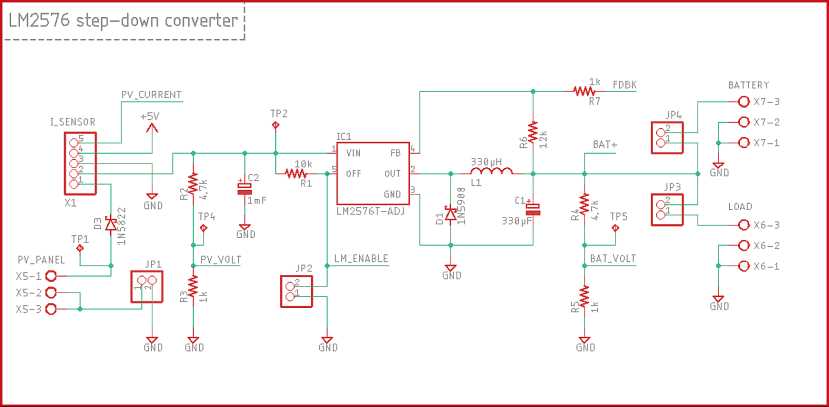
Use a step-down switching controller paired with a current-sensing stage to capture the highest possible output from a photovoltaic panel. A practical configuration includes a DC-DC buck converter, input voltage sensing, panel current measurement, and a microcontroller running a tracking algorithm. The switching transistor, fast recovery diode, and inductor form the power stage, while a resistor divider feeds panel voltage data to the control unit. Keep the inductor within the 22–68 µH range for small systems under 200 W, and select a MOSFET with low RDS(on) below 20 mΩ to reduce thermal loss.
The control section relies on continuous sampling of panel voltage and current. Two analog inputs measure these signals through precision shunt resistors (0.01–0.05 Ω) and filtered voltage dividers. Firmware compares instantaneous power values and adjusts the PWM duty cycle that drives the switching transistor. Typical PWM frequencies range from 20 kHz to 100 kHz, balancing switching loss and magnetic component size. A gate driver between the microcontroller and MOSFET stabilizes switching edges and prevents partial conduction.
Layout planning strongly affects performance. Place the inductor, diode, and MOSFET within a tight loop to reduce parasitic inductance. Use short copper traces for the high-current path and a separate ground reference for sensing lines. Add a low-ESR electrolytic capacitor (220–470 µF) at the panel input and a ceramic capacitor bank near the switching transistor. Temperature monitoring through an NTC thermistor allows the controller to lower duty cycle if the heat sink exceeds 80 °C, protecting the power stage during high irradiance.
Maximum Power Point Tracking Hardware: Practical Design and Implementation
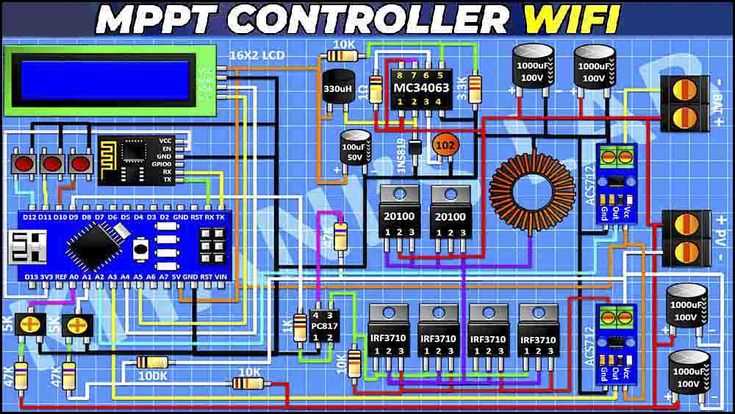
Use a synchronous buck power stage controlled by a microcontroller that measures panel voltage and current through a low-side shunt resistor (5–20 mΩ). The sensing signal should pass through an instrumentation amplifier with gain between 20 and 50 so the ADC receives a stable 0–3.3 V range. Sampling frequency near 5–10 kHz provides enough resolution for power calculations without overloading the controller.
A typical photovoltaic module rated at 36 cells delivers about 17–18 V at peak power. Select a step-down switching topology designed for an input range of 10–25 V and output matching the battery system, often 12 V or 14.4 V charging level. MOSFETs with Rds(on) below 10 mΩ reduce conduction losses; gate drivers must provide at least 1–2 A peak current so transitions remain below 50 ns.
The tracking algorithm works by adjusting duty cycle while monitoring calculated power (P = V × I). A small perturbation step, usually 0.2–0.5% duty change, prevents oscillation near the peak point. Controllers such as ARM Cortex-M0+ units running at 48 MHz can compute the multiplication and filtering inside a loop shorter than 200 µs.
Layout decisions strongly influence stability. Place the inductor, switching transistors, and input capacitors inside a compact current loop under 3–4 cm perimeter. Ceramic capacitors with X7R dielectric, 22–47 µF each, should sit directly across the supply path. Keep the sensing traces separate from switching nodes and route them as a differential pair toward the amplifier stage.
Thermal limits must be calculated from conduction and switching losses. For example, a MOSFET carrying 8 A with 8 mΩ resistance dissipates roughly 0.51 W. Add switching loss estimated from gate charge and transition time; total heat may approach 1 W per device. Copper area of about 6–8 cm² on a 1-oz PCB layer keeps junction temperature under 90 °C without a heatsink.
Protection blocks prevent failure during abnormal sunlight spikes or battery faults. Implement input over-voltage shutdown near 26–28 V using a comparator tied to the controller interrupt pin. Current limiting through the shunt reading should clamp output at roughly 110–120% of rated charge current. Reverse polarity protection using a P-channel MOSFET reduces voltage drop compared with a diode.
Verification requires controlled illumination tests. Connect the panel emulator or programmable supply and sweep voltage while logging power through UART or CAN output. A well-tuned controller maintains operating voltage within ±1% of the peak point across temperature shifts from −10 °C to 60 °C, confirming that the implemented power-tracking hardware behaves as intended.
Key Components and Connections in a Basic Solar Maximum-Power Tracking Controller Layout
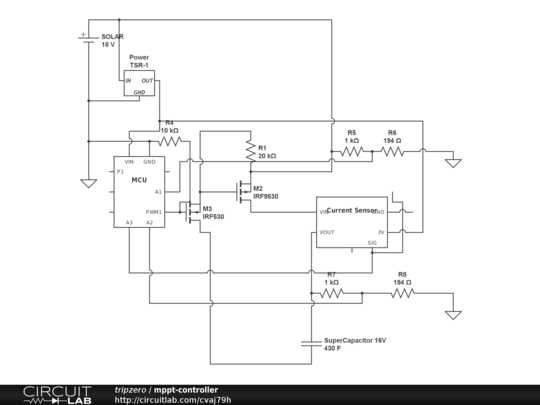
Place a high-speed DC-DC power stage between the photovoltaic module and the battery or load, using a low-Rds(on) MOSFET (≤10 mΩ) paired with a Schottky or synchronous rectification path to reduce switching losses. Add a current shunt of 0.01–0.05 Ω on the panel side and route its differential signal directly to the control microcontroller’s ADC through an RC filter (≈1 kΩ + 100 nF). Keep the power inductor close to the switching transistor; values of 33–100 µH suit small 12 V solar modules operating around 50–150 kHz.
The controller block, sensing network, and power stage must be wired with short traces and a shared ground reference to prevent measurement error. Voltage from the solar panel enters through a divider (for example 100 kΩ / 20 kΩ for 0–25 V measurement) feeding the ADC, allowing the firmware to evaluate power and adjust duty cycle. The DC-DC stage transfers energy to the battery rail while the firmware shifts duty ratio to keep panel voltage near its optimal point.
- Solar input terminals: connect directly to bulk capacitors (220–470 µF low-ESR) to suppress ripple.
- Switching transistor: N-channel MOSFET rated at least 30–40 V for 12 V panels.
- Inductor: choose saturation current ≥1.5× expected panel current.
- Current sensing element: precision shunt or hall sensor routed to the control unit.
- Controller: microcontroller or dedicated tracking IC adjusting PWM duty cycle.
- Output filter: 100–330 µF electrolytic plus 1–10 µF ceramic close to the load node.
- Feedback wiring: analog traces separated from the switching node to reduce noise pickup.