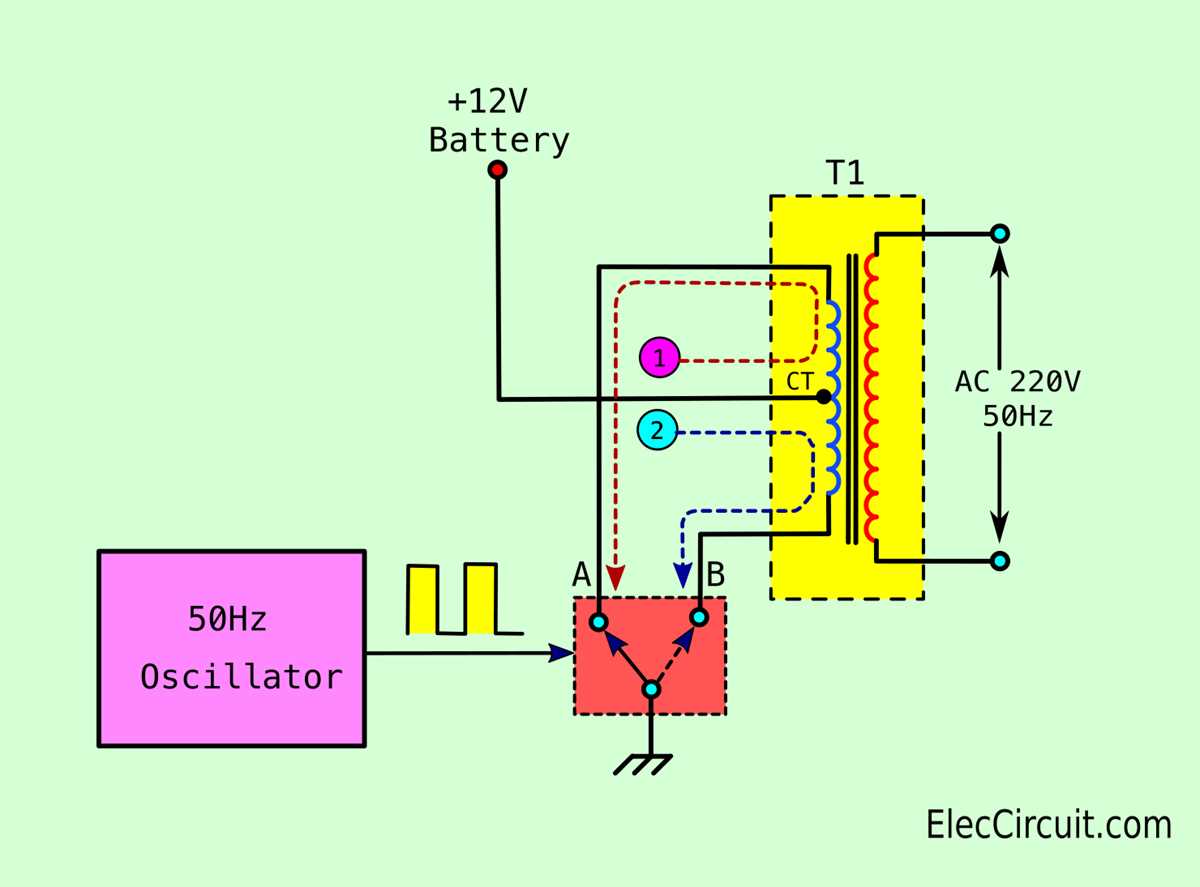
Select transistors with voltage and current ratings that exceed the load requirements by at least 20 percent. Check thermal resistance and maximum switching frequency to prevent overheating during prolonged operation.
Arrange components to minimize trace length between input and output sections. Short paths reduce energy loss, lower electromagnetic interference, and improve overall efficiency of the assembly.
Include gate resistors and protective diodes to control switching speed and prevent voltage spikes. Proper sizing ensures reliable operation and protects semiconductors from overstress.
Use a stable DC source and measure output waveform to verify functionality. Compare actual voltage and frequency with theoretical values to confirm that the design performs as intended under load conditions.
Document each connection and label terminals to simplify troubleshooting. Accurate records reduce the risk of errors during assembly or when diagnosing faults in high-voltage sections.
Understanding Transistor Selection and Ratings
Choose devices with voltage ratings higher than the maximum input supply to prevent breakdown under load. Include at least a 20–30% margin above expected peak voltage to account for spikes and transient conditions.
Check current handling capabilities against continuous and peak load requirements. Verify both drain-source current limits and pulsed current ratings, especially for high-frequency switching applications.
Consider thermal resistance and package type. Low RθJA values improve heat dissipation, while TO-220 or D2PAK packages allow easier mounting with heatsinks for higher efficiency operation.
Examine gate charge and input capacitance to match driver capabilities. Lower gate charge allows faster switching with less energy loss, while high-capacitance devices may require stronger gate drivers to avoid delayed turn-on times.
Use a comparison checklist for final selection:
- Drain-source voltage rating
- Continuous and pulsed current capacity
- Maximum power dissipation
- Gate threshold voltage
- Package type and thermal resistance
- Switching speed and gate charge
Test selected transistors under load conditions to confirm they remain within safe thermal and electrical limits. Monitoring junction temperature and voltage drop ensures reliable operation and longevity of the assembly.
Configuring the Layout and Connections
Place switching devices close to the input and output terminals to minimize trace length and reduce energy loss. Short paths decrease voltage drop and improve overall efficiency during high-frequency operation.
Separate high-current paths from control and signal lines to prevent interference. Use thick copper traces or bus bars for main conduction paths, and keep low-current traces isolated to maintain signal integrity.
Include decoupling capacitors near each active element to stabilize voltage and absorb transient spikes. Proper placement of capacitors reduces oscillations and ensures smooth operation under varying load conditions.
Label each connection clearly and maintain consistent polarity. Documenting terminals and wire color codes prevents miswiring, simplifies testing, and helps identify potential faults quickly during assembly or troubleshooting.
Testing Performance and Troubleshooting Faults
Measure input and output voltages first to verify the assembly delivers expected levels. Any significant deviation indicates connection errors, insufficient gate drive, or damaged switching elements.
Check waveform shape with an oscilloscope to ensure proper switching frequency and amplitude. Distorted waveforms may signal timing issues, parasitic inductance, or incorrect capacitor placement.
Component Verification
Test each transistor and driver individually. Confirm that switching occurs at correct voltage thresholds and that devices do not overheat under load. Replace any element that fails thermal or electrical checks.
Inspect all connectors and solder joints for loose connections or cold joints. A small resistance increase at a connection can create voltage drops, reducing efficiency and causing erratic operation.
Load Testing and Observation
Apply controlled load gradually and monitor voltage, current, and temperature at each stage. Observe the system under near-maximum load to confirm stability and identify components under stress.
Document each test result carefully to compare against design specifications. Noting deviations helps trace intermittent faults or predict potential failures before permanent damage occurs.
Use troubleshooting sequences systematically. Begin with supply verification, proceed to gate drive inspection, check switching elements, then assess output stages. This structured approach minimizes trial-and-error and ensures safe, efficient fault resolution.