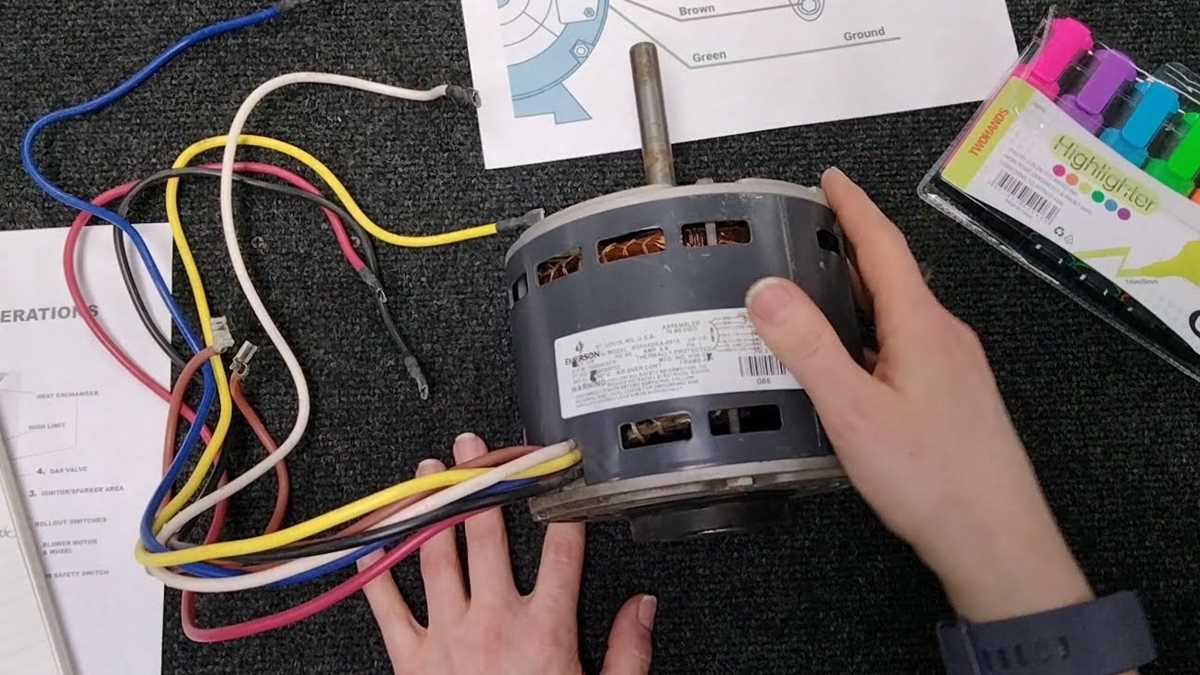
Use a five-lead HVAC fan drive connection layout that assigns one conductor to neutral, one to supply, and three to speed control through a resistor pack or control module. Red commonly carries incoming power, black routes to high rotation speed, blue to medium speed, yellow or brown to low speed, while white typically serves as neutral return. Confirm the color scheme with the equipment label because some manufacturers swap the medium and low channels.
A practical check involves measuring resistance between the three speed leads. The highest resistance usually corresponds to the slowest fan rotation, while the lowest value feeds the fastest setting. If a climate control panel uses a resistor block, each speed lead connects to a separate resistor path before reaching the supply line. Systems using an electronic module route the same conductors through a transistorized controller rather than fixed resistors.
Mount the resistor pack or control module inside the air duct so airflow cools it during operation. Heat buildup around this component often leads to burnt connectors or melted insulation. Secure each conductor with tight terminals and inspect for oxidation; poor contact raises resistance and causes unstable fan speeds. After assembly, test every speed position from the control switch and confirm steady airflow without surging or intermittent shutdown.
Five-Lead HVAC Fan Drive Connection Layout
Connect the common lead from the fan drive unit to the neutral terminal of the power supply, then route the remaining four conductors to separate speed taps on the control switch or resistor pack. Typical color mapping in residential air handlers uses white for common return, black for high rotation rate, blue for medium-high, yellow for medium-low, and red for low rotation. Confirm the label on the casing before attaching any conductor, because manufacturers sometimes swap blue and yellow assignments.
Measure resistance between the common return and each speed tap with a multimeter before energizing the system. The highest resistance normally corresponds to the slowest fan rotation, while the lowest value indicates maximum airflow. Example readings frequently fall within these ranges: low speed 40–60 Ω, medium-low 25–40 Ω, medium-high 15–25 Ω, and high 8–15 Ω. A reading close to zero suggests insulation damage or internal winding contact.
Speed Selection Circuit
Each colored conductor links to a different internal coil segment. A rotary selector or relay board chooses which segment receives line voltage. Only one speed tap should carry power at a time; connecting multiple taps simultaneously can overheat the windings and trip the thermal protector embedded inside the drive assembly.
Secure unused conductors with insulated caps and keep them separated from grounded metal surfaces inside the air handler cabinet. Vibration from continuous operation can loosen terminals, so crimp connectors rated for at least 105 °C should be used. Leave roughly 10–15 mm of stripped copper to ensure solid contact without exposed strands.
Testing After Installation
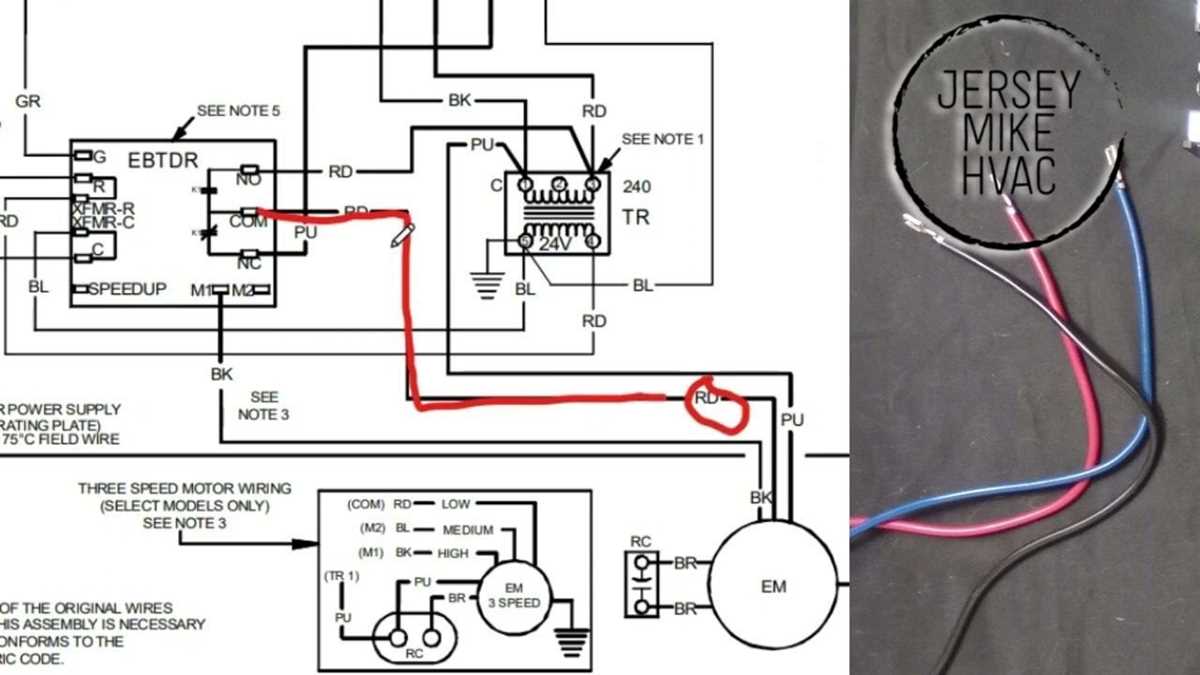
After completing the connections, restore power and activate the ventilation mode. Observe the fan wheel for smooth acceleration and listen for humming that might indicate incorrect tap selection. Airflow should increase distinctly with each higher setting. If two speeds sound identical, the control switch may be feeding the same tap twice or a conductor may be misrouted.
For long-term reliability, verify that supply voltage remains within ±10 % of the unit rating, typically 115 V or 230 V depending on the HVAC system. Voltage outside this band raises coil temperature and shortens insulation life. Periodic inspection of terminals and insulation sleeves once per heating or cooling season helps maintain stable operation.
Identifying the Function of Each Wire in a 5 Wire Blower Motor (Power, Ground, Speed Taps, and Capacitor Leads)
Check the supply conductor first: measure voltage between the incoming line and chassis reference with a multimeter set to AC. A stable reading near the rated value (commonly 120 V or 230 V depending on HVAC unit type) indicates the power feed. This conductor typically connects to a relay or control board terminal labeled “L”, “Line”, or “Hot”. Trace it physically toward the control module rather than the fan assembly; the feed path normally runs through a switch, thermostat relay, or furnace control board before reaching the drive unit.
The ground path can be verified through continuity testing. Set the meter to resistance mode and probe between the suspected grounding conductor and the metallic housing of the fan assembly. A value close to 0 Ω confirms the protective path. In many HVAC assemblies this lead is green or green-yellow, though color alone should not determine identification. A true grounding conductor attaches directly to the metal frame using a screw or ring terminal and does not pass through switches, resistors, or control electronics.
Speed tap conductors are recognized by their connection to the fan control board or selector switch and by the resistance differences between them. Each tap corresponds to a winding section that alters rotational rate. Typical resistance patterns show measurable variation between taps.
- Low-speed lead: highest resistance to the common return.
- Medium-speed lead: moderate resistance.
- High-speed lead: lowest resistance.
Disconnect the equipment from mains supply before measuring. Place one probe on the common terminal and check each speed lead individually; values might range from roughly 2–10 Ω depending on the coil design. HVAC control boards energize only one speed conductor at a time.
Recognizing Capacitor Connections
Two conductors often route toward a cylindrical run capacitor mounted near the fan housing. These leads do not connect directly to the power feed; they terminate at capacitor tabs labeled “C”, “FAN”, or similar. Capacitance values commonly fall between 3 µF and 10 µF for residential air handlers. Their role is phase shift generation that allows the single-phase stator field to initiate rotation. If tracing physically, these conductors typically run together in a small pair toward the capacitor bracket rather than the control board.
Practical Identification Sequence
- Disconnect power from the HVAC system.
- Locate the grounding path attached to the metal chassis.
- Trace the main supply lead entering from the control module.
- Measure resistance from the common return to locate low, medium, and high speed taps.
- Follow the remaining pair leading to the run capacitor terminals.
This structured inspection allows clear identification of each conductor role in a five-lead fan drive assembly without relying on color coding or printed schematics.