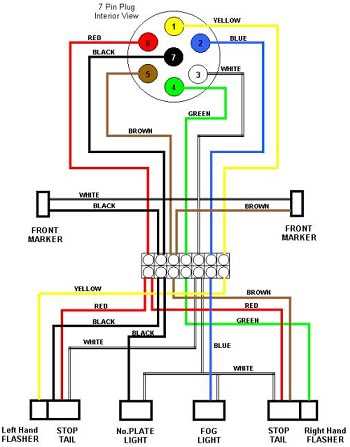
Confirm the power source voltage before attaching any conductors. Most 12-volt systems require careful connection to prevent blown fuses or short circuits.
Identify each pin on the connector and mark it for brake lights, turn signals, ground, and auxiliary power. Proper labeling avoids misconnection and ensures correct operation.
Use secure terminals and tighten screws to recommended torque levels, typically 0.4–0.6 Nm. Insulated ferrules improve contact stability and reduce electrical noise interference.
Test each function individually by applying power and observing corresponding lights or accessories. Measure voltage at each pin to verify proper load handling and signal integrity.
Organize and route all conductors to avoid contact with moving parts or heat sources. Coil excess lengths and secure with clips or ties to maintain clean, safe connections.
7 Pin Connector Setup and Testing
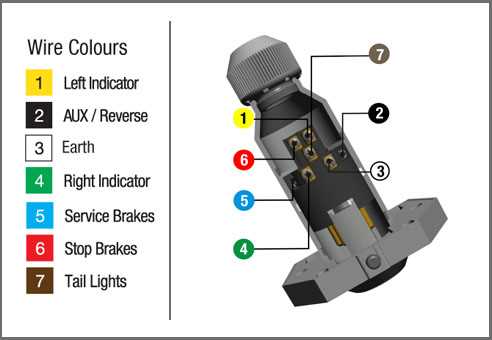
Begin by labeling each pin according to its function, including brake lights, turn signals, ground, and auxiliary power. Accurate identification prevents cross-connection and ensures proper signal flow.
Use a multimeter to verify voltage at each terminal before connecting to any device. Most systems operate at 12 volts DC, and incorrect connections can blow fuses or damage components.
Secure all conductors with proper terminal screws and check that wires are routed away from moving parts or heat sources. Test each function individually to confirm reliable operation under load.
Identifying Pins and Functions on a 7 Pin Connector
Start by inspecting the connector and noting each terminal’s shape and position. Most 7-pin connectors follow a standard layout with pins designated for ground, tail lights, brake lights, left and right turn signals, reverse lights, and auxiliary power.
Label each pin with a small tag or marker to prevent mistakes during connection. Accurate labeling allows you to trace signals and avoid miswiring that could damage electrical components.
Use a multimeter to test continuity from the vehicle socket to each pin. This confirms which conductor corresponds to each function and helps identify any breaks or shorts in the system.
Check the voltage at each terminal while activating its respective control, such as turning on brake lights or signaling a turn. Typical readings are 12 volts DC; deviations may indicate a weak connection or damaged wire.
Document pin colors and functions in a simple table or sketch. Standard color coding often includes brown for tail lights, yellow for left signals, green for right signals, white for ground, blue for brakes, and red for auxiliary circuits.
Secure the pins and connectors after verification to maintain firm electrical contact. Loose terminals can cause intermittent failures or flickering lights, which compromise safety.
Re-test all functions together once connections are complete. Operate lights and signals simultaneously to confirm that each function works under load and that no cross-talk occurs between terminals.