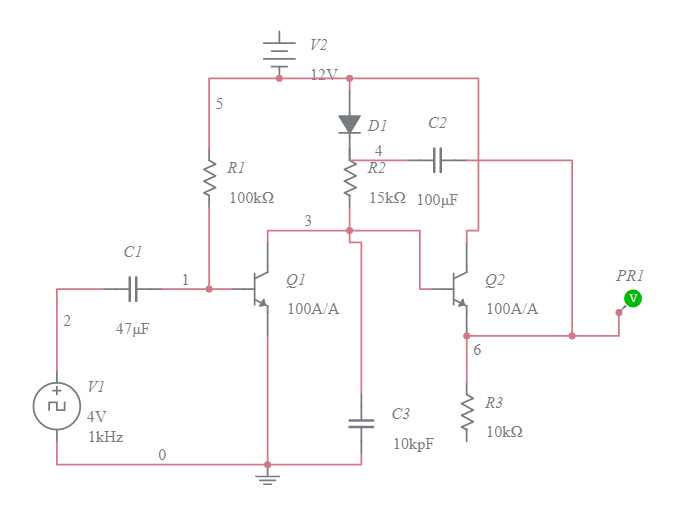
Connect the collector terminal of a bipolar transistor directly to the positive supply rail, route the input signal to the base terminal through a bias resistor network, and take the output from the lower terminal of the device. This configuration produces a voltage at the output node that closely tracks the input level while delivering higher current capability.
A typical setup uses a supply between 9 V and 15 V and a bias divider composed of resistors ranging from 10 kΩ to 100 kΩ. The divider establishes the base potential. The output node appears roughly 0.6–0.7 V below that base potential because of the base–emitter junction drop in a silicon transistor.
The load connects to the output node through a resistor or directly if the current demand stays within transistor limits. For example, if the base node is held at 5 V, the output node stabilizes near 4.3 V. This property allows the stage to act as a voltage buffer between a high-impedance signal source and a lower-impedance load.
Choose transistor types such as 2N3904 or BC547 for low-power applications. Maintain collector current within the device rating; many small signal transistors handle 100 mA or less. Heat dissipation equals voltage drop across the transistor multiplied by current through the device.
Emitter Follower Circuit Diagram Showing BJT Buffer Stage Connections and Voltage Behavior
Connect the collector terminal of the bipolar transistor directly to the positive supply rail, route the signal source to the base through a bias resistor, and take the output from the lower transistor terminal. This layout allows the output node to track the input voltage while supplying higher current to the load.
Base Bias and Voltage Relationship
Establish the base potential using a resistor divider tied between the supply rail and ground. A common arrangement uses 47 kΩ for the upper resistor and 10 kΩ for the lower resistor on a 12 V supply, producing a base potential close to 2.1 V. The output node appears about 0.6–0.7 V lower because of the silicon junction drop inside the transistor.
If the base receives a 5 V signal from a signal generator or preceding amplifier stage, the output node stabilizes around 4.3 V. This voltage tracking behavior makes the configuration suitable as a buffer between high-impedance sources and loads requiring more current.
Current Gain and Load Interaction
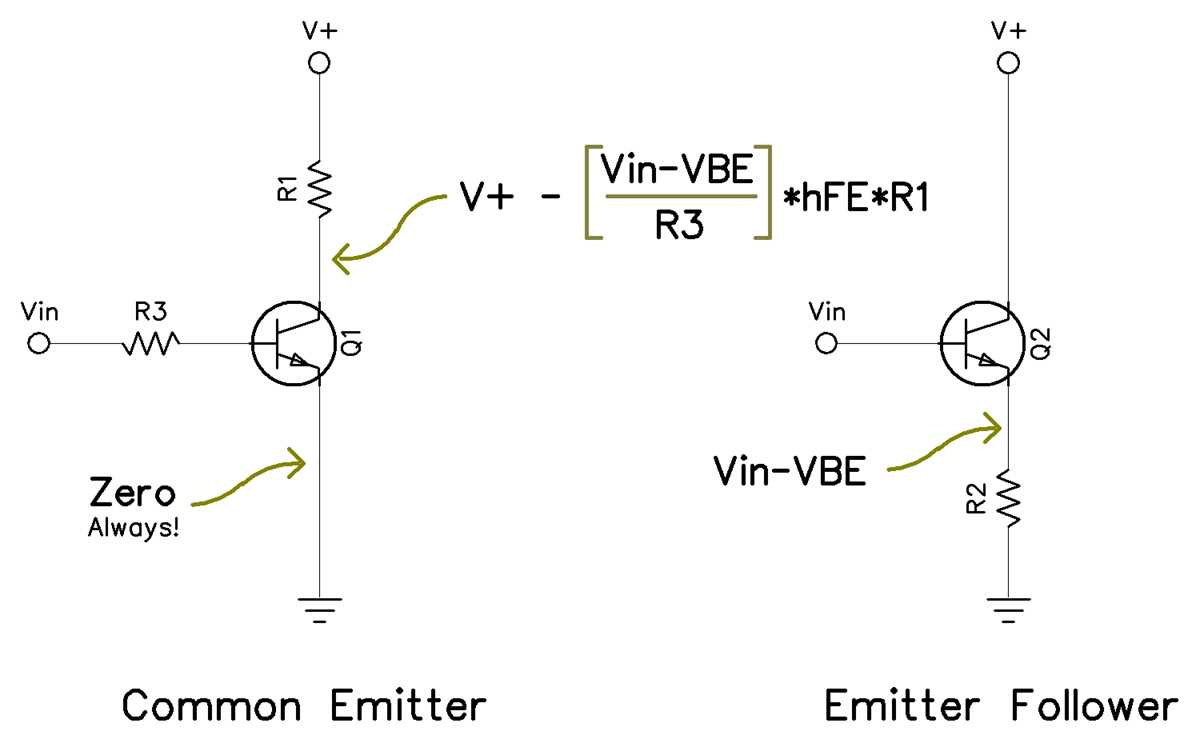
The transistor multiplies base current by its current gain factor β. For a device such as 2N3904 with β near 100, a base current of 0.2 mA allows the output node to deliver roughly 20 mA to the load resistor.
Attach the load between the output node and ground. For example, a 220 Ω load connected to an output near 4.3 V draws roughly 19.5 mA, which remains within the operating range of common small-signal transistors.
Keep the collector tied firmly to the supply rail and minimize lead length between the transistor and bias network. Long traces introduce stray resistance that shifts the base potential and alters the voltage tracking behavior.
Connecting Base Collector and Emitter Terminals in a BJT Follower Stage Layout
Attach the collector lead of the bipolar transistor directly to the positive supply rail, route the input signal to the base through a resistor network, and use the lower transistor terminal as the output node. This arrangement lets the output voltage closely track the base potential while allowing larger current flow into the load.
Terminal Connections
Identify the transistor pinout before installation; common small-signal devices such as 2N3904 or BC547 have specific lead arrangements that differ between manufacturers. Connect the base to the signal source through a resistor between 1 kΩ and 10 kΩ, tie the collector to the supply line between 9 V and 15 V, and route the output from the lower terminal through a load resistor connected to ground. The voltage at that output point typically remains about 0.6–0.7 V below the base potential due to the silicon junction drop.
Keep conductor paths short between the transistor, bias resistors, and the load component. Excess lead length adds unwanted resistance that alters base potential and shifts the output voltage level.