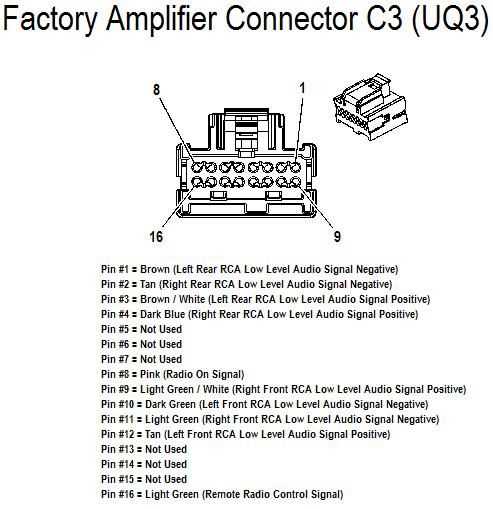
Start by ensuring that your vehicle’s power source is properly connected. For most aftermarket systems, you’ll need to link the power wires directly to the car’s battery or ignition, depending on whether you want the system to turn on with the vehicle. Use the correct gauge wire for your vehicle’s power requirements to avoid overheating or electrical issues.
Next, identify the wires for the speakers. These typically consist of four main connections for the four speakers, each corresponding to positive and negative terminals. For additional speakers or a subwoofer, you’ll need to account for more wires and ensure they are correctly matched to the respective outputs on the new head unit. Always check the polarity of each speaker wire to avoid phase issues in the audio output.
When installing a new audio unit, ensure that all necessary adapters are used for seamless integration with your car’s existing setup. These adapters can include harnesses for connecting the power, ground, and speaker wires to the new system. Check the dimensions of the head unit to ensure it fits the dash properly and securely before securing it in place. Once installed, test the system for proper function and troubleshoot any issues with audio output, connections, or power.
2006 Vehicle Audio System Wiring Guide
Start by disconnecting the vehicle’s battery to avoid any electrical shocks or damage during installation. It’s important to ensure the power is fully off before working with the electrical components inside the dashboard. Make sure to keep track of the ground connections, as these will be essential for ensuring the system operates properly without electrical noise.
Locate the factory harness to access the vehicle’s original audio connections. You will need to disconnect the factory head unit from the power, ground, and speaker wires. For those replacing an old head unit, keep the wiring diagram for reference. If you’re upgrading to a new system, make sure to identify which wire corresponds to each component: power, speakers, and remote turn-on for amplifiers or subwoofers.
When wiring the new head unit, ensure the power wire is connected to a constant 12V source, while the ignition wire should be connected to a switched 12V source. This will allow the system to turn on and off in sync with the vehicle’s ignition. Use a multimeter to verify that each connection is providing the correct voltage before proceeding with further wiring.
The speaker wires should be connected to the output terminals on the new head unit. It’s important to match the positive and negative terminals properly to avoid sound quality issues. Use a speaker wire with proper insulation and gauge to ensure efficient audio delivery. Double-check each connection and test the speakers by briefly powering on the system before finalizing the installation.
If you’re installing an amplifier, connect the amp’s power, ground, and remote turn-on wires according to the manufacturer’s instructions. The power wire should be routed directly to the battery with an inline fuse for safety. The ground should be attached to a clean, metal surface near the amp to ensure a solid electrical connection. The remote turn-on wire should be connected to the head unit’s remote output terminal.
For aftermarket speakers, check the impedance ratings and ensure they match the head unit’s or amplifier’s specifications. Connecting speakers with a mismatched impedance can lead to poor sound quality or even damage to the amplifier. Always use the correct gauge wire for speakers to maintain sound clarity and performance.
Once all the connections are made, secure the head unit in place, ensuring that all wires are neatly tucked away and do not interfere with other components. Test the system to confirm all functions are working as expected. If there’s no sound or the system isn’t powering on, recheck the wiring, especially the power and ground connections. After confirming everything works properly, reattach the vehicle’s battery and finalize the installation with any necessary trim pieces or panels.
Identifying and Connecting the Power Wires for Your Audio System
First, locate the power wire from the vehicle’s harness. This wire is typically red and provides a constant 12V source, which powers the unit even when the ignition is off. Use a multimeter to verify that the wire provides power when the vehicle is off to ensure proper connection.
The second important wire is the ignition wire, often blue or yellow. This wire activates the system when the key is turned to the “on” position. Ensure this wire connects to a switched 12V source so that your system turns on and off with the vehicle’s ignition, preventing battery drain.
To connect the power wires, use high-quality connectors to ensure solid contact. Crimp connectors are a good choice, but soldering can offer a more reliable and permanent connection. Avoid using twist-on connectors, as they may loosen over time and cause poor connections.
Next, connect the ground wire, typically black, to a clean metal part of the vehicle’s frame. It is essential for preventing electrical interference. Use a wire with adequate gauge, ensuring that the connection is tight and secure for optimal performance.
Test each wire after connecting to ensure that it is working as intended. Turn on the vehicle, and use a multimeter to check the power at the head unit. The constant power should show 12V at all times, while the ignition wire should show 12V only when the ignition is on.
If the connections are correct and the system still doesn’t power up, check for blown fuses or any loose wires. Make sure the ground is properly connected and the wires are free of corrosion. Double-check the connections before finalizing the installation.