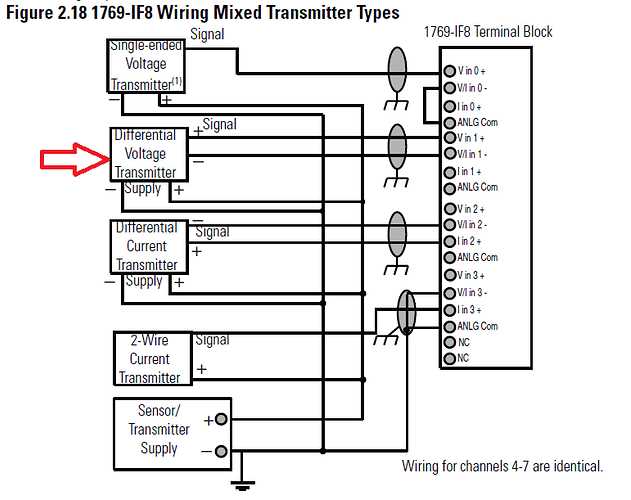
Use shielded twisted-pair conductors for every sensor channel and land the signal leads on the correct terminal group of the isolated eight-input measurement card used in ControlLogix racks. Each channel accepts differential signals, so the positive lead from the transmitter must be attached to the “+” terminal while the return line connects to the matching “–” point. This arrangement minimizes noise pickup and stabilizes readings from devices such as 4–20 mA transmitters and low-level voltage sensors.
The terminal block is divided into channel pairs with independent isolation barriers. Channel groups share no direct electrical path, which allows field instruments operating at different ground potentials to coexist in one module. Connect the shield drain wire to the chassis grounding point rather than the signal return. Doing so prevents ground loops that often appear in installations with long cable runs or multiple power sources.
For current transmitters, route the loop supply through the input terminals so that the card measures the loop current directly. A typical arrangement places the field transmitter in series with the input point and the DC supply, forming a closed loop across the channel contacts. Voltage sources require a different layout: the positive output from the sensor goes to the channel “+” position, while the reference line attaches to the channel “–” contact. Maintain polarity consistency across all channels to simplify troubleshooting.
Label every terminal position and keep conductor lengths equal within each pair. Short, balanced leads reduce electromagnetic interference, particularly in cabinets containing motor drives or switching power units. Technicians working with multi-channel analog acquisition hardware often leave service loops of 5–7 cm near the terminal block; this small slack allows quick replacement of the removable connector without cutting and re-terminating field cables.
1756 IF8I Wiring Diagram: Practical Guide to Connecting the Analog Input Module
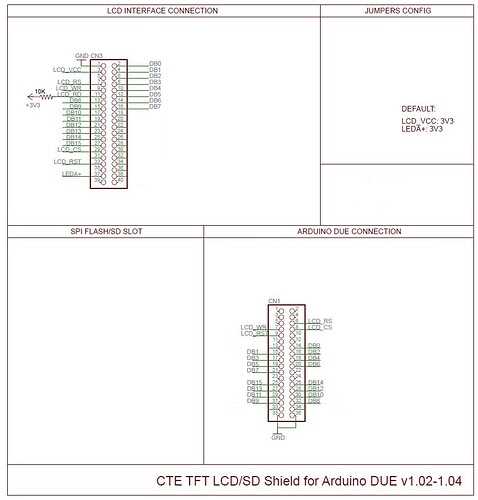
Connect each signal pair directly to the correct terminal group of the isolated eight-channel analog input card and keep sensor leads twisted and shielded. Route the positive lead of the transmitter to the channel “+” terminal and the return lead to the matching “–” terminal; do not combine returns between channels because the module provides channel-to-channel isolation designed for individual signal loops.
Use the terminal layout printed on the module door as the reference for conductor placement. Typical industrial transmitters deliver either 4–20 mA current loops or ±10 V signals, and the connection scheme differs slightly depending on the signal source type. Maintain shield continuity but bond the shield at one side only, usually the control cabinet ground rail. Recommended practices:
- Use 18–22 AWG stranded instrumentation cable for stable analog transmission.
- Keep sensor cables at least 150 mm away from motor power lines or VFD output cables.
- Terminate shields on the chassis ground bar, not on signal terminals.
- For loop-powered transmitters, connect the supply through the device before returning to the input terminal.
- Label each pair with channel numbers (0–7) to simplify maintenance and calibration.
After completing conductor placement, verify channel configuration in the controller project so electrical connections match the configured signal type. A quick validation routine helps prevent measurement faults:
- Measure loop current or voltage at the terminal block with a calibrated multimeter.
- Compare the measured value with the reading displayed in the PLC tag.
- Apply a known test signal (for example 12 mA or 5 V) and confirm proportional scaling.
Stable readings with minimal noise indicate correct cable routing and terminal assignment.
Terminal-by-Terminal Wiring Layout for the 1756-IF8I Module and RTB Connections
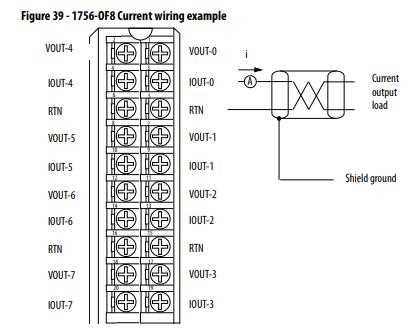
Connect each signal pair directly to its assigned RTB screw terminal following the channel sequence printed on the removable block: Channel 0 uses terminals IN0+ and IN0−, Channel 1 uses IN1+ and IN1−, continuing through Channel 7. Route the positive lead of the transmitter to the “+” position and the return lead to the “−” position for each pair. Tighten terminal screws to approximately 0.5–0.6 N·m to maintain stable electrical contact and prevent drift caused by vibration in control cabinets.
For differential inputs, attach the signal source positive conductor to the channel’s positive pin and the negative conductor to the corresponding return pin on the RTB. If shielded cable is used, terminate the shield at the designated SHLD terminal or chassis ground on one side only. This reduces noise pickup along the cable path and prevents circulating ground currents that distort low-level analog signals.
Channels are arranged sequentially across the removable terminal block, typically grouped in pairs. Each pair forms a fully isolated measurement path. Maintain separation between adjacent pairs by guiding conductors through separate cable ducts where possible. Keep analog signal leads away from motor power lines, variable frequency drive outputs, and relay coils. Parallel runs longer than 2–3 meters near high-current conductors may introduce measurement deviation exceeding ±0.2% of full scale.
The RTB also includes dedicated terminals for loop power reference and grounding. When connecting current transmitters operating in the 4–20 mA range, route the transmitter output through the positive channel terminal and return through the negative channel terminal without tying the negative lead to panel ground. After installation, verify continuity across each terminal pair and confirm that adjacent channels show no unintended bridging. Proper terminal mapping guarantees stable signal acquisition across all eight inputs.