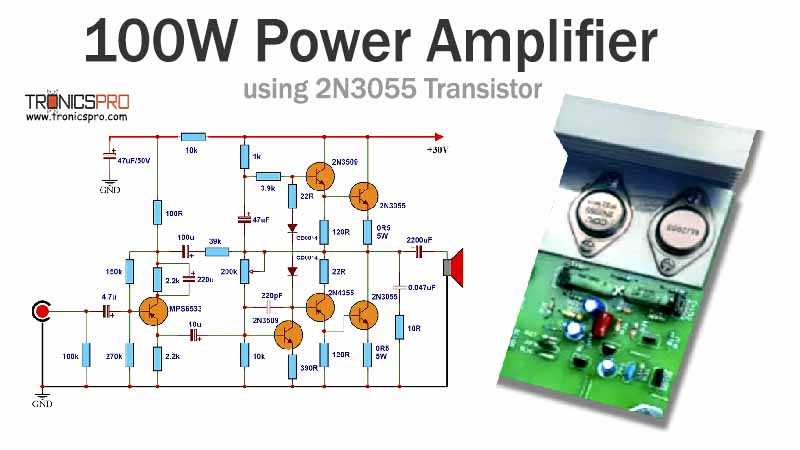
Choose a common-emitter arrangement built around a small-signal negative-positive-negative bipolar junction device when voltage gain above 40 is required from a single stage. A typical setup uses a collector load between 2.2 kΩ and 10 kΩ with a supply between 9 V and 15 V. Bias stability improves when the base is fed through a voltage divider; values such as 47 kΩ and 10 kΩ hold the operating point near the center of the collector voltage range. This placement keeps the output swing symmetrical and prevents clipping at moderate input levels.
Thermal stability depends strongly on the emitter path. Insert an emitter resistor between 470 Ω and 1 kΩ; this creates negative feedback that stabilizes current flow when temperature shifts occur. If higher voltage gain is required, connect an electrolytic bypass capacitor across that resistor. Capacitor values around 47 µF–220 µF maintain low reactance at audio frequencies, allowing AC signal growth while DC bias conditions remain controlled.
Input coupling normally relies on a capacitor between 1 µF and 10 µF. This component blocks DC from the previous stage while allowing alternating signal energy to pass. The output path often uses a similar capacitor feeding a load between 10 kΩ and 100 kΩ. Selecting these capacitances determines the low-frequency cutoff; for example, a 4.7 µF capacitor with a 47 kΩ load places the lower response limit near 0.7 Hz, far below the audible band.
A clean schematic layout shortens high-current paths and keeps the base node isolated from the collector trace. Place decoupling near the supply node with a 100 nF ceramic capacitor in parallel with a 10 µF electrolytic. This pair suppresses supply ripple and prevents oscillation. When these component values and placement practices are followed, a single three-terminal semiconductor stage delivers stable voltage multiplication suitable for audio pre-stages, sensor interfaces, and low-level signal conditioning.
Single-Stage Bipolar Gain Stage Layout
Choose a common-emitter configuration with a base bias network formed by two resistors and an emitter resistor that stabilizes operating current. A typical layout uses a 10 kΩ collector load, 1 kΩ emitter resistor, and a voltage divider such as 47 kΩ / 10 kΩ connected to the signal control node. With a 12 V supply this arrangement places the collector potential near 6 V, allowing symmetrical signal swing without clipping.
Capacitive coupling blocks DC shift between stages. Place an input capacitor between the signal source and the control terminal; values from 1 µF to 10 µF handle audio frequencies above roughly 20 Hz when paired with a 10 kΩ input impedance. Output coupling often uses 4.7 µF–22 µF depending on the load resistance. Lower capacitance raises the cutoff frequency, which may thin low-frequency response.
Bias Network Design
Stable operating point depends on divider current exceeding base current by at least a factor of ten. Example: if collector current equals 2 mA and current gain equals 100, base current is roughly 20 µA. Divider current around 200–300 µA works well. With a 12 V supply, resistor values near 39 kΩ (upper) and 8.2 kΩ (lower) produce about 2 V at the base node, giving approximately 1.3 V across the emitter resistor after the 0.7 V junction drop.
- Emitter resistor: 680 Ω–1.2 kΩ stabilizes thermal drift
- Collector load: 4.7 kΩ–15 kΩ sets voltage gain
- Supply: 9–15 V common for small signal stages
- Quiescent collector current: 1–3 mA for low noise
Voltage gain roughly equals collector resistance divided by emitter resistance (AC value). If a bypass capacitor shunts the emitter resistor, gain rises sharply. For instance, with a 10 kΩ collector load and a 1 kΩ emitter resistor fully bypassed by a 100 µF capacitor, gain may exceed ×100. Without bypassing, gain stays closer to ×10 and distortion drops.
Signal Coupling and Frequency Limits
Three capacitors usually define the bandwidth: input coupling, emitter bypass, and output coupling. Their values determine the lower cutoff frequency through interaction with surrounding resistances. Approximate formula:
f ≈ 1 / (2πRC)
- Input capacitor with base impedance sets first low-frequency limit
- Emitter bypass capacitor influences gain at low frequencies
- Output capacitor interacts with load resistance
High-frequency limits come from internal junction capacitances and wiring length. Keep leads short, place the collector load close to the device, and route the input trace away from the output node. Breadboard layouts often introduce stray capacitance that reduces bandwidth above several hundred kilohertz.
Noise reduction improves with metal-film resistors and a filtered supply rail. A small decoupling capacitor such as 100 nF placed between supply and ground near the device suppresses ripple. With careful bias values, clean wiring, and moderate current levels, a single bipolar gain stage delivers strong voltage amplification suitable for microphones, sensors, and pre-audio stages.