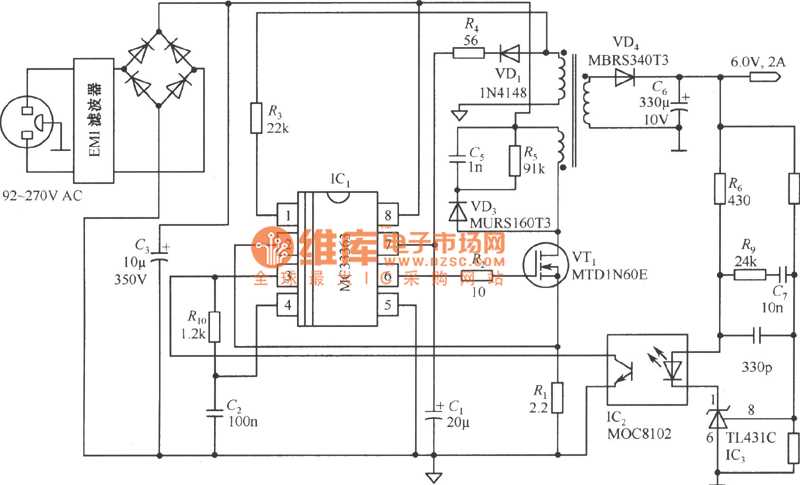
Select a step-down transformer rated around 9V AC and at least 1A before assembling the 6-volt DC unit. This component lowers mains voltage to a safer level that can later be converted to stable direct current. The secondary leads of the transformer connect to a four-diode bridge rectifier that converts alternating input into pulsating DC.
Use a filter capacitor between 1000 µF and 2200 µF after the rectifier block. This capacitor smooths voltage ripple produced during rectification. Without this filtering stage, the output fluctuates and small electronic devices such as microcontrollers, radios, or LED modules may malfunction. The positive capacitor lead connects to the rectifier positive terminal, while the negative lead ties to the common ground line.
Add a linear regulator rated for 6 volts, such as a fixed output device, after the smoothing capacitor. The regulator stabilizes the output and prevents voltage spikes when load conditions change. Connect the regulator input pin to the filtered DC node, attach the ground pin to the common return path, and route the regulated output pin toward the final output terminals.
Keep conductor paths short and place small ceramic capacitors near the regulator pins. A 0.33 µF capacitor at the input and a 0.1 µF capacitor at the output help maintain stable voltage during rapid load changes. This arrangement produces a steady 6-volt direct current source suitable for low-voltage electronics and embedded devices.
6V DC Power Supply Circuit Diagram
Use a 9V AC step-down transformer rated around 1A as the input stage. The secondary leads connect directly to a four-diode bridge rectifier that converts alternating voltage into pulsating direct current. After rectification, place a large electrolytic capacitor between the positive output node and ground. This component smooths ripple and stabilizes the voltage level before it reaches the regulator stage.
Typical component path for a 6-volt DC unit:
- AC mains → step-down transformer
- Transformer secondary → bridge rectifier block
- Rectifier positive terminal → 1000–2200 µF electrolytic capacitor
- Filtered DC node → 6V linear regulator input
- Regulator ground pin → common return line
- Regulator output pin → final 6V output terminals
Install small ceramic capacitors close to the regulator pins, commonly 0.33 µF at the input and 0.1 µF at the output. Short conductor paths and solid grounding reduce voltage ripple and maintain steady 6-volt direct current for small electronic loads.
Transformer Selection and AC Input Stage for a Stable 6V Output
Choose a step-down transformer with a 9V AC secondary rated between 1A and 2A. This rating provides headroom above the final 6-volt direct current level after rectification and regulation. A transformer with too low secondary voltage may drop below the regulator threshold, while a higher value increases heat inside the regulator.
The primary winding must match the local mains voltage such as 120V or 230V. Connect the primary leads through a fuse placed before the transformer input. A small slow-blow fuse rated around 500 mA protects the unit from short circuits or internal faults.
Route the transformer secondary leads directly to the rectifier stage. Keep these conductors short and twisted together to reduce electromagnetic noise. Twisting the pair also lowers the chance of interference reaching nearby low-voltage components.
For compact electronic builds, a laminated EI-core transformer rated near 9VA to 12VA works well. Toroidal types can also be used and often produce lower magnetic leakage around the enclosure.
Install the transformer physically away from low-signal sections. Magnetic fields from the iron core may induce hum in nearby audio stages or sensor modules. Mounting the transformer near the enclosure wall and rotating the core orientation can reduce this effect.
After the transformer stage, the AC output proceeds toward the rectifier bridge where alternating voltage becomes pulsating DC. From that point, filtering capacitors and a regulator stage shape the output into a stable 6-volt direct current line.