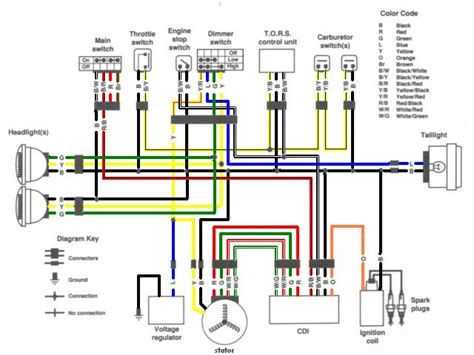
Use a clear circuit map of the ignition and charging lines before touching any connector on this classic 348–349 cc sport ATV from a well-known Japanese manufacturer. The machine relies on a compact harness that links the stator, CDI module, starter relay, regulator–rectifier, and handlebar switches through color-coded conductors. Matching each conductor color with its terminal point prevents misconnection that may lead to a no-spark condition or a charging fault.
The ignition path typically runs from the stator coil to the CDI unit and then to the ignition coil that feeds the spark plug. White-green and white-red conductors often carry trigger signals, while black or black-white lines connect grounding points along the frame. A detailed electrical scheme shows how the kill switch interrupts the CDI ground line; tracing that single path helps diagnose sudden engine shutdown or failure to start.
Lighting and auxiliary circuits branch from the regulator–rectifier output. From there, current flows through the main fuse toward the handlebar switch cluster and the headlamp assembly. Brown leads usually distribute switched power, while yellow lines frequently route AC output from the stator lighting coil. Observing these paths on the electrical chart allows quick inspection of connectors near the steering stem and under the seat where corrosion often appears.
Maintenance becomes simpler with a precise connection chart that displays plug shapes, conductor colors, and grounding bolts along the frame rails. Mechanics often print the electrical layout and mark tested points such as the starter solenoid terminals, battery positive cable, and frame ground lug. This approach speeds troubleshooting of charging loss, dim lighting, or intermittent ignition across this well-known sport quad platform.
CDI, Stator, and Ignition Switch Connections on the 348–349 cc Sport ATV
Trace the stator leads to the CDI module before checking the ignition switch circuit. On this 348–349 cc sport quad from a Japanese manufacturer, the alternator assembly under the left engine cover feeds several conductors directly into the ignition control unit. Typical routing uses:
- White/Red lead – pulse signal from the pickup coil to the CDI trigger input.
- Green or Black lead – chassis ground shared by CDI, ignition coil, and frame bolts.
- Brown lead – switched 12-volt supply from the key switch.
- Orange lead – output from the CDI unit to the ignition coil primary terminal.
- Yellow lead – AC lighting current from the alternator assembly.
Follow these color paths carefully on the electrical layout; misplacing the trigger conductor or ground line causes loss of spark during cranking.
Check the key switch terminals next. The switch mounted near the handlebar clamp connects battery voltage to the CDI only when the key rotates to the ON position. Inside the harness bundle, the brown conductor carries power from the fuse block toward the switch, while a black or black-white line routes the stop circuit that disables ignition when grounded. If the engine spins yet produces no spark, unplug the switch connector and verify continuity between the brown feed and the outgoing line toward the ignition control module.
During troubleshooting, inspect connector blocks between the stator assembly and CDI unit located under the seat panel. Use a multimeter and verify:
- Pickup coil resistance around 95–115 Ω.
- Ignition coil primary resistance close to 0.3–0.5 Ω.
- Continuity between frame ground points and the CDI ground lead.
Values outside these ranges indicate damaged coils, corroded terminals, or broken conductors within the harness that links the alternator assembly, ignition control box, and key switch.
Color Codes and Connector Paths Between Stator, CDI Unit, and Ignition Coil
Identify conductor colors before separating any connector between the alternator assembly, ignition control box, and spark coil. On the 348–349 cc sport ATV produced by the well-known Japanese brand, the trigger and power lines leave the engine case through a rubber grommet and travel along the left frame rail toward the CDI module mounted under the seat. Each conductor color indicates a specific function, so mixing them leads to spark loss or erratic timing.
White with a red stripe usually carries the pickup coil signal. This lead exits the stator housing and runs through a two-pin plug located near the carburetor side of the engine. From that connector it continues directly to the CDI trigger terminal. The pickup sensor produces a short AC pulse whenever the flywheel magnet passes the sensor tip, allowing the ignition module to determine firing timing.
Black or black-white conductors connect ground points. One branch attaches to the engine case near the stator cover bolt, while another runs into the CDI harness block. These lines also pass through the handlebar stop switch circuit; grounding this path instantly stops ignition output.
The orange conductor links the CDI output to the ignition coil primary terminal. This wire usually travels inside the main harness above the cylinder head and ends at a single-spade connector attached to the coil mounted near the frame backbone. When the CDI releases stored energy, voltage travels through this orange lead and energizes the coil winding that produces the high-voltage spark.
Brown lines provide switched battery voltage to the ignition control unit. The path begins at the fuse holder next to the battery, moves through the key switch assembly, then reaches a multi-pin connector under the seat. If the brown conductor loses continuity, the CDI receives no power even though the starter motor may still crank the engine.
Connector routing along the frame usually follows three main junction points: one two-pin plug close to the stator exit point, a larger harness coupler beneath the fuel tank, and the CDI block under the rear fender. Corrosion inside these plugs often raises resistance and weakens the trigger signal.
Inspect each connection carefully, clean the terminals with contact cleaner, and confirm tight pin engagement before reassembling the harness. Proper alignment of color-coded conductors between the alternator assembly, ignition control module, and spark coil restores stable ignition pulses and prevents intermittent misfire during acceleration.