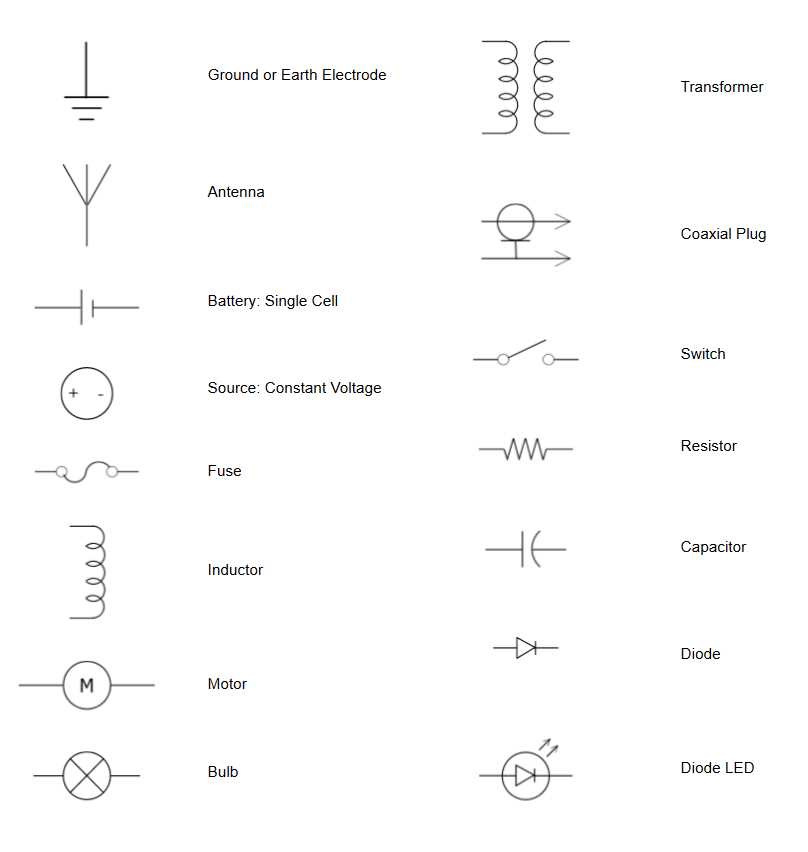
Use a simple circle with a small cross or filament mark inside to denote a light-emitting lamp in an electrical schematic. This notation appears in residential wiring plans, appliance documentation, and training materials because it is quickly recognized and clearly separates lighting components from switches, resistors, and power sources. When drafting a wiring layout, place the lamp mark directly along the conductor path where the light device connects.
The graphic usually represents an incandescent light unit, historically the most common household source. In many drafting standards the circle measures roughly 6–10 mm on printed plans, with two thin intersecting lines showing the filament. For compact layouts used in textbooks or service manuals, the mark may shrink to 3–4 mm while preserving the internal cross so the reader still identifies the lighting element without confusion.
Position the lamp mark between conductors that deliver power from the source through a control device such as a toggle or push switch. A typical lighting line drawing shows the power source on the left, a switch placed along the live conductor, and the lamp mark at the end of the path. This arrangement allows technicians to trace current flow visually and quickly determine how the lighting device activates.
When documenting modern LED fixtures, engineers often retain the same circular lamp mark but add a short label like LED beside it. This keeps the schematic readable while signaling the technology used. Clear labeling, consistent spacing between components, and uniform line thickness help readers interpret the wiring plan without misreading the lighting element or its electrical connection.
Lamp Indicator Mark in Electrical Schematics
Place the lamp indicator mark on the conductor line exactly where the light emitter connects between power and return paths. A common drafting convention uses a small circle with a filament cross or short arc inside it. The circle diameter in many engineering templates ranges from 3 to 5 mm on A4 technical sheets, which keeps the element readable while preventing overlap with connection nodes.
In training manuals for electrical drafting, the light-emitter mark usually represents an incandescent load rated between 0.5 W and 100 W depending on the system scale. When used in low-voltage teaching layouts (3–24 V), the mark often denotes miniature lamps used for status indication. In building wiring plans operating at 110–240 V AC, the same graphic element refers to room lighting devices connected through a switch contact placed upstream on the phase conductor.
Graphical Variations Used in Technical Drawings
Several graphic variants appear across engineering standards. The simplest form is a plain circle intersected by two curved lines that mimic a glowing filament. Another drafting approach places a cross inside the circle. European electrical drawing standards frequently use the curved filament version, while older American textbooks show the cross pattern. Both convey the presence of a resistive light emitter rather than a motor, heater, or electronic component.
Clarity improves when the lamp mark sits slightly offset from dense conductor intersections. Maintain at least 2 mm spacing between the circle boundary and adjacent node dots or switch contacts. If multiple lamps appear in a lighting branch, label them with identifiers such as L1, L2, or L3 directly above the circle. This practice helps maintenance staff locate fixtures quickly during troubleshooting.
Usage in Lighting Control Layouts
In residential lighting plans, the lamp indicator mark connects to a switch through a single phase conductor while the neutral line runs directly to the fixture. For multi-point control, such as stairwell lighting, the lamp mark remains fixed while two or more switching devices redirect the phase path. Drafting guidelines recommend positioning the light element at the end of the line sequence to make the energy flow visually clear.
When documenting electronic boards rather than building wiring, the same graphic may represent a tiny indicator lamp or LED module. In that case, engineers often add a series resistor mark nearby. Labeling such as “HL1” or “IND1” appears next to the circle to differentiate the indicator from power lighting loads. Consistent labeling reduces confusion during assembly and testing.
How the Bulb Symbol Is Represented and Labeled in Standard Electrical Circuit Diagrams
Use the conventional lamp mark consisting of a small circle with a crossed filament line when indicating a lighting load on an electrical schematic. This graphic immediately signals a resistive light source and prevents confusion with heaters, motors, or resistors. The cross inside the circle imitates the filament path found in classic incandescent lamps and remains widely recognized in training manuals and engineering references.
Placement rules help maintain readability. The lamp indicator is normally positioned directly along the conductor path rather than floating beside it. Connection lines must touch the outer circle, not the internal cross, ensuring that readers interpret the component as part of the electrical path rather than a visual note.
Common Graphic Variants Used for Lighting Elements
- Circle with a simple “X” – standard incandescent light representation in many IEC-based drafting systems.
- Circle with a looped filament line – sometimes used in older educational schematics.
- Circle with short parallel arcs – occasionally applied when depicting halogen lighting.
- Rectangle containing a filament line – rare variant used in simplified training charts.
Component identifiers must accompany the graphic when the plan includes multiple light sources. Engineers typically assign a letter prefix followed by a number. The letter may vary depending on documentation standards but remains consistent within a project.
Typical Labeling Conventions
- L1, L2, L3 – common notation for lighting loads.
- LA1 or LB1 – used when grouping lights by zone.
- H1 or HL1 – frequently applied in industrial control drawings.
- LT1 – sometimes used in architectural electrical sheets.
Voltage or power data is often placed beside the identifier. A concise format is preferred: “L2 – 24 V / 3 W” or “HL1 – 230 V”. These annotations allow technicians to select the correct lamp type during installation or replacement without consulting external documentation.
Consistency across the entire electrical drawing set matters more than stylistic variation. If the crossed-circle lamp mark and the prefix “L” are chosen, every sheet in the documentation package should follow the same approach. Mixing icons or identifier systems complicates troubleshooting and slows maintenance work.
When a lighting device acts as an indicator rather than illumination, an additional note may appear near the graphic, such as “PWR”, “FAULT”, or “RUN”. This short label clarifies the purpose of the lamp within the control layout and helps operators understand panel status at a glance.