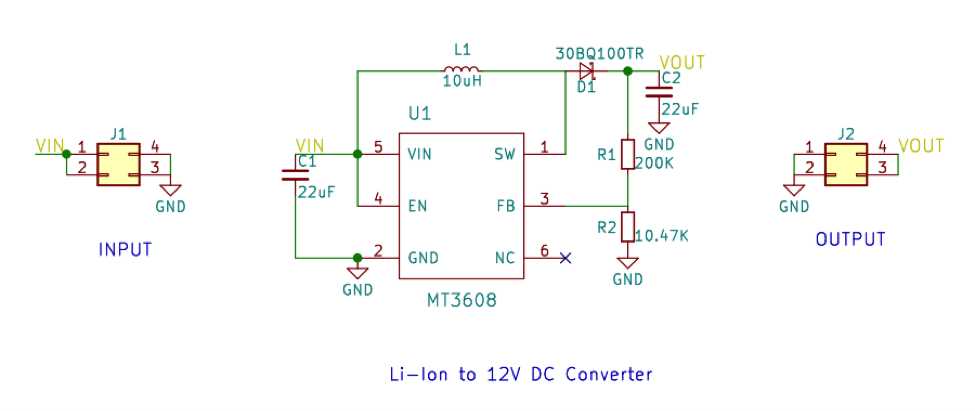
Use a 4.7–22 µH inductor rated for at least 3 A and pair it with a fast Schottky rectifier such as SS34; this arrangement supports stable voltage boosting from 2 V–24 V input to outputs reaching roughly 28 V. The switching controller operates near 1.2 MHz, which allows compact magnetic components and small ceramic capacitors. Place a 10–22 µF low-ESR capacitor directly across the supply pins to suppress ripple generated by the internal MOSFET switching stage.
The connection layout relies on a feedback divider connected to the FB pin. A common pair is 100 kΩ (upper) and 10 kΩ (lower), producing an output close to 12 V. Adjusting the upper resistor changes the final voltage according to the formula Vout = 0.6 V × (1 + R1/R2). Keeping the feedback trace short reduces noise pickup from the switching node, which oscillates at high frequency and carries sharp voltage transitions.
Place the diode and inductor near the SW pin to shorten the high-current path. Wide copper traces handle peak currents approaching 2 A. Output filtering benefits from a 22–47 µF ceramic or low-ESR electrolytic capacitor, which lowers ripple and stabilizes load response during rapid current changes. Excessive trace length between the switch node, diode, and coil increases electromagnetic interference and reduces conversion stability.
Thermal performance improves when the ground pin connects to a broad copper area acting as a heat spreader. During operation near maximum load, switching losses inside the integrated MOSFET may generate noticeable heat. A compact board layout, short current loops, and properly rated passive components maintain stable voltage amplification across battery-powered devices, portable power banks, and small embedded power supplies.
Practical Guide to Building and Using a Step-Up Converter Based on the MT3608 Controller
Use a 22 µH inductor rated for at least 2–3 A and place it as close as possible to the switching chip pins; long traces increase ripple and reduce output stability. Connect the input capacitor (typically 10–22 µF ceramic, low ESR) directly across the supply terminals, then route the coil to the switching pin and a Schottky diode such as SS14 or SS24 toward the output node. The output capacitor should be 22–47 µF to smooth the pulsed current produced during switching at roughly 1.2 MHz. Feedback resistors define the output voltage: choose R1 between 100 kΩ and 200 kΩ, then calculate R2 using Vout = 0.6 V × (1 + R1/R2). For example, 12 V output from a 5 V source can be set with R1 = 150 kΩ and R2 ≈ 8.2 kΩ. Keep the diode, coil, and switching node loop extremely short to limit EMI and heat buildup.
Assembly Layout Tips
Place the diode and inductor within a few millimeters of the controller, route ground traces wide, and isolate the feedback line from the switching node to prevent voltage drift.
Using the Boost Converter in Real Projects
Applications include powering 12 V LED strips from lithium cells, generating 9 V rails for audio devices, or raising USB power to 15–18 V for small tools. Expect 85–93 % conversion efficiency when the input stays above 3 V and the load remains under about 1.5 A. Thermal behavior improves with thick copper pours under the controller and a coil with low DC resistance (below 100 mΩ). Output ripple can drop below 50 mV if ceramic capacitors are placed directly across the load terminals.
Pin Configuration and Component Connections in the MT3608 Boost Converter Circuit
Connect the input supply to the VIN pin through a low-impedance trace and place a 10–22 µF ceramic capacitor directly between VIN and ground within a few millimeters of the package. This capacitor suppresses input ripple caused by switching pulses that can exceed several hundred milliamps. A supply range of 2 V–24 V is typically supported, but stable operation strongly benefits from keeping wiring short and minimizing parasitic resistance.
The SW pin links the internal switching transistor to the external inductor and Schottky diode. Use an inductor between 4.7 µH and 22 µH with a saturation rating above the peak current of about 4 A to avoid inductance collapse during high load. The diode must have fast recovery and low forward voltage; models such as SS34 or similar rated for at least 3 A reduce power loss and thermal buildup.
The GND pin serves as the reference point for all control and power paths. Route it to a solid ground plane rather than a thin trace. High-current return paths from the diode, input capacitor, and output capacitor should converge near this point to reduce switching noise and prevent voltage spikes that could disturb feedback sensing.
The FB pin controls the output level through a resistive divider connected to the output node. The regulator maintains approximately 0.6 V at this pin. Select resistor values according to the relation Vout = 0.6 × (1 + R1/R2). Typical values range from 10 kΩ to 200 kΩ to balance noise immunity and current consumption. Place the divider close to the controller pins and route the trace away from the switching node.
The EN pin manages power state. Tie it directly to VIN for continuous operation or drive it with a logic signal between 0 V and the input voltage range. A threshold around 1.5 V activates the regulator, while lower levels shut it down and reduce current draw to microamp scale. If unused, a short trace to VIN avoids floating behavior.
- Inductor: 4.7–22 µH, saturation current ≥4 A
- Input capacitor: 10–22 µF ceramic, low ESR
- Output capacitor: 22–47 µF to reduce ripple below 50 mV
- Schottky diode: ≥3 A current rating
- Feedback resistors: typically 10–200 kΩ range
Place the inductor, diode, and switching pin connection in the smallest possible loop area. A compact layout limits electromagnetic emission and reduces ringing at frequencies around the internal switching rate near 1.2 MHz. Keep the feedback path isolated from this high-energy node and route it along a quiet section of the board.