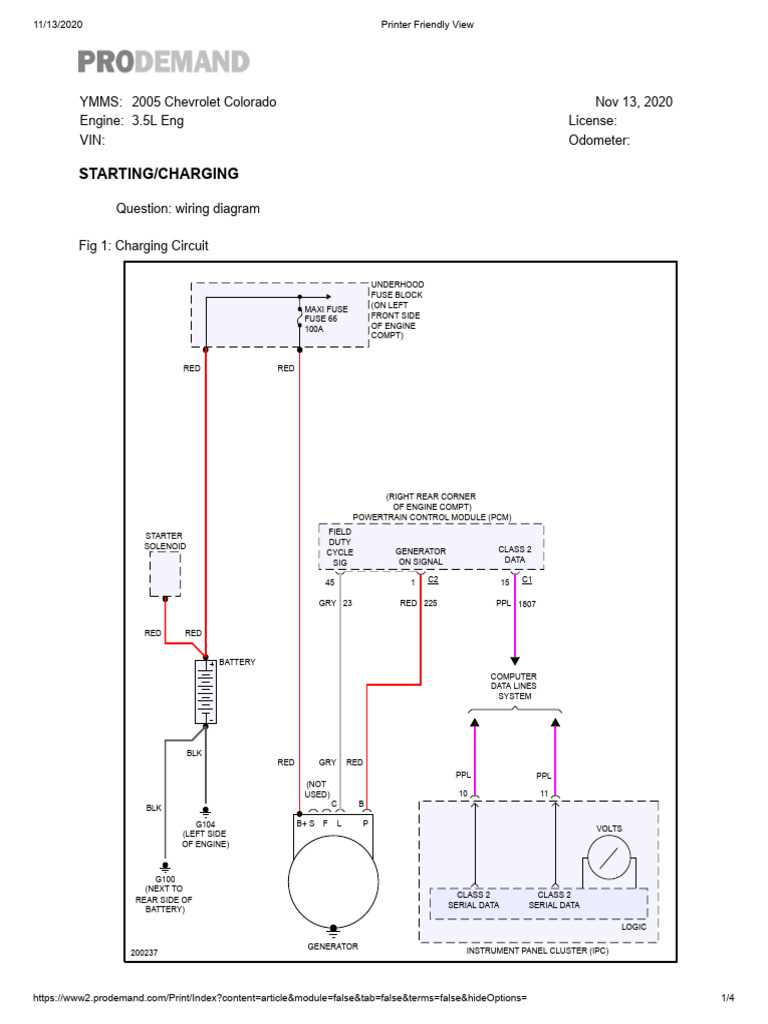
Connect the thick positive battery lead directly to the large solenoid terminal marked “B”. From this point, a second heavy cable routes power toward the vehicle’s main distribution point, while a thinner purple control lead from the ignition switch attaches to the small “S” post. This arrangement appears on many GM bowtie models such as Silverado, Impala, and Malibu, where the ignition key sends a short 12-volt signal through the control lead to activate the solenoid and spin the crank motor.
Use 4–6 AWG copper cable for the primary battery feed. Thinner conductors overheat during cold starts, especially on V6 and V8 engines that draw 150–220 amps while cranking. The control lead normally uses 12–14 AWG. Many factory harnesses also include a fusible link near the battery junction; this short protective segment prevents harness damage if a short circuit appears near the solenoid.
The ground path receives less attention yet causes many no-crank complaints. The motor housing grounds through the engine block, so a clean metal-to-metal contact between engine, chassis, and battery negative terminal must exist. Install a braided ground strap between the block and frame rail, and verify resistance below 0.2 ohms. Higher readings often lead to slow rotation or a clicking solenoid.
When tracing the circuit layout, check the ignition switch output first, then the neutral-safety or clutch switch, and only afterward the solenoid post. A multimeter should show 11.5–12.6 volts on the control terminal during key activation. If voltage appears yet the motor does not rotate, inspect the solenoid contacts or internal brushes inside the crank unit.
GM Ignition Motor Circuit Layout: Practical Guide for Diagnostics and Installation
Connect the battery’s positive lead directly to the solenoid terminal marked “B” and route the ignition-switch signal line to the small control post labeled “S”; this single check resolves most crank failures in older GM vehicles. Voltage at the control post should read 11.8–12.6 V while the key is turned to the crank position. If the reading drops below 9.5 V, inspect the ignition switch harness, neutral-safety switch, and ground strap between engine block and chassis. A typical configuration used on many GM V8 platforms includes four conductors:
- Thick red cable from battery to main solenoid stud.
- Medium gauge purple lead from ignition switch to control terminal.
- Short metal bridge between solenoid output and motor housing.
- Ground path through engine block connected to chassis strap.
Loose eyelets, oxidation on the battery stud, or a cracked fusible link near the battery junction often interrupt current flow. Clean terminals with a brass brush and tighten to roughly 13–16 Nm to prevent intermittent crank issues.
For installation or fault tracing, follow a structured sequence that isolates each segment of the ignition-motor electrical route:
- Disconnect the battery negative terminal.
- Trace the thick supply cable from battery to solenoid stud; check insulation damage and resistance below 0.2 Ω.
- Inspect the purple control conductor from ignition switch; continuity should remain stable while moving the harness.
- Verify the neutral-safety or clutch switch: closed circuit only in Park/Neutral or with pedal depressed.
- Measure voltage at the solenoid control post while the key is held in crank position.
- If voltage exists yet the motor remains silent, bench-test the solenoid plunger and internal contacts.
- Reassemble using ring terminals with heat-shrink sleeves to prevent corrosion near the engine block.
This arrangement appears across many GM sedans and pickups from the late 1980s through early 2000s; conductor colors may shift, though terminal positions remain consistent.
How to Identify Each Terminal in a Chevrolet Starter Wiring Diagram (Battery, Solenoid, Ignition Switch, Ground)
Locate the battery terminal first: it is the thickest cable connection on the motor-mounted magnetic relay and usually uses a heavy red lead coming directly from the positive battery post. The stud is larger than control terminals and often secured with a 10–13 mm nut. Any branch wires feeding the vehicle’s main power distribution may share this same post, which makes it the busiest electrical junction in the engine bay.
The relay control terminal (often marked S) accepts a thinner wire arriving from the ignition key circuit. Turning the key to the crank position sends about 12 V through this lead, energizing the relay coil and pushing the internal plunger that bridges the high-current contacts. Trace this conductor back toward the steering column harness; it normally measures near battery voltage only during the crank position and drops to 0 V in accessory or run positions. Adjacent to it may appear another small post labeled R on older systems, which routes temporary voltage to the ignition coil during engine cranking. The difference in conductor thickness is a reliable visual cue: control leads remain narrow while the power feed cable is thick and heavily insulated.
The ground point is not a separate stud on many units; the return path travels through the motor housing into the engine block. Confirm it by locating the braided or black cable connecting engine metal to the chassis or battery negative. A resistance test between the casing and the battery negative terminal should read close to 0 Ω; higher values indicate corrosion or a loose engine ground strap.