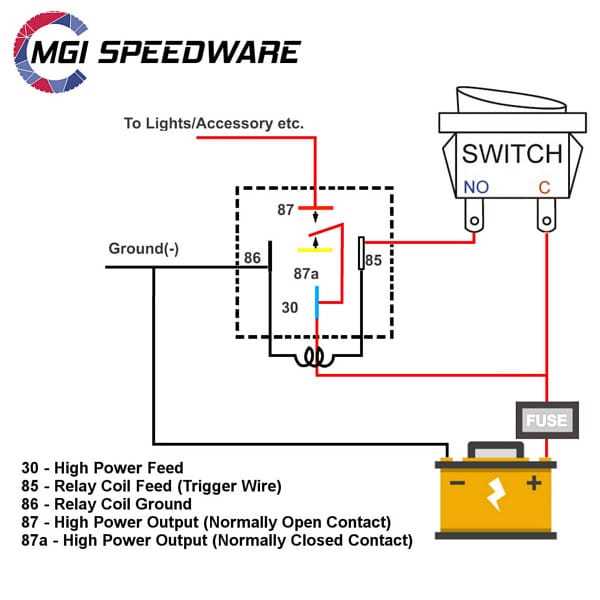
Use a five-terminal electromagnetic switch with terminals 30, 85, 86, 87, and 87a by linking the power feed to 30, the control coil to 85 and 86, the normally open output to 87, and the normally closed path to 87a. This arrangement allows a low-current trigger to control a higher load such as auxiliary lights, fuel pumps, cooling fans, or horn circuits without routing heavy current through a dashboard button.
Terminal 30 acts as the main supply point. Connect it directly to the battery through a fuse sized slightly above the expected load. Terminal 87 becomes active once the internal contact closes; connect the device being powered to this point. Terminal 87a carries current only while the coil remains inactive, which is useful for circuits that must remain powered until the control signal appears.
The control side uses 85 and 86. One side attaches to chassis ground while the other receives a trigger signal from a switch, ECU output, or ignition line. When voltage reaches the coil, a magnetic field moves the internal armature, shifting the contact from 87a to 87. Typical automotive units tolerate 12–14.4 V and switching loads between 20 A and 40 A, though verifying the printed rating on the housing prevents overheating.
For stable operation, keep the high-current path between the battery, terminal 30, and the load short and use copper conductors sized 2.5–4 mm² (14–12 AWG) for devices drawing above 15 A. The control circuit may use thinner conductors such as 0.75–1 mm² (18–20 AWG). Mount the component with the terminals facing downward where possible; this limits moisture entry and prolongs contact life.
5-Terminal Automotive Switch Connection Layout
Use terminal 30 as the main power entry from the battery through a fuse rated slightly above the expected load (for example 15–30 A for auxiliary lamps). Terminal 87 delivers power to the device once the internal contact closes. Terminal 87a provides a normally-closed path that carries current only while the control coil is inactive, useful for circuits that must stay powered until the switch activates.
Connect terminals 85 and 86 to the control circuit that energizes the electromagnetic coil. One side typically goes to chassis ground, while the second side receives a low-current trigger signal from a dashboard switch, ignition feed, or control module. Current through this coil usually ranges from 120 mA to 200 mA at 12 V in most automotive units.
Terminal Roles
Terminal numbering follows a standardized automotive convention. Terminal 30 acts as the common contact. Terminal 87 becomes the output once the internal armature closes. Terminal 87a remains linked to 30 while the coil has no power. Terminals 85 and 86 belong to the coil itself; polarity generally does not matter unless the unit includes an internal suppression diode.
For high-load accessories such as radiator fans or auxiliary lighting, route a thick conductor (2.5–4 mm² cross-section) from the battery to terminal 30 through a fuse placed within 20–30 cm of the battery. The load connects to terminal 87 with the same gauge conductor. Ground returns for the load should attach directly to the chassis using a clean metal contact point.
Practical Layout Example
A typical auxiliary light circuit works like this: battery positive feeds terminal 30 through a 20 A fuse; terminal 87 goes to the lamp’s positive lead; the lamp’s negative lead attaches to chassis ground. Terminal 85 connects to ground, while terminal 86 receives 12 V from a dashboard toggle switch. Flipping the switch energizes the coil, pulling the internal contact and sending battery power to the lights.
If the device includes terminal 87a but the project does not require a normally-closed path, leave that contact unused and insulated. This prevents unintended current flow when the coil is inactive.
Mount the component close to the load to shorten the high-current path and reduce voltage drop. Keep the control circuit separate from heavy current conductors, secure all crimp connectors firmly, and protect exposed metal with heat-shrink tubing.
Understanding the Function of Each Terminal in a Standard 5-Terminal Automotive Switching Module (85, 86, 30, 87, 87a)
Connect the control coil correctly: terminal 85 normally goes to ground, while 86 receives the trigger voltage from a switch, ECU output, or ignition source. These two numbered posts energize the internal electromagnet that moves the contact arm. Polarity usually does not matter in basic units, yet models containing suppression diodes require strict orientation–85 must be negative and 86 positive. Measure resistance across 85–86 with a multimeter; values between 60 and 120 ohms indicate a typical 12-volt coil.
Terminal 30 acts as the common power feed entering the switching block. Route the main supply through this point from a fused battery line or distribution bus. Current flowing through 30 is redirected internally depending on whether the coil is energized. Use adequately sized conductors because this contact often carries the full load of devices such as cooling fans, pumps, lighting arrays, or compressors.
Terminal 87 functions as the normally-open output. When voltage is applied across 85 and 86, the internal armature moves and connects 30 directly to 87, sending power to the load. Without coil activation, 30 and 87 remain separated.
- Typical use: auxiliary lamps, horns, fuel pumps
- Current rating in many automotive units: 30–40 A
- Contact material: silver alloy to reduce arcing
Terminal 87a serves as the normally-closed path. In the resting state, 30 and 87a remain connected, allowing current to pass until the coil energizes. Once the magnetic field pulls the contact arm, this path opens and power transfers from 87a to 87. Such behavior allows automatic switching between two circuits without additional control electronics.
Interpret the five numbered posts as a simple switching logic structure:
- 85 – coil negative or chassis ground
- 86 – coil positive trigger
- 30 – common supply input
- 87 – output activated only after coil energization
- 87a – output active while coil remains idle
Using these roles correctly prevents overheated contacts, unstable switching, and unexpected device activation in automotive electrical systems.