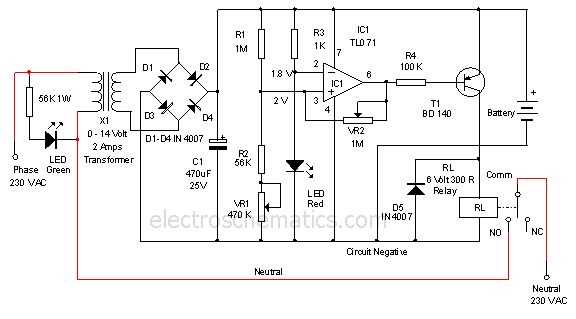
Use a regulated step-down transformer with a precision rectifier to maintain stable voltage output for handheld tool energy units. A well-matched diode bridge with low forward voltage drop ensures minimal heat generation during the replenishing process.
Integrate a current-limiting resistor in series with the energy storage cells to prevent overcurrent conditions. Monitoring voltage rise across the storage modules with a microcontroller or analog comparator allows for automatic cut-off at full capacity.
Include thermal protection elements such as thermistors or thermal fuses to safeguard against overheating during prolonged recharging. Proper layout of conductive tracks and separation of high-current paths reduces electromagnetic interference and improves longevity of the electronic assembly.
Consider LED indicators connected through voltage dividers to provide clear visual feedback of charging stages. Matching the LED current to the output voltage prevents premature burnout while signaling charge progression effectively.
Recharge Unit Wiring Layout for Portable Power Tools
Use a regulated DC source with overcurrent protection to feed the pack of cells safely. A linear voltage regulator rated for at least 2 A per cell string ensures stable charging without overheating the power stage.
Include a thermistor in series with the load terminals to monitor temperature fluctuations. A typical 10 kΩ NTC component can trigger cutoff circuits if the cells exceed 45 °C.
Voltage and Current Control
Configure a resistor-divider network to feed a comparator for end-of-charge detection. Adjust R1 and R2 so the threshold matches 4.2 V per lithium unit or 1.5 V per NiMH unit, depending on the pack type.
- Use a MOSFET switch with logic-level gate drive to control the current flow dynamically.
- Include a small capacitor (0.1 µF) across the sense resistor to filter spikes and prevent false shutoffs.
- LED indicators wired through a 470 Ω resistor can show charging status clearly.
Protection and Monitoring
- Add a reverse-polarity diode at the input to prevent damage if the adapter is connected backward.
- Use a PTC fuse inline with the positive lead to block overcurrent conditions instantly.
- For multi-cell packs, a balancing network with resistive bleed paths keeps each unit at the same potential.
Position the components on a compact PCB with short traces for high-current paths. Avoid crossing high-voltage lines over sensitive analog nodes to minimize noise and ensure accurate voltage detection.
Test the assembled layout first with a lower voltage supply and no load to verify regulator operation, thermal sensor response, and LED signaling before connecting a full cell pack.
Identifying Key Components in a Portable Power Tool Recharging Unit
Focus first on the transformer: it regulates incoming mains voltage to a lower, safe level suitable for the recharging cells. Look for models with clear voltage ratings printed on the casing, often between 12V and 24V, and note whether they include thermal protection to prevent overheating during extended use.
Next, examine the rectifier assembly. These are usually diodes arranged in a bridge configuration to convert alternating current into direct current. High-current diodes rated for at least 5A are typical for modern hand-held equipment recharging systems. Check for heat sinks attached to prevent junction overheating, as excessive heat can reduce lifespan.
Voltage Regulation and Safety Modules
Observe the voltage regulator ICs or shunt circuits, which maintain a consistent output despite fluctuations in supply. Many units incorporate LEDs or indicator resistors for charge status monitoring. Fuses or PTC thermistors are commonly integrated to cut off excess current automatically, protecting both the internal cells and the electronics. Identifying these elements ensures safer operation and easier troubleshooting.