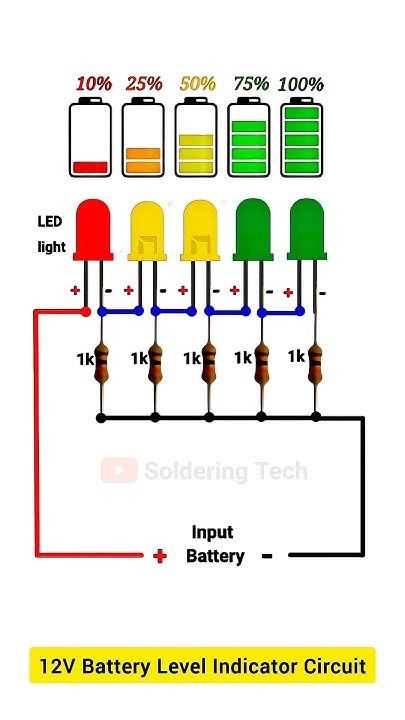
Connect a voltage monitoring module that translates terminal potential into a row of LEDs showing stored energy inside a lead-acid accumulator used in vehicles or backup systems. A practical design divides the working span between 10.5 and 13.8 volts into several visual steps. Three-color LED groups provide quick interpretation: red close to 10.6–10.9 V for deep discharge, amber near 11.7–12.1 V for partial charge, and green above 12.6 V when the accumulator remains ready for normal loads.
The electronic layout typically relies on comparators such as LM339 or an LED bar-driver like LM3914. A resistor divider reduces terminal potential before it reaches the sensing input. Example values: 15 kΩ paired with 3.3 kΩ lowers the measured voltage to roughly one quarter of the original value. Each comparator output drives an LED through a 330 Ω resistor, keeping diode current near 10 mA while maintaining clear brightness.
Stable reference thresholds determine switching points. A 2.5 V precision reference diode or a TL431 shunt reference produces consistent comparator limits. Capacitors improve stability: place 0.1 µF ceramic across the supply pins of the comparator chip and 10 µF electrolytic across the divider output to suppress fluctuations caused by motors, relays, or switching converters connected to the same power source.
Adjustment involves matching LED activation points with measured voltages using a calibrated multimeter. Typical checkpoints include 10.5 V for discharge warning, 12.0 V for medium charge, and 12.7 V representing a nearly full lead-acid accumulator at rest. Correct resistor ratios and accurate references allow the LED array to present a reliable visual report of stored electrical energy without complex instrumentation.
12V Battery Level Indicator Circuit Diagram
Use a three-stage LED charge monitor built around an LM3914 driver to visualize the condition of a twelve-volt DC accumulator pack. Connect the sensing input through a 10 kΩ resistor divider so the chip receives about 1.2–1.4 V at full charge (≈12.6 V at the source). Calibrate the reference pin with a 2 kΩ trimmer so the first LED activates near 11.4 V, the middle segment near 12.0 V, and the final segment above 12.5 V. A small NPN transistor such as BC547 can switch the LED chain if the pack must power heavier diodes without stressing the driver IC. Place a 100 nF ceramic capacitor across the supply pins to suppress voltage ripple produced by motors or switching loads.
Component Arrangement
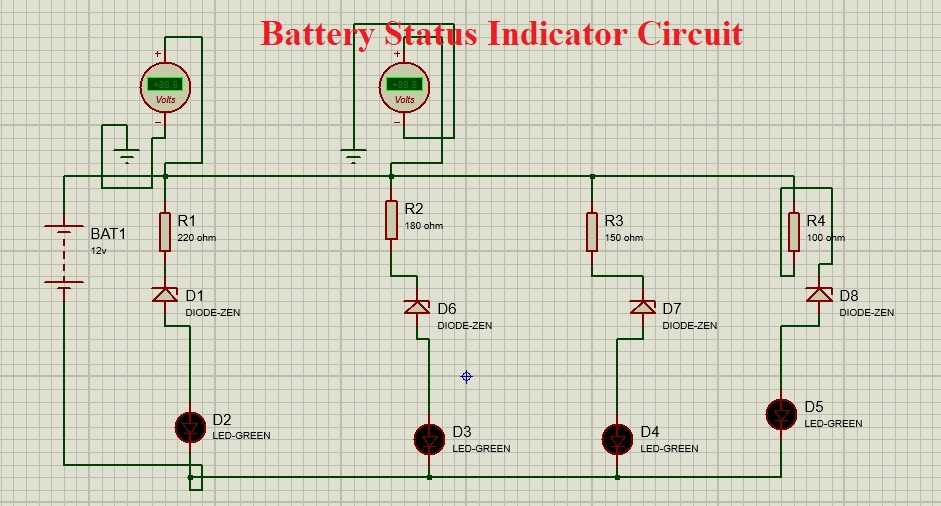
The wiring scheme contains four main parts: the LM3914 scale driver, a resistor ladder that defines voltage thresholds, a row of light diodes for visual status, and a protection stage connected to the positive terminal of the energy pack. The sensing divider often uses 10 kΩ and 3.3 kΩ resistors, producing a measurement span that maps roughly 10.5–12.6 V to the internal comparator chain. Each diode connects to one output pin of the driver through a 330 Ω current limiter. If only three lights are desired, link unused outputs to ground. For improved stability in vehicles or solar storage systems, add a 1N5819 Schottky element in series with the supply input to block reverse polarity and reduce voltage drop compared with a silicon rectifier. Mount all components on a compact prototyping board and route the sensing trace separately from high-current paths to avoid measurement drift.
Components and Wiring Required to Build a 12V Battery Level Indicator Circuit
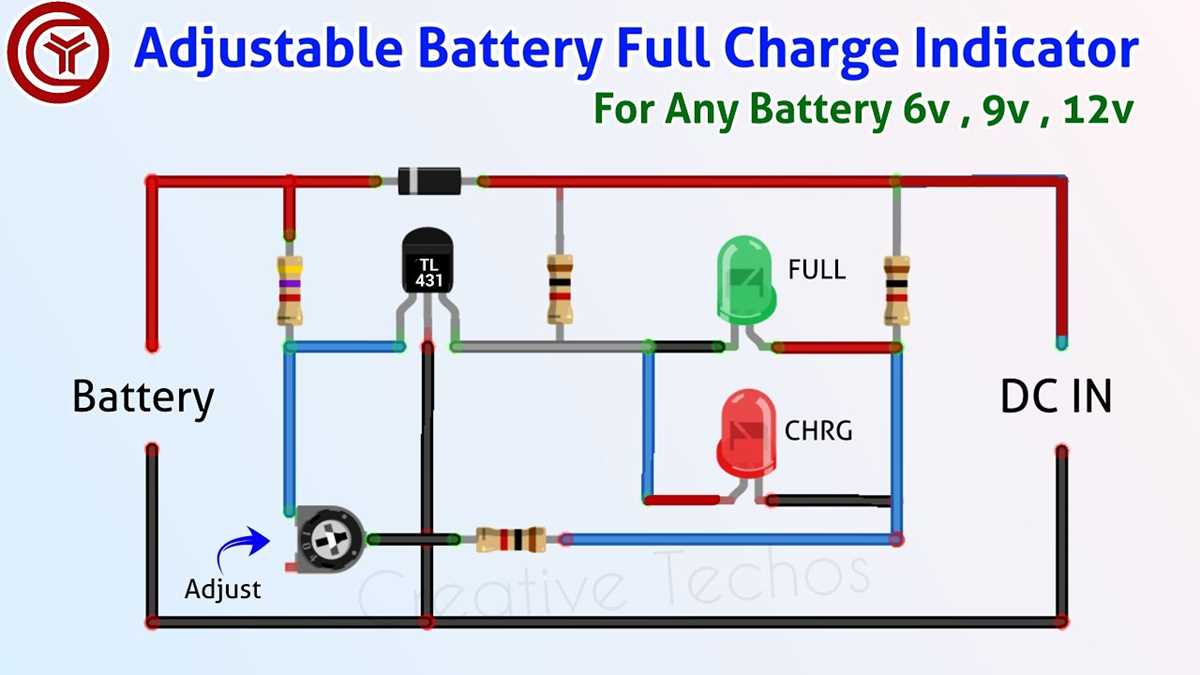
Use a quad comparator such as LM339 or LM324 together with several reference resistors and light-emitting diodes to monitor the charge state of a 12-volt power source. A small voltage divider samples the supply and feeds scaled voltage to comparator inputs. Each comparator compares the measured value with a fixed reference generated by resistor networks. When the measured voltage crosses a threshold, the corresponding LED turns on. Choose resistors between 4.7 kΩ and 47 kΩ to keep current consumption low while maintaining stable reference values.
Main Electronic Parts
- LM339 or LM324 comparator IC
- 4 LEDs (green, yellow, orange, red for visual charge stages)
- 4–6 resistors for reference thresholds (typically 10 kΩ)
- 1 voltage divider pair (e.g., 33 kΩ and 10 kΩ)
- Current-limiting resistors for LEDs (330 Ω–1 kΩ)
- Small prototype board or stripboard
- Power connector and hookup wires
Connect the positive terminal of the power source to the divider input and comparator supply pin, while the negative terminal goes to common ground across the board. The divider output feeds the non-inverting inputs of several comparators. Reference voltages produced by resistor chains connect to the inverting inputs. Each comparator output drives an LED through a current-limiting resistor. Example trigger points often used for a lead-acid accumulator include roughly 11.7 V, 12.0 V, 12.4 V, and 12.7 V. Arrange traces so that ground paths remain short and shared references stay stable.
Basic Wiring Sequence
- Route ground rail across the prototype board.
- Install the comparator IC and connect its supply pins.
- Build the sampling divider from the positive terminal to ground.
- Create several reference points with resistor chains.
- Wire comparator outputs to LEDs through 330 Ω–1 kΩ resistors.
- Connect the monitored power source and verify LED thresholds with a multimeter.
Use solid copper traces or short jumper wires to prevent measurement drift. Place reference resistors close to the comparator pins to reduce noise pickup. For field use in vehicles or solar storage systems, add a small capacitor (around 100 nF) across supply pins to suppress voltage spikes.