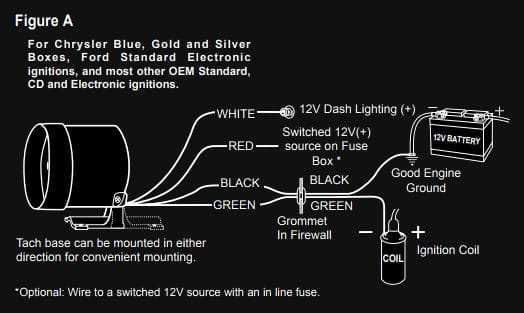
Connect the signal lead directly to the ignition coil negative terminal on gasoline engines with a single coil; this point carries the pulse sequence that the engine speed indicator reads. Use a shielded conductor if the cable run exceeds 1.5–2 meters to reduce interference from the ignition system. The power lead should attach to a switched 12-volt source that activates with the ignition key, while the ground line must be fixed to bare chassis metal to avoid unstable readings.
For vehicles equipped with distributorless ignition or coil-on-plug systems, the pulse source usually comes from the engine control unit output pin marked for speed signal. Many control modules deliver a square-wave signal ranging between 0–5 V or 0–12 V. Check the instrument specification before connection; some gauges require an adapter module when the signal amplitude is low.
Routing of conductors affects measurement stability. Keep the signal lead separated from alternator output cables and high-current starter lines by at least 10–15 cm. If the indicator needle jumps or digital values fluctuate, install a small inline resistor (typically 10 kΩ) or a noise filter capacitor between the signal and ground near the instrument housing.
Diesel engines often lack an ignition pulse source, so the speed display must receive impulses from the alternator “W” terminal or a crankshaft sensor output. In such setups, calibration becomes necessary: adjust the internal selector or dip switches to match the cylinder count or pulse ratio so that the displayed rotational speed corresponds to the crankshaft frequency.
Engine Speed Gauge Connection Guide: Step-by-Step Procedure
Connect the signal lead from the engine speed gauge directly to the ignition coil negative terminal on gasoline engines with a distributor. Use a 16–18 AWG insulated conductor and keep the run shorter than 1.5 m to reduce electrical noise. Attach the red supply lead to a switched 12-volt source that becomes live only after the ignition key is turned. Ground the black lead to a clean chassis point with bare metal contact; resistance between this point and the battery negative post should remain under 0.2 ohm.
Mount the instrument in a position with clear visibility and minimal vibration. Secure the bracket with M4 or #8 screws and add rubber washers if the dashboard panel is thin metal. Route the signal conductor separately from high-current cables such as alternator output or starter supply lines; keep at least 10 cm spacing to limit interference that may cause erratic needle movement.
For engines with coil-on-plug ignition modules, connect the signal lead to the ECU pulse output or a dedicated engine speed terminal marked “TACH OUT,” “ENG SPD,” or similar on the control unit. If the vehicle uses a four-cylinder configuration, confirm the gauge switch or selector is set to “4 CYL.” Six- and eight-cylinder engines require different pulse scaling, so adjust the selector before powering the unit; wrong selection produces readings double or half of the actual crankshaft rotation rate.
Install an inline fuse rated 1–3 A on the 12-volt supply lead no farther than 20 cm from the source. This prevents internal damage during short circuits or reversed polarity. If the gauge lighting uses a separate illumination lead, attach it to the dashboard light circuit so brightness changes with the vehicle dimmer control. Use crimp terminals with heat-shrink insulation instead of twisted joints; loose connections cause unstable readings at high engine speed.
After completing all connections, turn the ignition key to the accessory position and confirm the pointer moves from zero during engine start. At idle most gasoline engines show roughly 650–900 rotations per minute depending on model. Gradually raise throttle and check for smooth needle movement without sudden jumps. If oscillation appears, add a 10 kΩ resistor in series with the signal lead or install a noise suppression filter between the coil terminal and the gauge input.
Identifying Gauge Terminals and Matching Them With Ignition Coil, Power, and Ground Wires
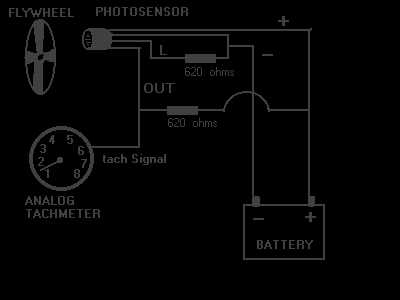
Locate the labeled posts on the instrument body and match them with the vehicle conductors before any connection is made. Most engine speed gauges use three or four terminals stamped as “IGN”, “SIG”, “GND”, and sometimes “LAMP”. The “SIG” post receives the pulse from the ignition coil negative side, “IGN” connects to switched 12-volt supply from the ignition switch, and “GND” attaches to a solid chassis ground point. If the casing lacks clear markings, inspect the rear circuit board traces: the signal terminal usually routes through a small resistor network toward the input transistor.
Verify the ignition coil lead before attaching the signal conductor. On classic distributor systems, the pulse source is the negative coil terminal marked “–” or “1”. This terminal produces rapid voltage transitions between roughly 0 V and 12 V every time the coil collapses. Use a multimeter in frequency mode or a test light while the engine cranks; the correct terminal will flash quickly. Avoid the positive coil side, which carries steady ignition voltage and will produce incorrect gauge readings.
Typical Terminal Identification
- SIG – impulse input from ignition coil negative terminal.
- IGN – switched 12 V from ignition key circuit (live only with key in ON).
- GND – direct chassis ground; resistance to battery negative should stay under 0.3 Ω.
- LAMP – optional lighting feed tied to dashboard illumination circuit.
Confirm the switched power line with a voltmeter before attaching it to the “IGN” terminal. With the key in OFF position, voltage must read 0 V; with the key turned to ON, the line should supply approximately 12–14 V depending on battery charge. Avoid constant battery feeds because the gauge electronics remain energized and can slowly drain the battery during long parking periods.
Ground Connection Checks
- Select a bare metal point on the firewall or instrument support bracket.
- Scrape away paint or coating to expose clean steel.
- Attach a ring terminal and secure it with a star washer and bolt.
- Measure resistance between that point and battery negative; values above 0.5 Ω indicate poor grounding.
After matching each terminal with its conductor, perform a quick functional check: switch the ignition on and crank the engine while observing the needle. A brief jump during cranking confirms the signal path from coil negative to the gauge input. If the pointer stays at zero, inspect the impulse lead continuity and verify that the coil actually produces pulses.