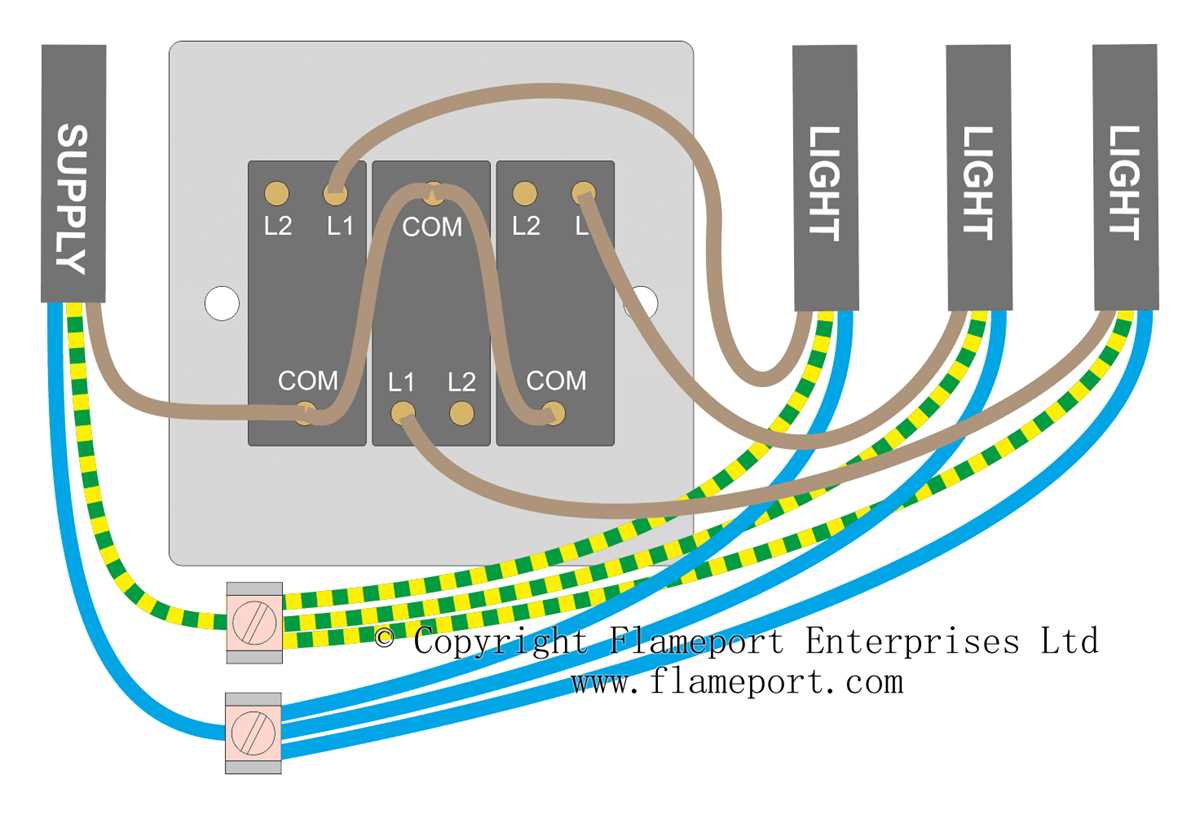
Use a clear power distribution sketch that shows the source, control switch, protective device, and lamp points on one page. Place the supply line at the left side of the drawing and route conductors horizontally before branching downward to fixtures. This arrangement reduces confusion during installation and allows quick tracing of faults. Mark the supply voltage (commonly 120 V or 230 V) directly near the source symbol.
Include a protective breaker or fuse between the supply and the control switch. For a typical residential branch, specify a rating of 10–16 A for LED lamp groups. Draw the switch in series with the phase conductor while the neutral conductor runs directly to the lamp holder. This approach ensures that the lamp is isolated from live voltage when the switch is off.
Use standardized symbols so technicians recognize components without text labels. A circle with a cross usually represents a lamp point, while a break in the line indicates a manual switch. Label conductor colors directly along the lines: brown or black for phase, blue for neutral, and green-yellow for grounding. These markings reduce wiring mistakes during panel connection.
For rooms with multiple fixtures, draw parallel branches from a junction box instead of linking lamps in sequence. Each branch should return to the same neutral path. This arrangement keeps voltage stable and prevents one failed lamp from affecting the rest of the group. Indicate cable type such as NYM 3×1.5 mm² or 14/2 NM near the conductor path so installers know the required wire size.
Add short notes beside key elements: switch location height (often 90–110 cm from floor level), junction box access point, and maximum load for the branch. Clear spacing between symbols and straight conductor lines make the plan readable even when printed in black and white.
Power Line Layout for Lamp Systems
Use a clear connection plan where the supply phase, neutral path, and protective ground are marked with distinct symbols and line styles; this prevents installation mistakes and speeds fault tracing. Phase conductors should be shown with solid lines, neutral with dashed lines, and ground with a triple-line mark. Place switches directly on the phase path rather than on the neutral line, because disconnecting the phase removes voltage from the lamp holder and reduces shock risk during maintenance.
Group luminaires logically and assign each group its own protective breaker rating. A typical residential branch serving ceiling fixtures often uses a 10 A or 16 A protection device with copper conductors of 1.5 mm² cross-section. Indicate the protection device at the beginning of the layout so installers can trace load distribution quickly. Each luminaire symbol should include a label such as L1, L2, or L3, allowing cross-reference with the panel schedule.
Switch representation must reflect the real control method. A single-pole wall control is drawn as a break in the phase conductor with a pivot symbol. For two-location control, add paired changeover switches connected by two traveler wires. This arrangement allows a corridor lamp to be controlled from both ends. Label travelers T1 and T2 so the wiring path remains clear during installation.
Distance and cable routing also belong in the scheme. For example, if a hallway fixture lies 8 m from the distribution board, mark the length beside the conductor path. Installers then estimate voltage drop and cable quantity without recalculation. Copper conductors supplying several LED luminaires usually show negligible drop under 15 m with 1.5 mm² wire, yet documentation still prevents guesswork.
Include junction boxes explicitly. Each box symbol should show incoming and outgoing conductors along with splice points. A common approach is a circular symbol labeled JB-01, JB-02, and so forth. Inside the box notation, show connections such as “Phase → switch → luminaire” and “Neutral → luminaire”. Such detail avoids unnecessary dismantling of ceilings during troubleshooting.
Mark load values beside each lamp symbol. For instance, LED fixtures may show 12 W, 18 W, or 24 W. Summing these numbers provides the total branch load. A line feeding five 12 W lamps carries 60 W; at 230 V this equals roughly 0.26 A, leaving wide margin under a 10 A breaker. This numeric annotation assists planning when additional fixtures might be added later.
Orientation improves readability. Arrange the supply panel on the left side and place loads toward the right. Conductors should run mostly horizontally or vertically, avoiding angled paths. Intersections require a dot when wires connect; lines that merely cross must remain without dots. This small visual rule eliminates misinterpretation during installation.
Add revision notes and date stamps beneath the layout. If a new luminaire or control point appears later, record the change with a revision code such as R1 or R2 along with the modification description. Technicians reviewing the plan months later can see exactly which conductor routes or switch connections were altered.