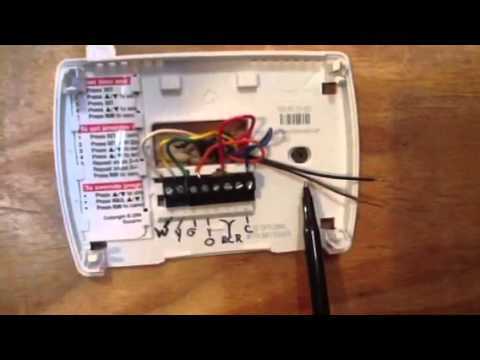
Connect the power supply to the correct input terminals before attaching control lines; most household climate regulators operate with 230 V AC on terminals marked L and N, while low-voltage units accept 24 V supplied by a heating controller. Verify voltage with a multimeter prior to attaching conductors. A mismatch between supply level and device rating often destroys internal switching components within seconds.
Typical wall-mounted climate regulators include three primary contacts: live input (L), neutral (N), and a switched output leading toward the heating unit or circulation pump. Mechanical models often contain a relay rated between 5 A and 16 A. Electronic versions sometimes provide a dry contact pair labeled COM and NO. In that case, the heating appliance receives a signal only after temperature drops below the configured threshold.
Cable selection matters. Copper conductors with a cross-section between 0.75 mm² and 1.5 mm² handle most residential control circuits. Longer cable runs increase resistance and may cause inaccurate switching behavior when low-voltage sensors connect through the same regulator housing. Shielded cable reduces electrical noise near pumps or compressors.
Pay attention to sensor placement and terminal assignment. Floor heating controllers often include two dedicated sensor contacts separated from mains terminals. The sensor itself usually carries resistance around 10 kΩ at 25 °C. Mixing these wires with mains supply lines causes measurement errors and unstable heating cycles.
Before energizing the system, tighten terminal screws and confirm conductor insulation remains intact near clamps. A short functional test helps confirm correct switching: lower the temperature setpoint, observe relay click, then raise it again until the heating device activates through the control contact.
Identifying Terminals R, W, Y, G, C and Matching Them to HVAC Connections
Check the letter marks on the control base and connect each conductor to the same letter on the HVAC control board. Terminal R carries 24-volt power from the transformer, W triggers heat relay activation, Y sends a cooling request to the compressor contactor, G controls the air handler fan relay, and C provides the common return path needed by many modern control units with displays or Wi-Fi modules.
Terminal Functions and System Roles
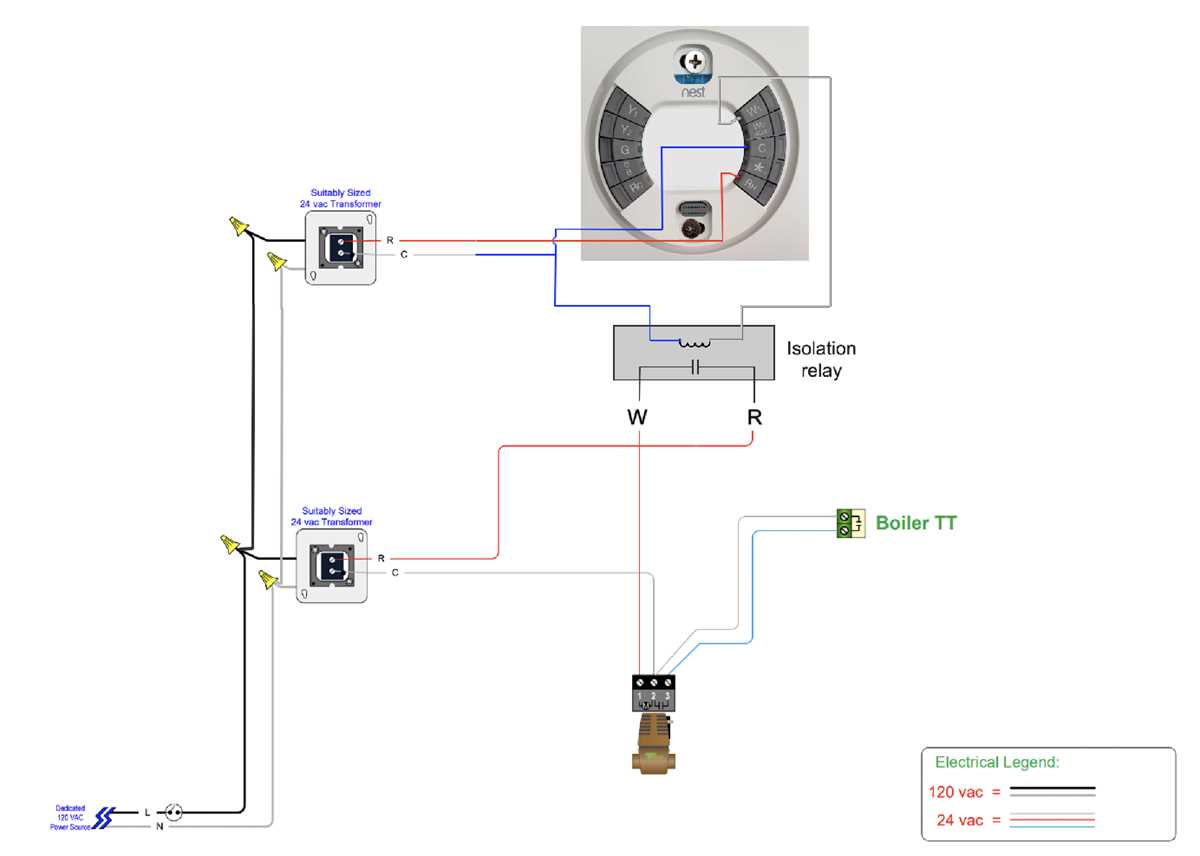
R usually appears as Rc, Rh, or a single R screw. Rc links to cooling power circuits, Rh feeds heating circuits; many systems bridge them with a factory jumper. W connects to the furnace control board heat input; once energized, the furnace ignition or heat pump auxiliary stage activates. Y routes through the air handler to the outdoor condenser contactor, closing the circuit that starts the compressor and condenser fan. G links directly to the blower relay coil, allowing manual fan operation independent of heating or cooling cycles.
C serves as the 24-volt common side of the transformer secondary winding. Smart climate controllers draw continuous current between R and C, typically 20–200 mA during idle operation. Without this return conductor, devices attempt “power stealing” through relay coils, which may cause chatter or intermittent compressor activation. A spare blue or brown conductor inside the cable often becomes the C lead when unused wires exist in the wall bundle.
Matching Conductors to HVAC Board Terminals
Open the furnace or air handler service panel and locate the low-voltage terminal strip on the control board. The letters on that strip must match the control base letters exactly: R to R, W to W, Y to Y, G to G, C to C. If cable colors differ from standard conventions (red-R, white-W, yellow-Y, green-G, blue-C), rely on letter labels rather than insulation color. A multimeter set to AC volts should show about 24 V between R and C, confirming transformer output before reconnecting conductors.
Step-by-step process connecting a wall temperature controller to furnace and air conditioner using a standard 24V control circuit
Disconnect power at the furnace service switch and verify zero voltage with a multimeter before touching any conductor. A typical low-voltage control circuit uses a 24-volt transformer located inside the furnace cabinet. Locate the control board and identify screw terminals marked with single letters such as R, C, W, Y, and G. Run a multi-conductor low-voltage cable from the wall climate controller location toward the furnace control board, leaving at least 15–20 cm slack inside the cabinet so conductors can be secured without tension.
Strip about 6–7 mm insulation from each conductor. Attach the red conductor to terminal R on the furnace board; this point supplies 24 V from the transformer. Attach the white conductor to terminal W which signals heat demand. Connect the yellow conductor to terminal Y; that line carries a cooling request toward the outdoor condenser contactor through the furnace control board. Attach the green conductor to terminal G which activates the blower relay.
Attach the common return conductor if the climate controller model requires continuous power. Many modern programmable units need a blue or black conductor connected to terminal C. Without this connection the display may remain blank or operate only with batteries. Route the same conductor color from terminal C on the furnace board toward the wall unit terminal labeled C.
| Terminal Mark | Function in 24V Circuit | Typical Conductor Color |
|---|---|---|
| R | 24 V supply from transformer | Red |
| C | Common return path | Blue or Black |
| W | Heat call signal toward furnace control | White |
| Y | Cooling call leading toward outdoor condenser | Yellow |
| G | Indoor blower relay activation | Green |
At the wall controller base plate, match conductor letters exactly with the furnace board markings. Insert each stripped conductor into the corresponding clamp terminal and tighten the screw until copper cannot move. Excess exposed copper should remain below 2 mm to prevent contact between adjacent terminals.
Trace the yellow Y conductor inside the furnace cabinet. It usually splits: one branch continues toward the outdoor condenser contactor while another lands on the furnace control board Y terminal. Ensure both connections remain tight because compressor activation depends on this path.
Restore electrical power and test operation using manual temperature adjustment. Increase setpoint above room temperature to confirm heat relay activation, then reduce setpoint below ambient level to trigger cooling. During cooling mode verify indoor blower operation and listen near the outdoor condenser contactor click which confirms a complete 24-volt control circuit.